Ratio Calculator: Simplify, Scale and Divide Ratios
A ratio compares two or more quantities — 12:18 says how much of one thing there is for each unit of another. Choose a mode above: simplify any ratio to lowest terms, scale it up or down by a factor, or split an amount fairly by ratio.
The ratio formulas
All three modes come from one idea: the two sides of a ratio stay in the same relationship when you multiply or divide both by the same number.
- Simplify: find the greatest common divisor (GCD) of the parts, then divide every part by it. The result has no common factor left.
- Scale: new ratio = (a × k) : (b × k), where k is your scale factor.
- Divide an amount: share of part i = amount × parti ÷ (sum of all parts).
Worked example
Simplify 12:18. The GCD of 12 and 18 is 6. Divide both sides by 6: 12 ÷ 6 = 2 and 18 ÷ 6 = 3, so 12:18 simplifies to 2:3.
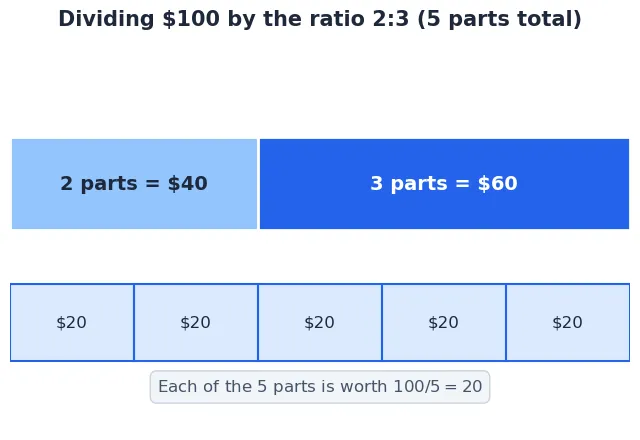
Divide $100 by 2:3. Total parts = 2 + 3 = 5. Each part is worth $100 ÷ 5 = $20. The shares are 2 × $20 = $40 and 3 × $20 = $60, which add back to $100.
How to use the ratio calculator
Pick the mode that matches your task, enter the numbers, and press Calculate. The calculator shows each step so you can check the working, not just the answer.
Step by step
- Choose a mode. Simplify reduces a ratio; Scale grows or shrinks it; Divide splits an amount.
- Enter the ratio parts. Decimals are fine — the calculator clears them before finding the GCD.
- Add the extra input. A scale factor for Scale mode, or the amount (and optional third part) for Divide mode.
- Press Calculate. You get the result plus the GCD or the per-part value used.
Ratios and fractions
A ratio is closely related to a fraction: 2:3 expresses the same relationship as the fraction 2/3, which is why dividing by a ratio uses the same total-parts idea as adding fractions with a common denominator. If you need the fraction arithmetic itself, a fraction calculator handles adding, subtracting and simplifying fractions step by step.
Simplifying ratios with the GCD
The greatest common divisor is the largest whole number that divides every part of the ratio. Dividing by the GCD is the fastest route to simplest form because it removes all common factors in one step.
Common simplifications
| Original ratio | GCD | Simplest form |
|---|---|---|
| 12 : 18 | 6 | 2 : 3 |
| 25 : 100 | 25 | 1 : 4 |
| 9 : 12 : 15 | 3 | 3 : 4 : 5 |
| 14 : 21 | 7 | 2 : 3 |
Finding a missing value
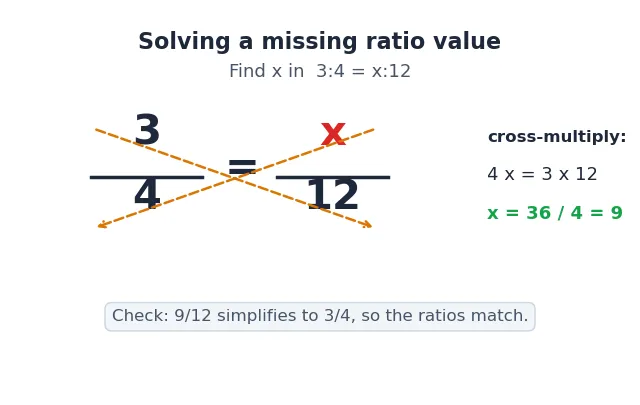
When you know three of the four numbers in a proportion such as 3:4 = x:12, cross-multiply: 4x = 3 × 12 = 36, so x = 9. The diagram above shows the two multiplication paths that make "cross" multiplication visual.
Dividing an amount by ratio
Splitting by ratio keeps every share proportional to its part. A 2:3:5 split of 100 servings gives 20, 30 and 50 — ten servings per part, since there are 10 parts in total.
Where this gets used
| Situation | Ratio | Amount | Shares |
|---|---|---|---|
| Two partners split profit | 2 : 3 | $100 | $40 and $60 |
| Recipe for three pans | 1 : 1 : 2 | 800 g flour | 200 g, 200 g, 400 g |
| Team bonus pool | 3 : 2 : 1 | $6,000 | $3,000, $2,000, $1,000 |
Shares as percentages
Sometimes you want each share as a percentage of the whole instead of a raw amount. A share of $40 from $100 is 40%, which is just the part divided by the total parts times 100. A percentage calculator converts any share to a percentage instantly if you prefer working that way.
Scaling ratios up and down
Scaling multiplies every part by the same factor, so the relationship never changes. Doubling a 2:3 paint mix to 4:6 gives twice as much paint with the same colour.
Scaling reference
| Original | Factor | Scaled | Use case |
|---|---|---|---|
| 2 : 3 | × 2 | 4 : 6 | Doubling a recipe |
| 2 : 3 | × 0.5 | 1 : 1.5 | Halving a batch |
| 5 : 2 | × 10 | 50 : 20 | Scaling a map ratio |
| 3 : 4 | × 1.5 | 4.5 : 6 | Adjusting a mix for a larger container |
Common mistakes
The classic error is scaling only one side — doubling 2:3 to 4:3 changes the mixture entirely. Another is forgetting that scaled ratios can be simplified again: 4:6 is correct but 2:3 is cleaner. Always scale every part, then simplify the result.
Frequently asked questions
What is a ratio in simplest form?
A ratio in simplest form has no common factor shared by all its parts. 12:18 is not in simplest form because both sides share the factor 6; dividing by 6 gives 2:3, which cannot be reduced further. Simplest form makes ratios easier to compare at a glance.
How do I simplify a ratio?
Find the greatest common divisor (GCD) of all the parts, then divide every part by it. For 12:18 the GCD is 6, so the simplified ratio is 2:3. The calculator above does this automatically, including ratios with decimals.
How do I divide an amount by a ratio?
Add the parts to get the total, divide the amount by the total to find the value of one part, then multiply by each part. To split $100 by 2:3: total parts = 5, one part = $20, so the shares are $40 and $60.
What is the difference between a ratio and a fraction?
A ratio compares two quantities (2:3), while a fraction usually describes one part of a whole (2/5). For a two-part ratio a:b, the first part as a fraction of the total is a/(a+b). They encode the same relationship in different forms.
How do I find a missing value in a ratio?
Set up a proportion and cross-multiply. For 3:4 = x:12, multiply 4 × x = 3 × 12, giving 4x = 36, so x = 9. Check by simplifying 9:12 back to 3:4 to confirm the ratios match.
Can a ratio have three or more parts?
Yes. Ratios like 2:3:5 are common for splitting among three people or mixing three ingredients. The same rules apply: divide every part by the GCD to simplify, and add all parts for the total when dividing an amount.
Can I use decimals in a ratio?
Yes. The calculator clears decimals first — 1.5:2.5 becomes 15:25 by multiplying by 10, which simplifies to 3:5. Avoid mixing decimals and fractions in one ratio; convert everything to the same form first.
Related calculators

Fraction Calculator
Add, subtract, multiply and divide fractions with this free fraction calculator.
Use calculatorPercentage Calculator
Find what P% of any number is — instant answers with the formula shown.
Use calculatorAverage Calculator
Paste your numbers to get the mean, median, mode, range, min and max.
Use calculator