Height Predictor Calculator
Estimate how tall your child will be as an adult from both parents heights and the childs sex, using the mid-parental height method with a likely range.

Formulas verified against standard references. Calculator logic tested with verified worked examples. Published: November 2, 2026 | Last reviewed: November 2026. Our methodology
What a Height Predictor Tells You
A height predictor estimates how tall a child will become as an adult from the heights of both biological parents and the childs sex. Height is strongly heritable, so the parents heights carry the single biggest signal about where a child is likely to land. The answer comes as a target height plus a likely range, because nutrition, health, and puberty timing also shape the final result.
You can use it at any age, even before birth, since it never measures the child. That is also its limit. A tall 9-year-old and a short 9-year-old with the same parents get the same prediction, so treat it as a well-grounded ballpark, not a diagnosis.
The Mid-Parental Height Formula
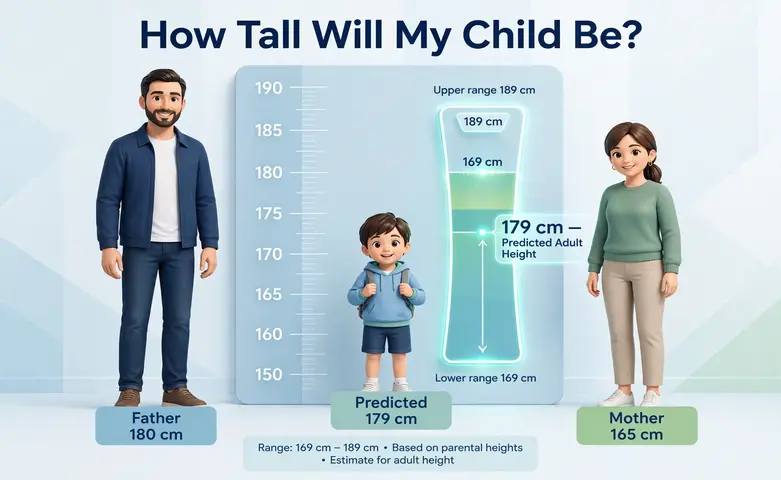
This calculator uses the mid-parental height method described by Tanner and colleagues in 1970, which pediatricians use as a first estimate. Average the two parents heights, then adjust for the childs sex. Add 13 cm (5 inches) for a boy or subtract 13 cm (5 inches) for a girl, because adult men are on average taller than adult women by about that amount.
In metric form the formula is (father height + mother height + 13) / 2 for a boy and (father height + mother height - 13) / 2 for a girl, with all heights in centimeters. In imperial form use 5 instead of 13, with all heights in inches. The 13 cm shift reflects the average male-female height difference, and the result is called the target height.
Worked Example
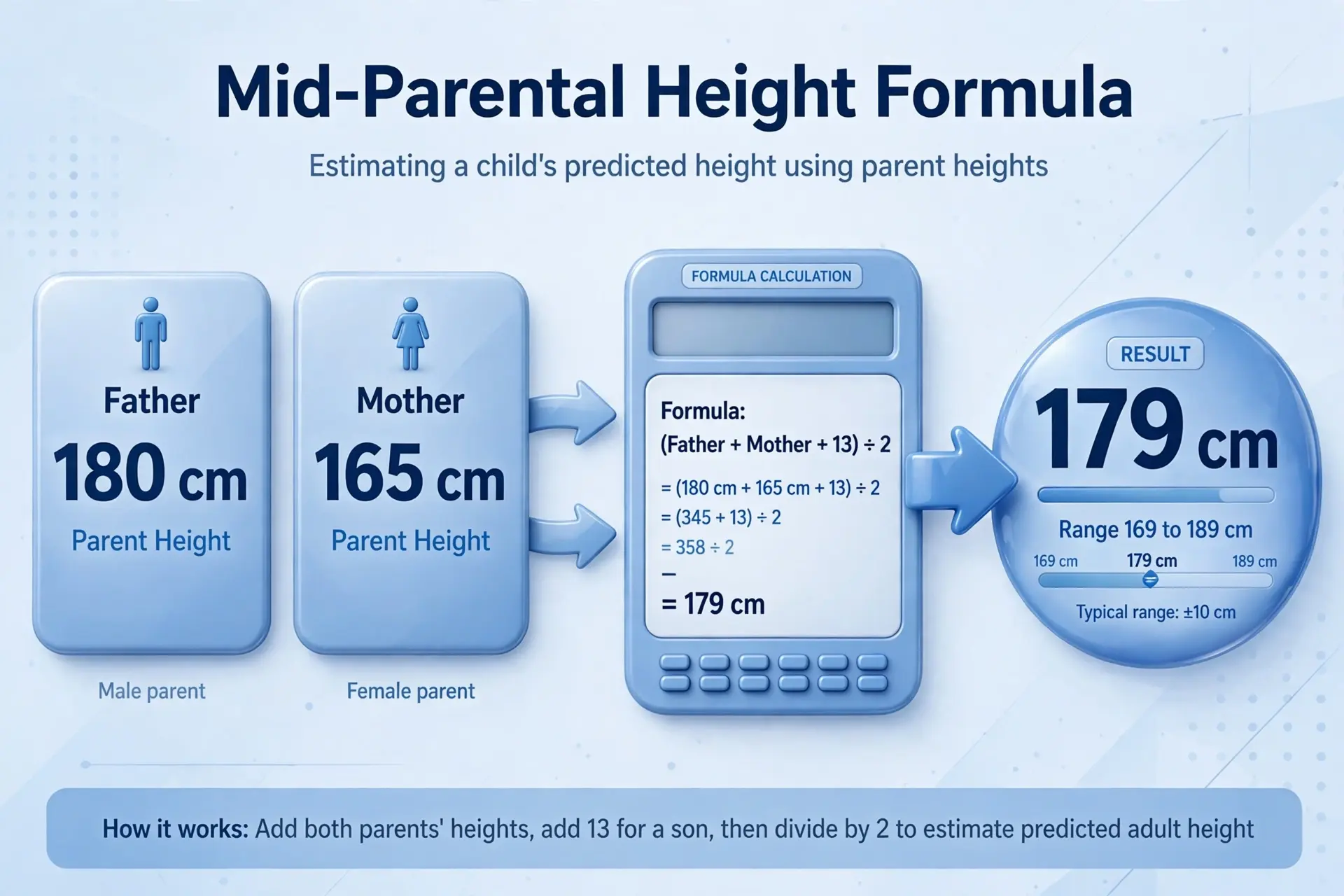
Take a boy with a 180 cm father and a 165 cm mother. Add the parents heights: 180 + 165 = 345 cm. Add the 13 cm boy adjustment: 345 + 13 = 358 cm. Divide by 2 for the target of 179.0 cm.
Apply the likely range of plus or minus 10 cm: 169.0 to 189.0 cm, where most boys with these parents finish. The same parents daughter would target (180 + 165 - 13) / 2 = 166.0 cm, with a likely range of 156.0 to 176.0 cm.
How to Read Your Result and the Range
Read the target as the center of the band, not a guaranteed height. Plus or minus 10 cm (4 inches) covers roughly two standard deviations, so most children with your inputs land inside it. A narrower band would miss about a third of children, which is why the calculator shows the wider clinical band.
Remember that the band is wide on purpose: a spread of 20 cm (8 inches) reflects how much of height the parents heights cannot explain. Landing anywhere inside it is normal. Just as the BMI calculator shows that healthy body metrics differ by build, healthy adult heights differ widely within one family.
What the Formula Does Not Measure
The mid-parental formula knows nothing about the child. It ignores nutrition, illness, hormones, sleep, and puberty timing, all of which shape final height. It also misses genetics beyond the parents: a short couple can carry tall genes from grandparents, and recent family studies found children average slightly taller than predicted.
It also says nothing about when growth happens. Early and late developers can share a target but reach it years apart. To support healthy growth, track what the formula cannot see: balanced meals, enough sleep, and regular activity. The calorie calculator can check whether a growing child eats enough for their activity level.
When to Talk to a Pediatrician
Talk to a pediatrician when the concern is how your child is actually growing, not what the formula guessed. The standard tool is the growth chart: after age 2, children usually track along a percentile curve, and a steady drift off it or growth below about 5 cm a year deserves a check. A projection more than 10 cm below the mid-parental target is also a reason clinicians refer to a pediatric endocrinologist.
Bring both parents heights and your childs measured heights over time to the visit. This calculator never replaces that assessment. For a weight benchmark once growth is complete, the ideal weight calculator uses adult height the same way pediatricians do.
Frequently asked questions
How accurate is a height predictor for a child?
The mid-parental method is a statistical estimate, not a precise forecast. Most children finish within about 10 cm (4 inches) of the target, but nutrition, health, and puberty timing also affect final height. Treat it as a well-grounded ballpark.
Why do you add 13 cm for a boy and subtract 13 cm for a girl?
The 13 cm (about 5 inches) reflects the average adult height difference between men and women, from research by Tanner and colleagues in 1970. Averaging the parents and then shifting by that amount centers the prediction on the expected height for the childs sex.
What does the plus or minus 10 cm range mean?
The range covers roughly two standard deviations, so most children with those parents land inside it. For a 180 cm father and 165 cm mother, a boy targets 179.0 cm with a likely range of 169.0 to 189.0 cm. Landing anywhere in the band is normal.
Can my child end up taller or shorter than the predicted range?
Yes. A small share of children finish outside the band because the formula ignores nutrition, illness, and genetics beyond the parents. Large studies found children average slightly taller than predicted, likely from better nutrition. A result outside the range is not a diagnosis.
At what age can you predict a childs adult height?
The mid-parental method works at any age, even before birth, because it needs only the parents heights and the childs sex. Methods using the childs own height and weight, like Khamis-Roche, need the child to be about 4 or older. For real growth assessment, a pediatrician plots measurements on growth charts over time.
Related calculators

BMI Calculator
Body mass index from height and weight.
Use calculatorCalorie Calculator
Daily calorie needs for your goal.
Use calculatorBody Fat Calculator
Estimate your body fat percentage.
Use calculatorBMR Calculator
Calories your body burns at rest.
Use calculatorIdeal Weight Calculator
Healthy weight range for your height.
Use calculatorWater Intake Calculator
How much water to drink each day.
Use calculatorProtein Intake Calculator
Daily protein target for your goal.
Use calculatorTarget Heart Rate Calculator
Exercise heart rate training zones.
Use calculatorWeight Loss Calculator
Timeline for reaching your goal weight.
Use calculatorSleep Cycle Calculator
Best bedtimes based on 90-minute sleep cycles.
Use calculator