Van Life Solar Calculator
Size a solar setup for your camper van before you buy anything. Enter how much power you use each day, your peak sun hours and how many cloudy days you want to ride out, and the calculator works out the panel wattage, the battery size and the charge controller you need. Free, no sign-up, everything runs in your browser.
Formulas: Panel watts = Daily watt-hours ÷ (peak sun hours × 0.80 system efficiency). Battery amp-hours = Daily watt-hours × days of autonomy ÷ (12 volts × usable share). Controller amps = Panel watts ÷ 12 volts × 1.25.

Formulas verified against standard references. Calculator logic tested with verified worked examples. Published: November 6, 2026 | Last updated: November 6, 2026. Our methodology
How to Use the Van Life Solar Calculator
Getting an answer takes five quick steps. The calculator sizes three things at once, the panels, the battery and the charge controller, so you buy a system that works together.
- Type your daily energy use in watt-hours, adding up each device as watts times hours per day.
- Type your peak sun hours per day. This is the number of hours of full sun, not the hours of daylight.
- Pick the wattage of one panel, usually 100 W or 200 W.
- Type how many days of autonomy you want, which is how long the battery must last with no sun.
- Pick your battery type, then press Calculate, or press Enter. The panel wattage appears first and large, with the battery size, the controller size and the step-by-step math below. Press Reset to clear the form and start over.

The Van Life Solar Formula
Three formulas size the three parts of the system. All three start from the same number, your daily energy use in watt-hours.
Panel watts = Daily watt-hours ÷ (peak sun hours × 0.80). The 0.80 is the system efficiency, which covers the energy lost in the charge controller, the battery, the inverter and the wiring. With 1,000 Wh a day and 5 sun hours, the panels must be 1,000 ÷ (5 × 0.80), which is 250 W.
Battery amp-hours = Daily watt-hours × days of autonomy ÷ (12 volts × usable share). The usable share is 0.80 for lithium and 0.50 for AGM, because only that share of a battery rated capacity can be used without damage. With 1,000 Wh a day, 2 days of autonomy and a lithium battery, the bank must be 1,000 × 2 ÷ (12 × 0.80), which is 208.33 Ah.
Controller amps = Panel watts ÷ 12 volts × 1.25. The 1.25 is a safety margin for continuous load, and the answer is rounded up to the next 5 A controller size. For 250 W of panels, that is 250 ÷ 12 × 1.25, which is 26.04 A, so a 30 A controller is the right pick.
Panel count is the panel watts rounded up to whole panels. A 250 W need with 200 W panels means 2 panels, which gives 400 W on the roof and a little headroom for cloudy spells.
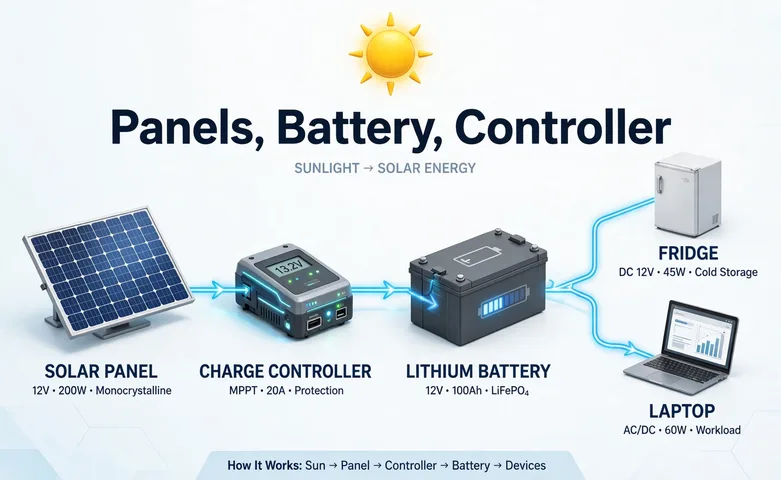
Worked Example: 1,000 Wh a Day in 5 Sun Hours
You run a 12 V fridge, lights, a laptop and phones in your van, and they use 1,000 Wh a day. You camp where you get 5 peak sun hours, you want 2 days of autonomy, and you use a lithium battery with 200 W panels. Here is exactly what the calculator does.
- Panel watts: 1,000 ÷ (5 × 0.80) = 250 W.
- Panels: 250 ÷ 200 = 1.25, rounded up to 2 panels, which is 400 W on the roof.
- Battery: 1,000 × 2 ÷ (12 × 0.80) = 208.33 Ah.
- Controller: 250 ÷ 12 × 1.25 = 26.04 A, rounded up to a 30 A controller.
- Check the generation: 400 W × 5 sun hours × 0.80 = 1,600 Wh a day, which covers the 1,000 Wh you use with room to spare.
Why the 0.80 Efficiency Factor Matters
Solar panels never deliver their rated watts all day. The rating is measured in perfect lab conditions, with the panel facing the sun at the ideal angle and temperature. On a van roof, the panel sits flat, the sun moves, dust builds up, and the charge controller and battery each take a small cut.
Van solar guides put those losses at about 20 percent in total, which is why the formula divides by 0.80. Skipping that step is the most common sizing error, and it leaves a system that looks right on paper and runs flat by the second evening.
Lithium vs AGM Batteries
Lithium LiFePO4 is the usual pick for van life, and the usable share is the reason. You can use about 80 percent of a lithium battery rated capacity, so a 200 Ah lithium bank gives you about 160 Ah of usable energy. It is also lighter and lasts through many more charge cycles than lead-acid.
AGM lead-acid costs less up front, but you can only use about 50 percent of its rated capacity without shortening its life. The same 1,000 Wh a day with 2 days of autonomy needs 208.33 Ah of lithium, but 333.33 Ah of AGM.
The calculator shows both, so you can compare the real cost. An AGM bank may be cheaper per amp-hour on the shelf, but you need nearly twice as many amp-hours to get the same usable energy. If you are comparing energy units, our energy converter can switch between watt-hours and amp-hours at your system voltage.
Common Sizing Mistakes
Using daylight hours instead of peak sun hours is the first mistake. Twelve hours of daylight in June is not twelve hours of full sun, and a panel that faces the sky flat on a roof catches far less than its rating for most of the day. Use 3 to 5 peak sun hours for planning, and check the number for your location and season.
Forgetting the fridge is the second. A 12 V fridge runs all day and night, and van solar guides put a typical one near 600 Wh a day on its own. Add it up honestly, or the battery will be sized for the lights and the laptop only.
Sizing the panels and forgetting the battery is the third. Panels refill the battery, but they do nothing after sunset. If the battery holds only one day of use, a single cloudy day ends the trip. Two days of autonomy is the usual starting point for full-time van life.
Finally, check the controller and the wiring for the panel size you picked, and use our voltage converter and power converter to check the volts and watts before you buy.
Disclaimer
This calculator gives an estimate for planning and is for informational purposes only, not installation advice. Solar output varies with weather, shade, tilt and season. High-current wiring, fuses and battery connections should be checked by a qualified installer. See our disclaimer.

Frequently asked questions
How many watts of solar do I need for a camper van?
Most vanlifers install 200 to 600 W of panels. A light setup with lights, phones and a small fridge runs on 200 to 300 W, while a full-time setup with a fridge, laptop and fan usually needs 400 to 600 W.
How many peak sun hours should I use?
Use 3 to 5 peak sun hours for most of the US, with 5 in summer and 3 to 4 in winter. Peak sun hours are hours of full sun, not hours of daylight, and they change with location and season.
What size battery do I need for 400 W of solar?
Van solar guides pair 400 W of panels with a 200 to 300 Ah lithium battery at 12 V. The exact size comes from your daily use and days of autonomy, so enter those numbers to get your own answer.
Do I need an MPPT charge controller?
An MPPT controller is the usual pick for a van, because it converts the panel voltage to the battery voltage more efficiently than a PWM controller. Size it for at least 1.25 times the panel current at 12 V.
Can solar power run a 12 V fridge?
Yes. A 12 V fridge is the most common van load, and van solar guides put a typical one near 600 Wh a day. Add that to your daily total before you size the panels and the battery.
Related calculators

Roofing Calculator
Work out roofing area, shingles and cost for any roof.
Use calculatorPaint Calculator
Find how much paint you need for walls, ceilings and rooms.
Use calculatorFlooring Calculator
Calculate flooring area, boxes and cost for any room.
Use calculatorInsulation Calculator
Work out insulation area, rolls and cost for walls and attics.
Use calculatorLumber Calculator
Calculate board feet and cost for any lumber project.
Use calculatorConcrete Calculator
Work out concrete volume, bags and cost for slabs and footings.
Use calculator