Insulation Calculator: Right R-Value for Your Home
Enter the area to insulate, your current and target R-values, and the material, and get the thickness to add, the coverage, and the heat loss you avoid.
Formulas verified against standard references. Calculator logic tested with verified worked examples. Last reviewed: October 2026. Our methodology
What R-Value Means
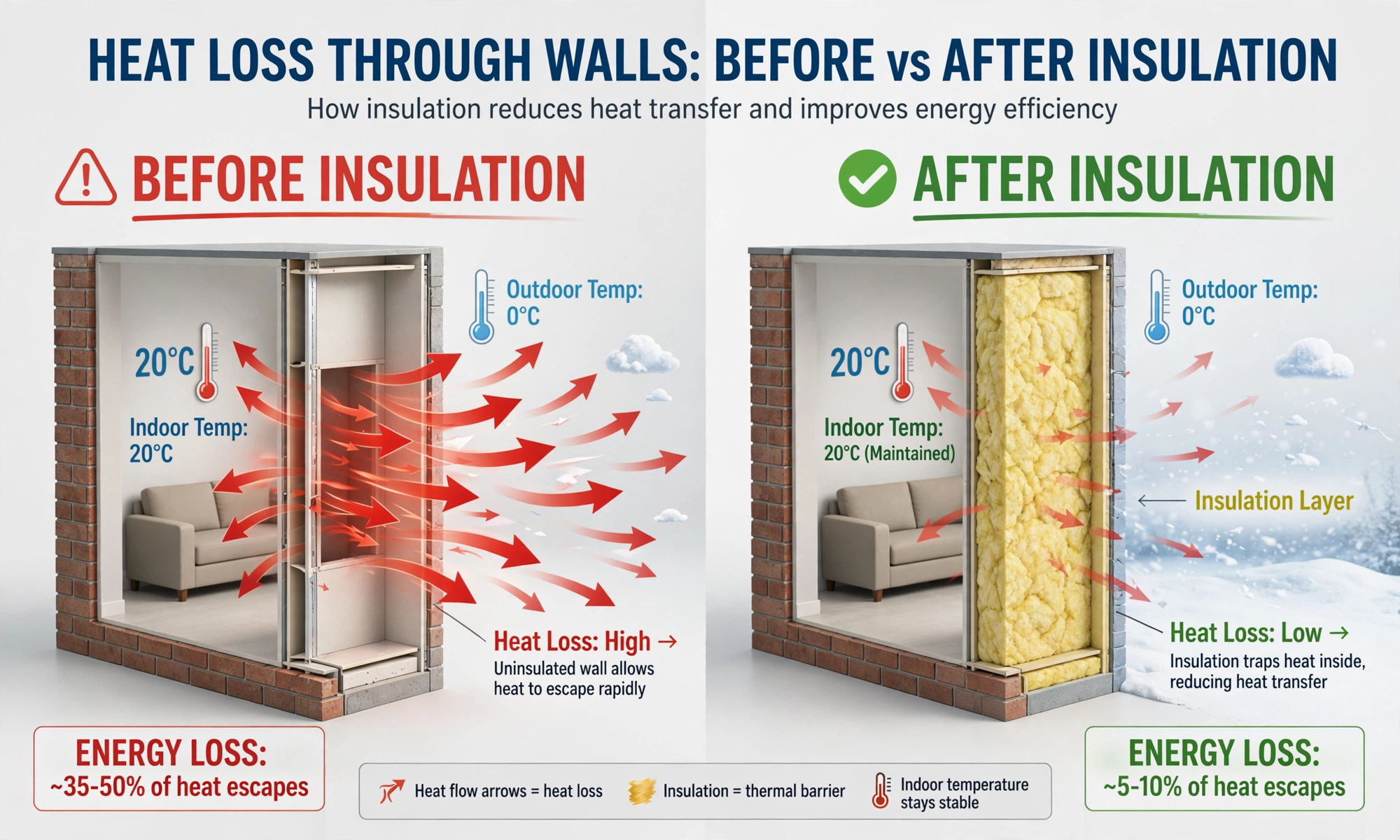
R-value measures resistance to heat flow: higher is better insulation. A wall at R-11 lets about twice as much heat through as a wall at R-22, because heat flow is proportional to 1 divided by R-value. Doubling R-value halves the heat loss through that surface, though it does not halve the whole heating bill, since windows, air leaks, and other surfaces matter too.
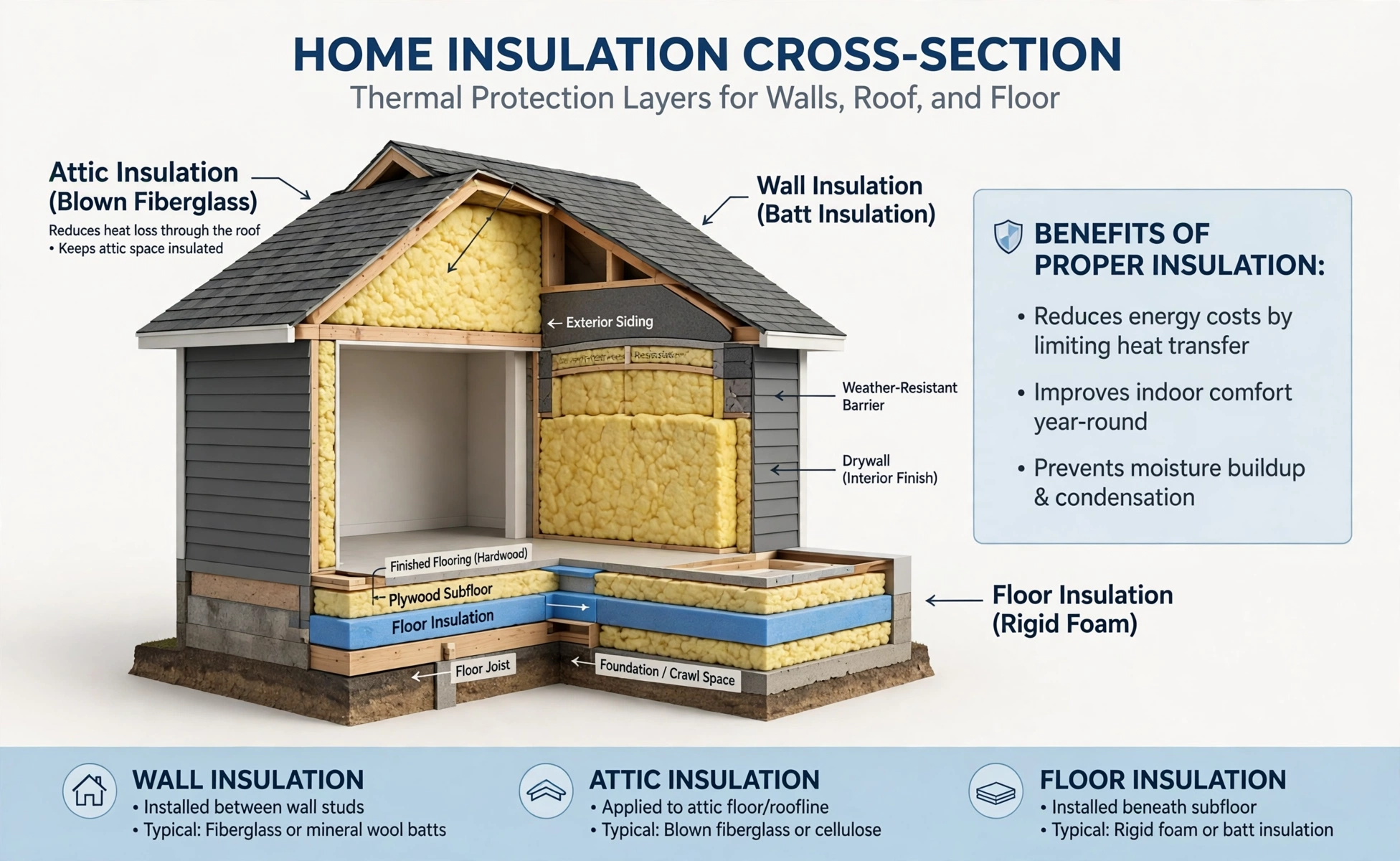
R-values add when layers stack: R-11 batts plus R-19 batts give about R-30, and adding a layer of R-5 foam board on top gives about R-35. That additive rule is what makes this calculator work: the thickness you need is the R-value gap divided by the material's R-value per inch.
For the soil and ground side of a build, a soil calculator covers the earthworks volumes that come before insulation goes in.
R-Value Per Inch by Material
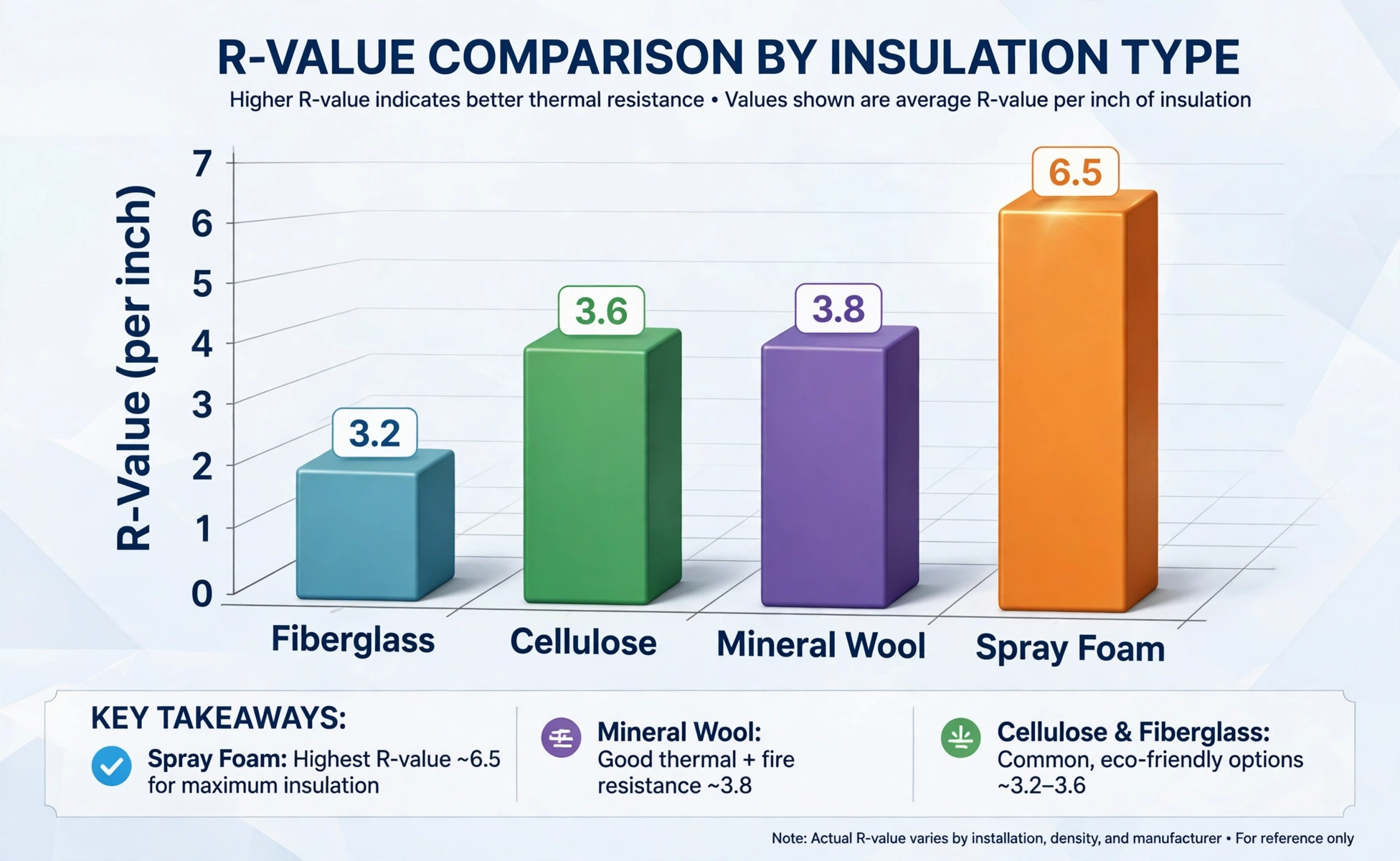
Different materials insulate differently per inch, which decides how thick the layer must be. Closed-cell spray foam leads at about R-6.5 per inch, so it fits high R-values into thin cavities. Rigid foam board is about R-5 per inch, fiberglass batts about R-3.7, cellulose about R-3.5, and mineral wool batts about R-2.5 to R-3 per inch in common products.
Per-inch values vary by product and density, so check the manufacturer's data sheet for the exact product you buy. The figures here are typical values for planning, and the calculator lets you pick the closest material to your product.
| Material | Typical R per inch | Inches for R-19 |
|---|---|---|
| Closed-cell spray foam | 6.5 | 2.9 |
| Rigid foam board | 5.0 | 3.8 |
| Fiberglass batts | 3.7 | 5.1 |
| Open-cell spray foam | 3.6 | 5.3 |
| Cellulose blown-in | 3.5 | 5.4 |
| Fiberglass blown-in | 3.2 | 5.9 |
| Mineral wool batts | 2.5 | 7.6 |
Worked Examples
Example 1: attic at R-11 now, target R-38, fiberglass batts at R-3.7 per inch. Gap is R-27, thickness is 27 divided by 3.7, or 7.3 inches to add. Heat loss through the attic falls by 1 minus 11/38, or about 71 percent.
Example 2: wall at R-13 now, target R-21, cellulose at R-3.5 per inch. Gap is R-8, thickness is 2.3 inches. Example 3: 1,000 square feet at R-19 target from R-0 with rigid foam board at R-5 per inch needs 3.8 inches over the full 1,000 square feet.
| Now | Target | Material | Thickness to add |
|---|---|---|---|
| R-11 | R-38 | Fiberglass batts | 7.3 in |
| R-13 | R-21 | Cellulose | 2.3 in |
| R-0 | R-19 | Rigid foam board | 3.8 in |
| R-19 | R-30 | Spray foam closed-cell | 1.7 in |
Recommended R-Values
Recommendations depend on climate and on whether the surface is an attic, wall, or floor. In general, attics want the most, often R-38 to R-60 in cold climates, walls want R-13 to R-21, and floors over unheated spaces want R-25 to R-30. Warm climates need less, but attics still benefit from R-30 or more because summer heat comes through the roof.
Check your local energy code or utility guidance for the exact target in your zone, and remember that air sealing matters as much as R-value: insulation full of gaps and drafts performs far below its label, since moving air carries heat past it.
| Surface | Warm climate | Mixed climate | Cold climate |
|---|---|---|---|
| Attic | R-30 | R-38 | R-49 to R-60 |
| Wall | R-13 | R-13 to R-21 | R-21 |
| Floor | R-13 | R-25 | R-30 |
Common Mistakes
The most common mistake is compressing batts into a thinner cavity: a 6 inch batt squeezed into 4 inches does not give R-19, it gives about the R-value of 4 inches of the material, since R-value per inch stays roughly constant and thickness is what was lost. Buy the batt thickness that fits the cavity.
A second mistake is leaving gaps: insulation that covers 95 percent of an area with 5 percent gaps loses far more than 5 percent of its performance, because heat flows through the gaps. A third mistake is insulating without air sealing first: seal cracks and penetrations, then insulate, for the rated performance.
Practical Uses
Use this calculator when topping up an attic, insulating a renovation, or checking a contractor's quote: enter the area, the existing R-value, and the target, and see the thickness in inches for each material, so a quote for 6 inches of cellulose can be checked against the 5.4 inches an R-19 gap actually needs.
Also use it to compare materials fairly: spray foam needs fewer inches but costs more per inch, while batts need more depth but cost less. The right choice depends on cavity depth, budget, and whether moisture control matters in that assembly.
Frequently asked questions
What does R-value mean?
Resistance to heat flow. Higher R-value means less heat passes through, so R-38 loses about half as much heat as R-19 through the same surface.
How thick should attic insulation be?
It depends on climate and material, but R-38 with fiberglass batts needs about 10 inches total. This calculator gives the added thickness from your current R-value.
Do R-values add up?
Yes. Layers stack: R-11 plus R-19 gives about R-30, and adding R-5 foam board gives about R-35.
What happens if I compress insulation?
Its R-value drops with thickness. A batt squeezed thinner gives roughly the R-value of its compressed thickness, not its labeled thickness.
Is spray foam better than fiberglass?
Per inch, closed-cell spray foam insulates about 75 percent better than fiberglass batts, but it costs more. The best choice depends on cavity depth and budget.
Does insulation help in summer?
Yes. Insulation slows heat in both directions, so it keeps summer heat out of the attic and living space just as it keeps winter heat in.
Should I air seal before insulating?
Yes. Seal cracks, gaps, and penetrations first, since air leaks carry heat past insulation and cut its real performance well below its label.