Soil Calculator: How Much Soil Do You Need?
Enter your bed shape, size, and soil depth to get the volume in cubic feet and yards, the weight in tons, and how many bags to buy.
Formulas verified against standard references. Calculator logic tested with verified worked examples. Last reviewed: October 2026. Our methodology
How Soil Volume Is Calculated
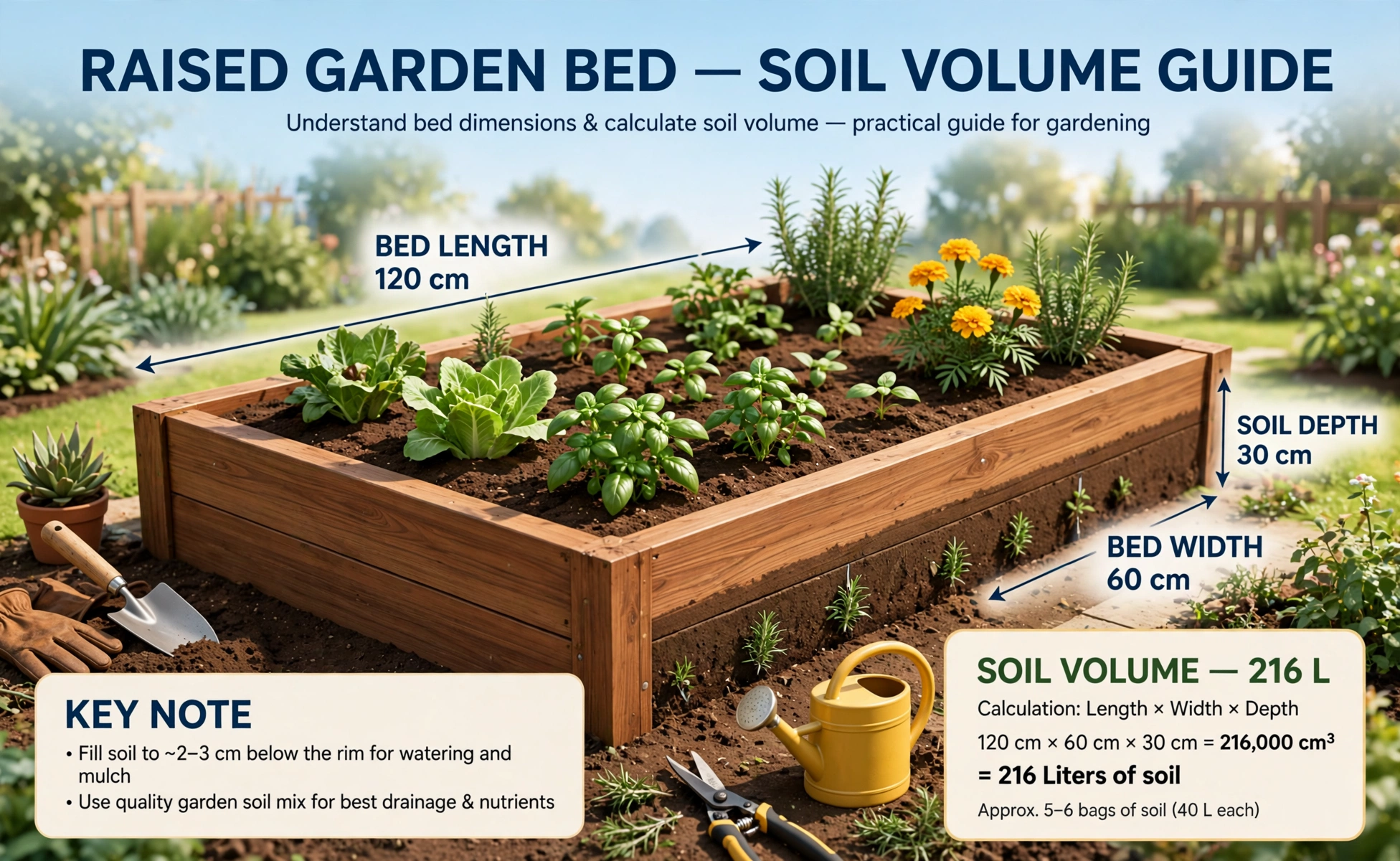
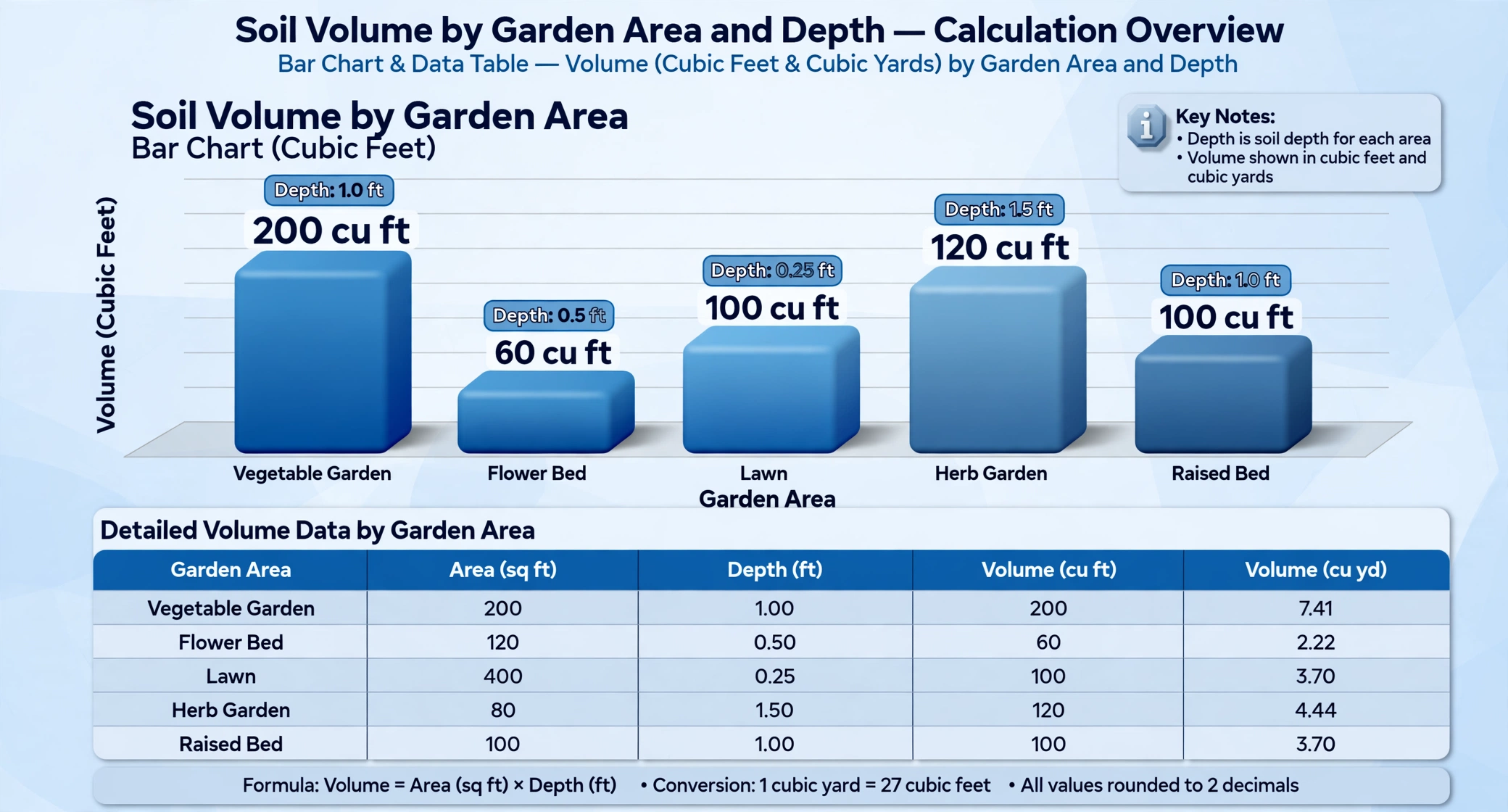
Soil volume is area times depth. For a rectangle, area is length times width. For a circle, area is pi times radius squared, where radius is half the diameter. Multiply area in square feet by depth in feet to get cubic feet, and divide cubic feet by 27 to get cubic yards, since a cubic yard is 3 feet on each side.
Depth needs care with units: depth is usually given in inches, so divide by 12 to get feet before multiplying. A 10 by 4 foot bed at 6 inches deep is 40 square feet times 0.5 feet, which is 20 cubic feet, or 0.74 cubic yards before waste.
For hard landscaping material by the same method, a gravel calculator covers stone and aggregate volumes.
Cubic Feet, Cubic Yards, and Tons
Suppliers sell bulk soil by the cubic yard and bagged soil by the bag, so both numbers matter. One cubic yard equals 27 cubic feet, and one cubic foot of loose topsoil weighs about 75 pounds, so one cubic yard weighs about 2,025 pounds, or just over 1 ton.
This calculator uses 75 pounds per cubic foot, a typical figure for loose screened topsoil. Wet soil can weigh 20 to 30 percent more, and dense clay heavier still, so treat weight as an estimate for delivery and handling, and volume as the number to order by.
| Unit | Equals | Typical topsoil weight |
|---|---|---|
| 1 cubic foot | 1,728 cubic inches | About 75 lb |
| 1 cubic yard | 27 cubic feet | About 2,025 lb, about 1 ton |
| 1 ton | 2,000 lb | About 0.99 cubic yards |
| 40 lb bag | About 0.53 cubic feet | Covers about 1 sq ft at 6 in |
Worked Examples
Example 1: rectangle 10 by 4 feet, 6 inches deep, 10 percent waste. Area 40 square feet, volume 20 cubic feet, with waste 22 cubic feet, which is 0.81 cubic yards, about 1,650 pounds, or 42 bags of 40 pounds.
Example 2: circle 6 feet across, 12 inches deep, no waste. Radius 3 feet, area 28.27 square feet, volume 28.27 cubic feet, about 1.05 cubic yards, about 2,121 pounds. Example 3: lawn topdressing 20 by 30 feet at 1 inch deep: 600 square feet times 1/12 foot is 50 cubic feet, or 1.85 cubic yards.
| Bed | Depth | Volume | Order with 10% waste |
|---|---|---|---|
| 10 x 4 ft rectangle | 6 in | 20 cu ft | 22 cu ft, 0.81 cu yd |
| 6 ft circle | 12 in | 28.27 cu ft | 31.1 cu ft, 1.15 cu yd |
| 20 x 30 ft lawn | 1 in | 50 cu ft | 55 cu ft, 2.04 cu yd |
How Deep Should Soil Be
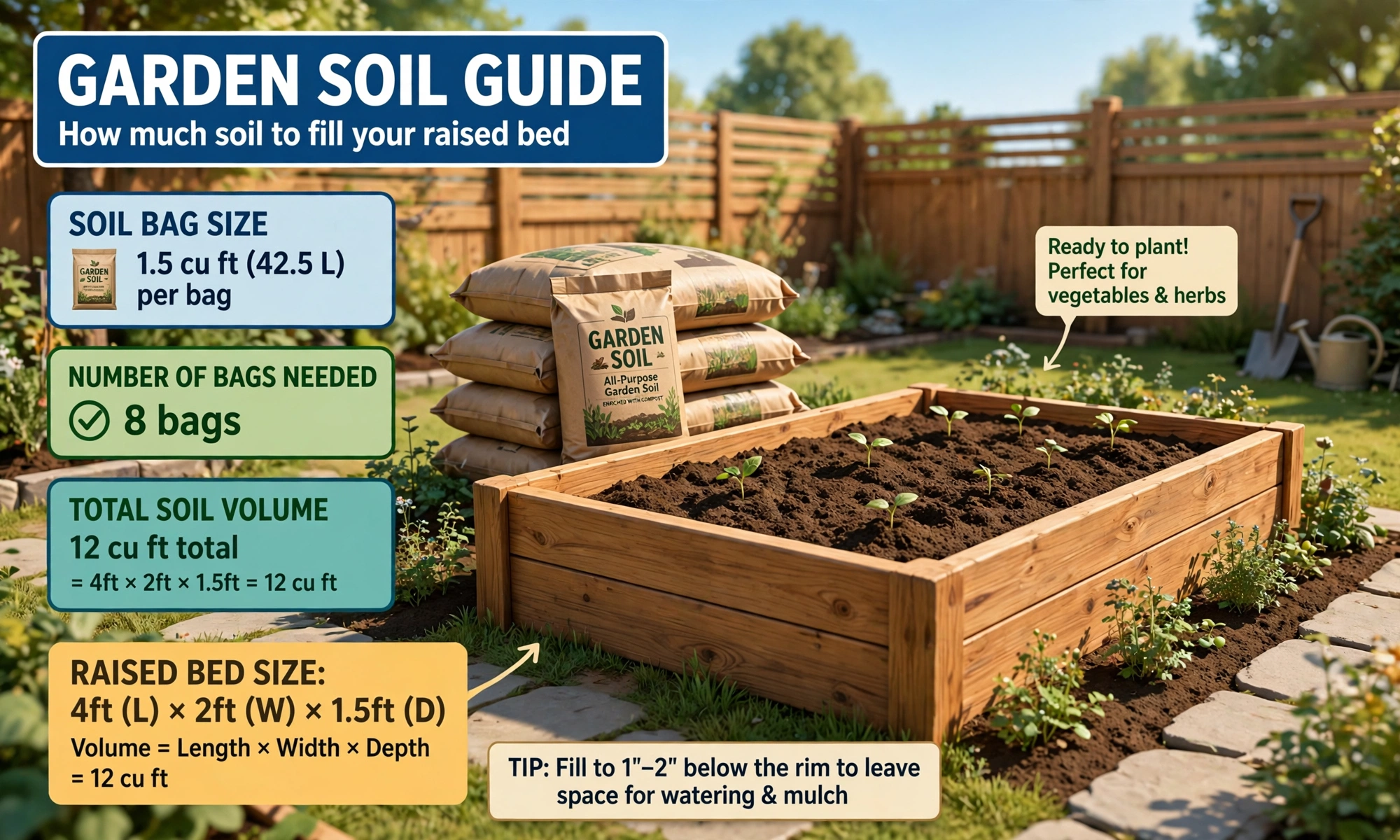
Depth depends on what grows there. Lawns topdressed need only 0.25 to 1 inch of soil. Flower beds want 6 to 12 inches of good soil. Raised vegetable beds work best at 12 to 18 inches, so roots have room and drainage. Trees and shrubs need a planting hole at least twice as wide as the root ball and as deep as it is tall.
Deeper is not always better: soil deeper than roots reach stays wet and can rot roots, and filling a bed to the brim leaves no room for mulch. Fill to about 1 inch below the rim, water to settle, then top up.
| Use | Recommended depth |
|---|---|
| Lawn topdressing | 0.25 to 1 inch |
| Flower bed | 6 to 12 inches |
| Raised vegetable bed | 12 to 18 inches |
| Planter box | 8 to 12 inches |
Common Mistakes
The most common mistake is mixing inches and feet: multiplying square feet by depth in inches without dividing by 12 overstates volume twelvefold. A second mistake is ordering exactly the calculated volume with no waste: settling, spillage, and uneven ground eat 5 to 10 percent, so add waste.
A third mistake is confusing diameter and radius for circles: area uses radius squared, so using the diameter as the radius quadruples the result. A fourth mistake is ordering by weight instead of volume: suppliers price by the yard, and wet soil weighs more without giving more volume.
Practical Uses
Use this calculator before ordering to avoid the two expensive outcomes: a short delivery that stalls the job, or a mountain of extra soil with nowhere to go. For bulk orders, round up to the nearest half yard, since suppliers charge by the yard and a small surplus tops up low spots.
For bags, round up to whole bags and keep the receipt: unopened bags return, but an opened shortfall means another trip. And check access before a bulk delivery: a truck needs a clear drop spot, or the soil arrives as bags whether you planned it or not.
Frequently asked questions
How much soil do I need for a 10 by 4 foot bed at 6 inches?
20 cubic feet, or 0.74 cubic yards, before waste. With 10 percent waste, order 22 cubic feet, about 0.81 cubic yards.
How many cubic feet are in a cubic yard?
27. A cubic yard is 3 feet by 3 feet by 3 feet, so divide cubic feet by 27 to get cubic yards.
How much does a cubic yard of soil weigh?
About 2,025 pounds, just over 1 ton, for loose topsoil. Wet soil weighs more, so treat weight as an estimate.
How many 40 lb bags make a cubic yard?
About 51 bags, since 2,025 divided by 40 is 50.6. Round up, since you cannot buy part of a bag.
How deep should soil be in a raised bed?
12 to 18 inches for vegetables, 6 to 12 inches for flowers, and 0.25 to 1 inch for lawn topdressing.
Should I add extra for waste?
Yes, 5 to 10 percent. Settling, spillage, and uneven ground all consume soil, and a short delivery stalls the job.
Is topsoil the same as garden soil?
No. Topsoil is the upper layer of natural soil, while garden soil is usually topsoil blended with compost and other matter for planting. Check what your supplier sells.