Voltage Converter
Enter a voltage, pick the unit it is in, and pick the unit you want. Get the converted value plus the equivalent in every supported unit, from microvolts to megavolts.

Formulas verified against standard references. Calculator logic tested with verified worked examples. Last reviewed: November 2026. Our methodology
The Volt and Its Metric Prefixes
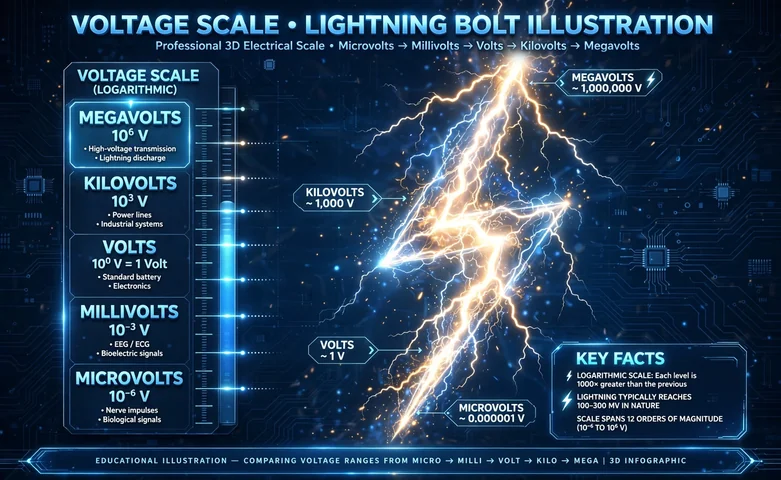
Voltage is electric potential difference: the push that moves charge through a circuit, measured in volts. Because real voltages span from millionths of a volt in sensors to millions of volts in transmission lines, metric prefixes do the heavy lifting.
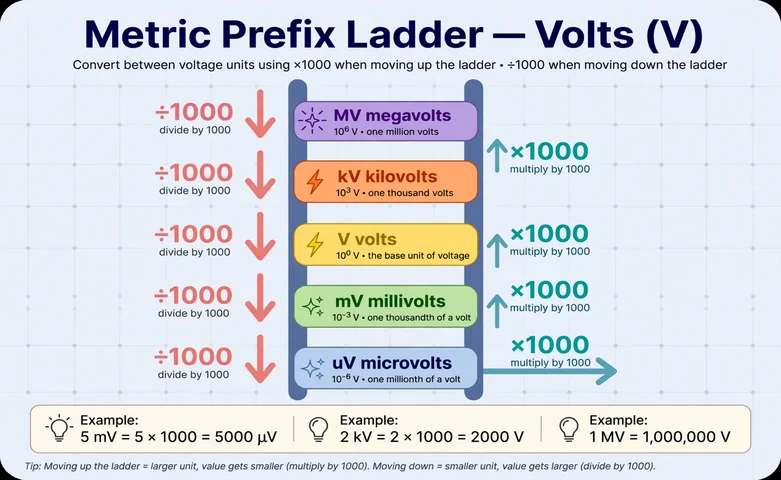
Every conversion is a power-of-ten shift through the volt. A millivolt is a thousandth of a volt, a kilovolt is a thousand volts, and the pattern continues in both directions with microvolts and megavolts.
The Conversion Formula
Convert in two steps: multiply by the source unit's factor to reach volts, then divide by the target unit's factor. In one line: result = value x (source factor / target factor), where each factor is relative to the volt.
Example: 240 millivolts to volts. Source factor 0.001, target factor 1: 240 x (0.001 / 1) = 0.24 V. Reverse: 13.8 kilovolts to volts is 13.8 x (1000 / 1) = 13,800 V.
| Unit | Symbol | Volts |
|---|---|---|
| Microvolt | uV | 0.000001 |
| Millivolt | mV | 0.001 |
| Volt | V | 1 |
| Kilovolt | kV | 1,000 |
| Megavolt | MV | 1,000,000 |
Where Each Unit Lives
Microvolts belong to sensors and biomedical signals: EEG electrodes output tens of microvolts. Millivolts are the language of thermocouples, strain gauges, and current shunts. Volts are everyday electronics and mains-adjacent work.
Kilovolts run distribution lines and industrial equipment; a 13.8 kV feeder is a standard utility voltage. Megavolts appear in transmission planning and high-energy physics. Picking the right unit keeps the significant digits where they belong.
Worked Examples
Sensor to controller: a thermocouple reads 25 mV and the controller expects volts. 25 x 0.001 = 0.025 V. Utility scale: a 13.8 kV line in volts is 13.8 x 1000 = 13,800 V. Lab precision: 500,000 uV to volts is 500,000 x 0.000001 = 0.5 V.
The table above the result shows all five equivalents at once, so one conversion answers the follow-up questions too.
AC, DC, and Unit Conversions
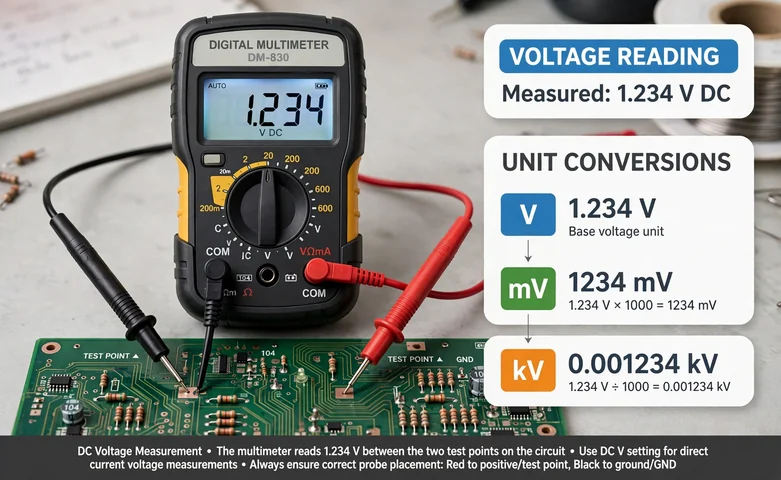
Prefix conversion is identical for AC and DC: 240 mV is 0.24 V whether it is a steady sensor output or an audio signal. The unit change never depends on the waveform.
What does depend on AC specifics is RMS versus peak: 230 V mains is an RMS figure, with peaks near 325 V. That is a measurement convention, not a unit conversion, so convert first and apply RMS math second.
Avoiding the Classic Mistakes
The common error is the direction: multiplying by 1000 when converting volts to millivolts is right, but the same instinct applied to millivolts-to-volts gives an answer a million times too big. When in doubt, sanity-check against the ladder: moving to a smaller unit makes the number bigger.
For power rather than potential, the acceleration converter covers another SI family, and the torque converter handles rotational units.
Frequently asked questions
How many millivolts are in a volt?
1,000. Multiply volts by 1,000 to get millivolts; divide millivolts by 1,000 to get volts.
How do you convert kilovolts to volts?
Multiply by 1,000. A 13.8 kV distribution line is 13,800 V.
What is the formula for voltage conversion?
Result = value x (source factor / target factor), with each factor defined relative to the volt (uV: 1e-6, mV: 1e-3, V: 1, kV: 1e3, MV: 1e6).
Is the conversion the same for AC and DC?
Yes. Metric prefix conversion is a pure unit change and never depends on the waveform.
How many volts is 500,000 microvolts?
0.5 V. Multiply by 0.000001.
When do you use megavolts?
Power transmission planning and high-energy physics, where voltages reach into the millions.
What is a volt, exactly?
The SI unit of electric potential difference: the potential that moves one ampere of current against one ohm of resistance.