Torque Converter
Convert torque between 9 units: newton-meters, kilonewton-meters, newton-centimeters, pound-feet, pound-inches, kilogram-force meters, kilogram-force centimeters, ounce-inches, and dyne-centimeters. Every conversion pivots through the newton-meter with high-precision factors, and the result includes a full table so you can see your value in all units at once.

Formulas verified against standard references. Calculator logic tested with verified worked examples. Last reviewed: October 2026. Our methodology
How Torque Conversions Work
Torque is force times distance from the pivot: τ = F × r. Its SI unit, the newton-meter, is the torque from one newton acting at one meter. Every conversion here pivots through the newton-meter: first multiply into N-m, then divide out to the target unit, so all 9 units stay consistent.
The factors are high-precision standards: 1 lbf-ft = 1.35581795 N-m (from the exact 1959 yard and pound definitions), 1 kgf-m = 9.80665 N-m (exact standard gravity), 1 lbf-in = 0.112984825 N-m. Results show up to 10 significant digits, more than enough for any wrench setting.
The Units, and Where You Meet Them
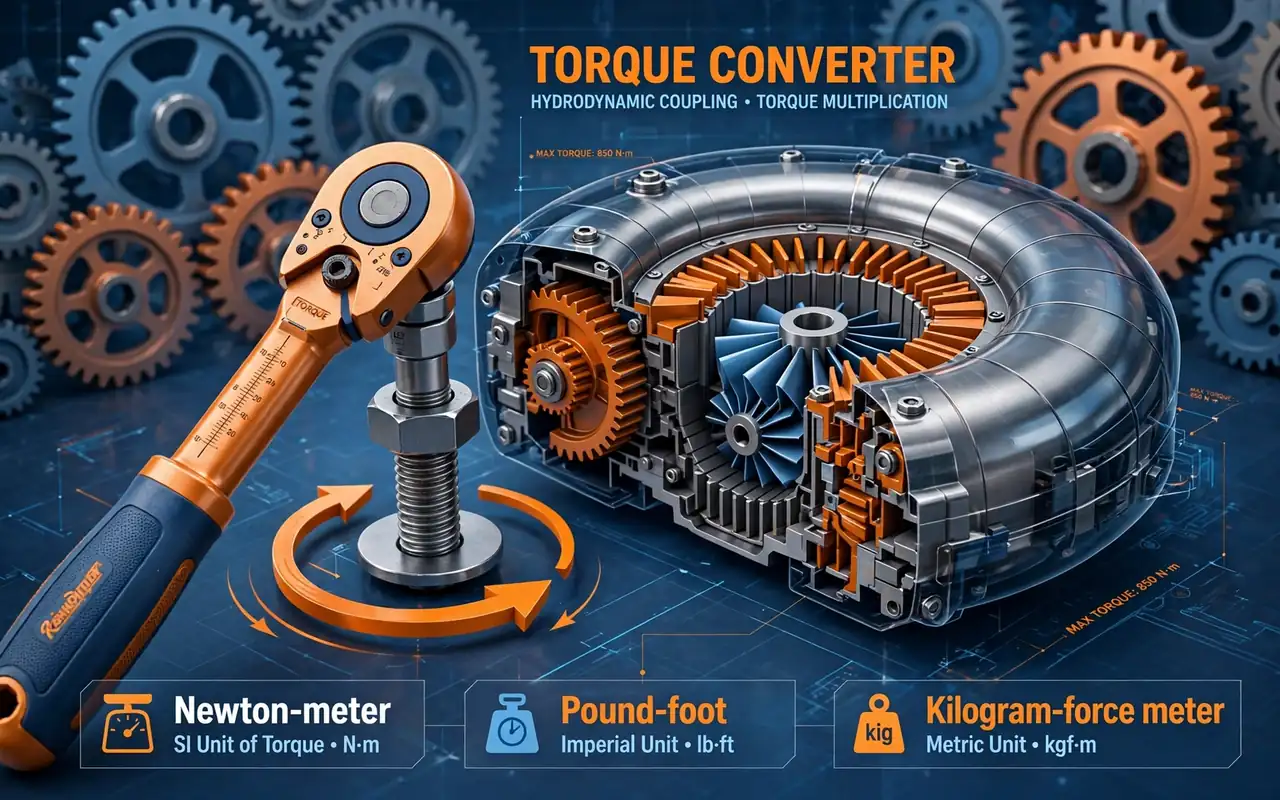
Newton-meters rule science, international engineering, and most car manuals outside the US. Pound-feet dominate US automotive specs: lug nuts, head bolts, spark plugs. Pound-inches cover small fasteners where foot-pounds would be clumsy decimals.
Kilogram-force meters survive in older metric machinery and some Asian specs; kilonewton-meters in heavy industry and structural work; dyne-centimeters in laboratory CGS contexts. Picking the wrong unit family is how a 140 N-m lug nut spec becomes a dangerous 140 lbf-ft guess, so convert deliberately.
| Unit | Equals in N-m | Typical use |
|---|---|---|
| Newton-meter (N-m) | 1 | SI standard, car manuals |
| Kilonewton-meter (kN-m) | 1,000 | Heavy industry |
| Pound-force foot (lbf-ft) | 1.35581795 | US automotive |
| Pound-force inch (lbf-in) | 0.112984825 | Small fasteners |
| Kilogram-force meter (kgf-m) | 9.80665 | Older metric machinery |
| Ounce-force inch (oz-in) | 0.0070615518 | Tiny screws, electronics |
| Dyne-centimeter | 0.0000001 | Laboratory CGS |
Common Conversions to Memorize
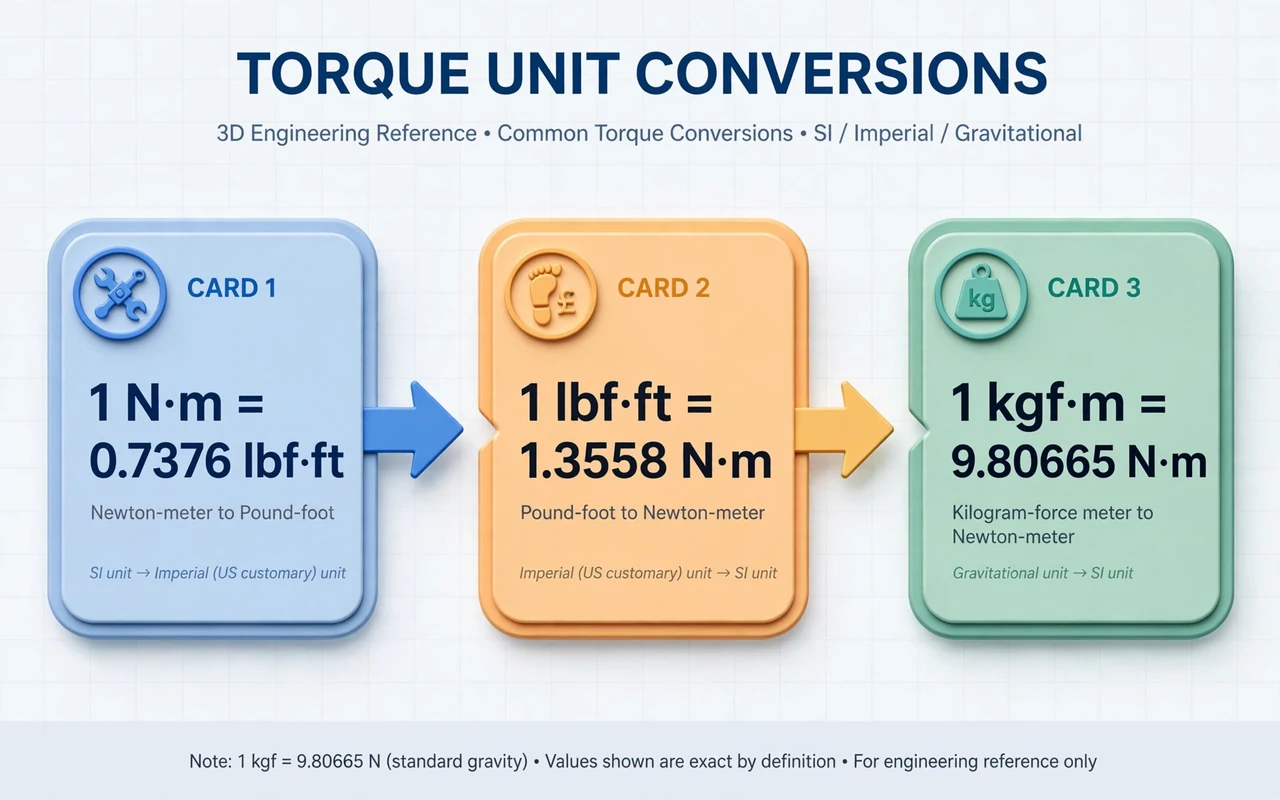
Three conversions cover most real-world needs. 1 N-m = 0.737562 lbf-ft, so multiply newton-meters by 0.74 for a quick mental estimate. 1 lbf-ft = 1.35582 N-m going the other way. And 1 lbf-ft = 12 lbf-in exactly, the whole-number bridge between the two US units.
Worked example: a manual calls for 140 N-m on wheel lug nuts and your wrench reads pound-feet. 140 × 0.737562 = 103.26 lbf-ft. Setting 103 on the wrench nails the spec; guessing 140 would over-torque by 36 percent.
| From | To | Multiply by |
|---|---|---|
| N-m | lbf-ft | 0.737562 |
| lbf-ft | N-m | 1.355818 |
| N-m | lbf-in | 8.850748 |
| lbf-in | N-m | 0.112985 |
| N-m | kgf-m | 0.101972 |
| kgf-m | N-m | 9.80665 |
| kgf-m | lbf-ft | 7.233014 |
Torque vs Force: Not the Same Thing
Torque and force share no units, even though both describe push. Force is measured in newtons or pounds-force; torque is force at a distance, newton-meters or pound-feet. Saying an engine makes 400 pound-feet of torque is not saying it pushes with 400 pounds.
The confusion bites with the similar names: a pound-foot of torque versus a foot-pound of energy are dimensionally identical but conceptually different. For pure force conversions (newtons to pounds-force), use the force converter instead.
Why Precision Matters on Fasteners
Under-torqued bolts loosen under vibration; over-torqued bolts stretch, strip, or snap. Wheel lugs, cylinder head bolts, and brake calipers all carry torque specs for this reason, and the spec's unit is part of the spec.
A torque wrench is only as honest as its calibration, so convert the spec to the wrench's own unit rather than converting the wrench reading in your head mid-job. When the manual gives a range, aim for the middle; when it gives angle-plus-torque (torque-to-yield), follow the angle step exactly.
Converting in Code and Spreadsheets
In a spreadsheet, keep one column in N-m as the canonical value and convert outward with the factors above; that avoids compounding rounding across chained conversions. In code, store the factor constants at full precision (1.35581795, not 1.36) and round only for display.
Watch for the hyphen confusion: some datasets write lb-ft, others lbf-ft or ft-lb. They all mean the same torque unit here. And never mix torque units with energy units in the same column, even though both reduce to newton-meters dimensionally.

Frequently asked questions
How do you convert N-m to lb-ft?
Multiply newton-meters by 0.737562. So 140 N-m = 103.26 lbf-ft.
How do you convert lb-ft to N-m?
Multiply pound-feet by 1.355818. So 100 lbf-ft = 135.58 N-m.
What is the difference between lb-ft and lbf-ft?
Nothing in practice: both mean pound-force foot, the US torque unit. This converter labels it lbf-ft throughout.
How many lbf-in are in one lbf-ft?
Exactly 12. The foot-to-inch factor of 12 carries straight into torque.
What is a kgf-m?
A kilogram-force meter, an older gravitational metric torque unit equal to 9.80665 N-m. Still seen in some Asian and older European machinery specs.
Is torque the same as force?
No. Force is a push (newtons); torque is force applied at a distance from a pivot (newton-meters).
Why does the converter show all units?
So you can sanity-check at a glance: if the N-m and lbf-ft rows disagree with your mental estimate, you may have picked the wrong direction.