Force Converter: Convert Newtons, Pounds-Force and More
Enter a force value, pick the from and to units, and get the converted force plus the same force in every other unit for comparison.

Formulas verified against standard references. Calculator logic tested with verified worked examples. Last reviewed: October 2026. Our methodology
What Force Is
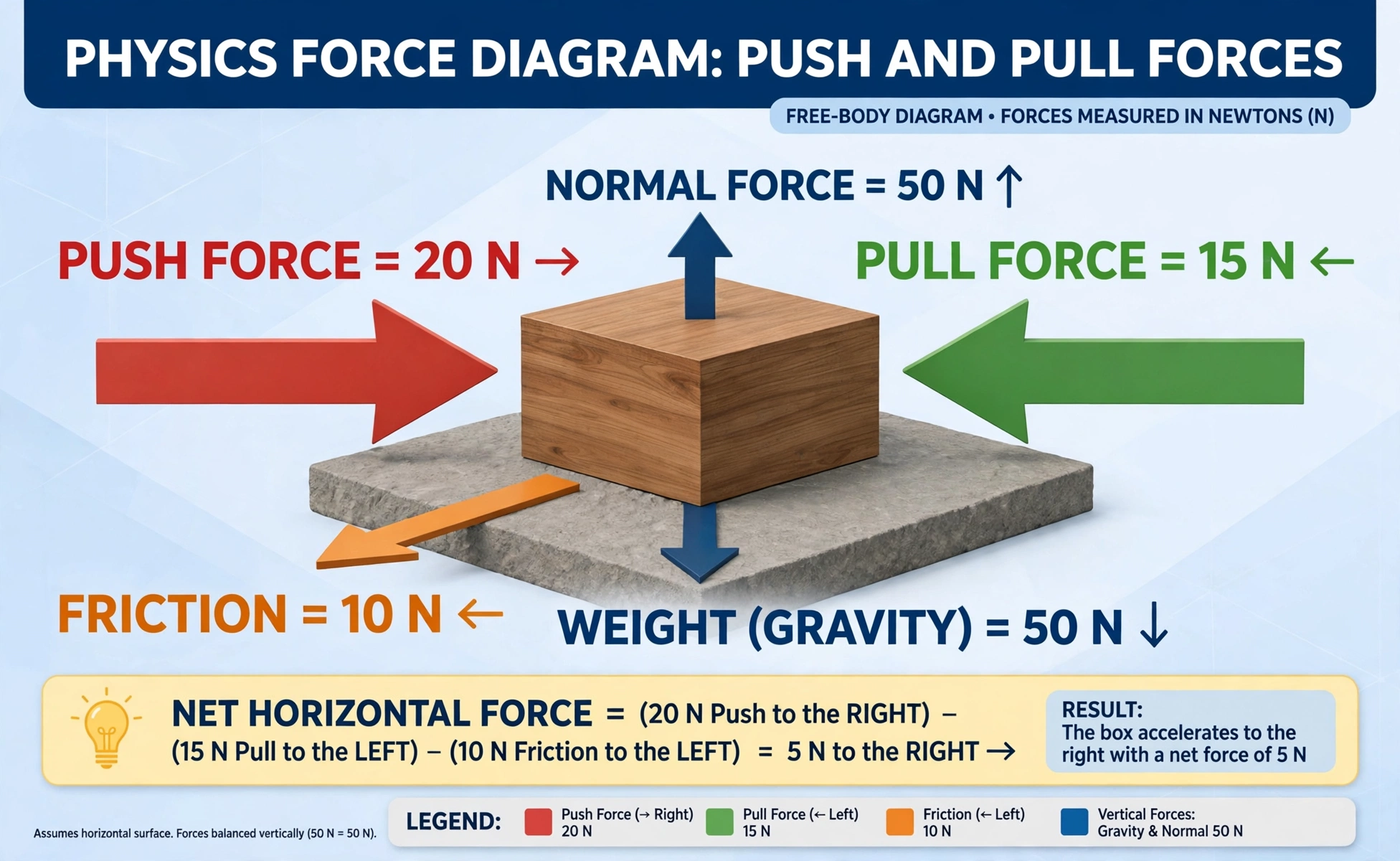
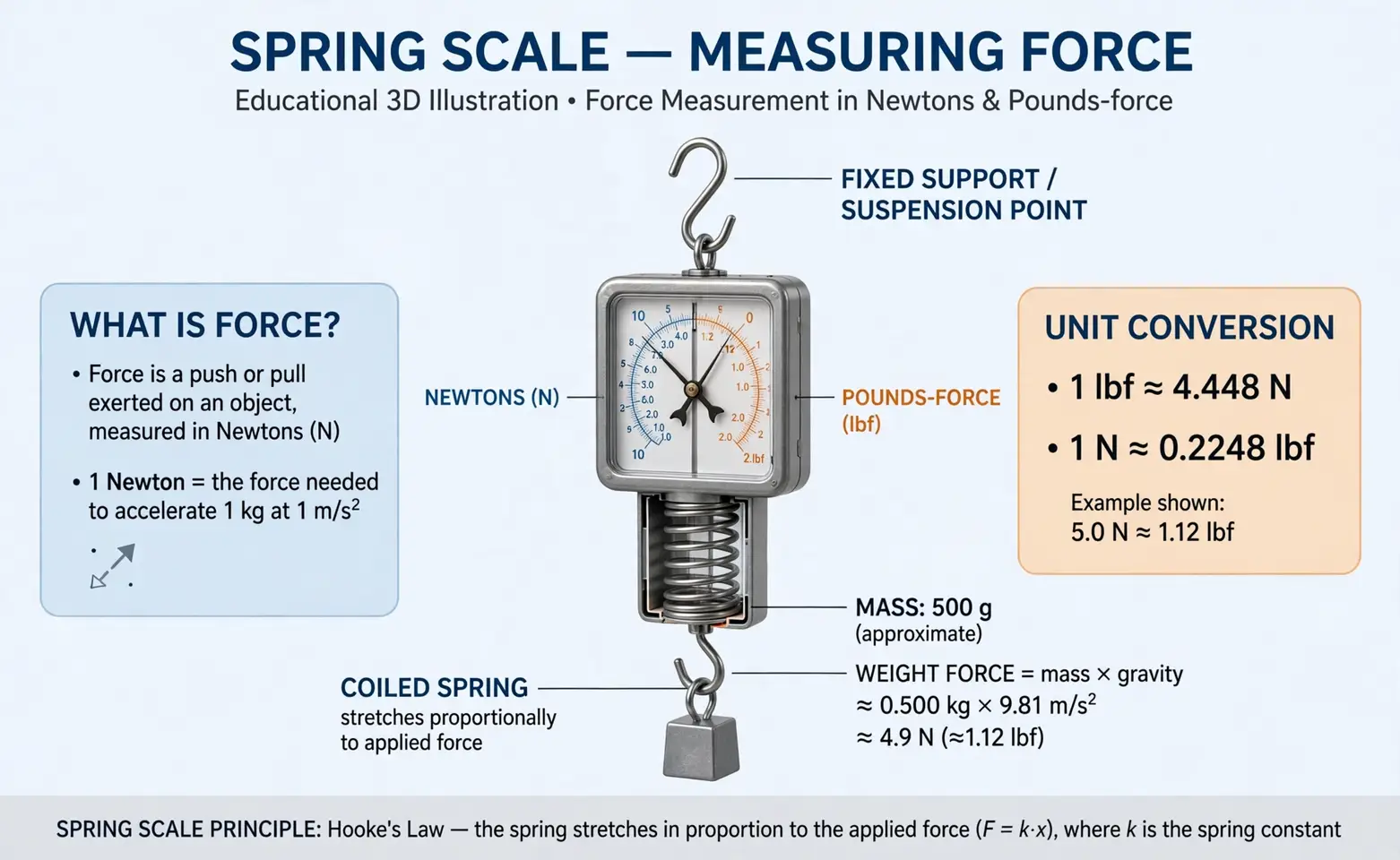
Force is a push or pull that changes motion, measured in newtons in the metric system. One newton is the force needed to accelerate one kilogram by one meter per second squared. That definition ties force to mass and acceleration: force equals mass times acceleration, so a heavier object or a larger acceleration needs a larger force.
Everyday forces are small in newtons: holding a 1-kilogram bag of sugar against gravity needs about 9.81 newtons, because gravity accelerates it at 9.81 meters per second squared. A person's weight in newtons is their mass in kilograms times 9.81, which is why weight and mass are different quantities, even though everyday language mixes them.
Force Units and Their Factors
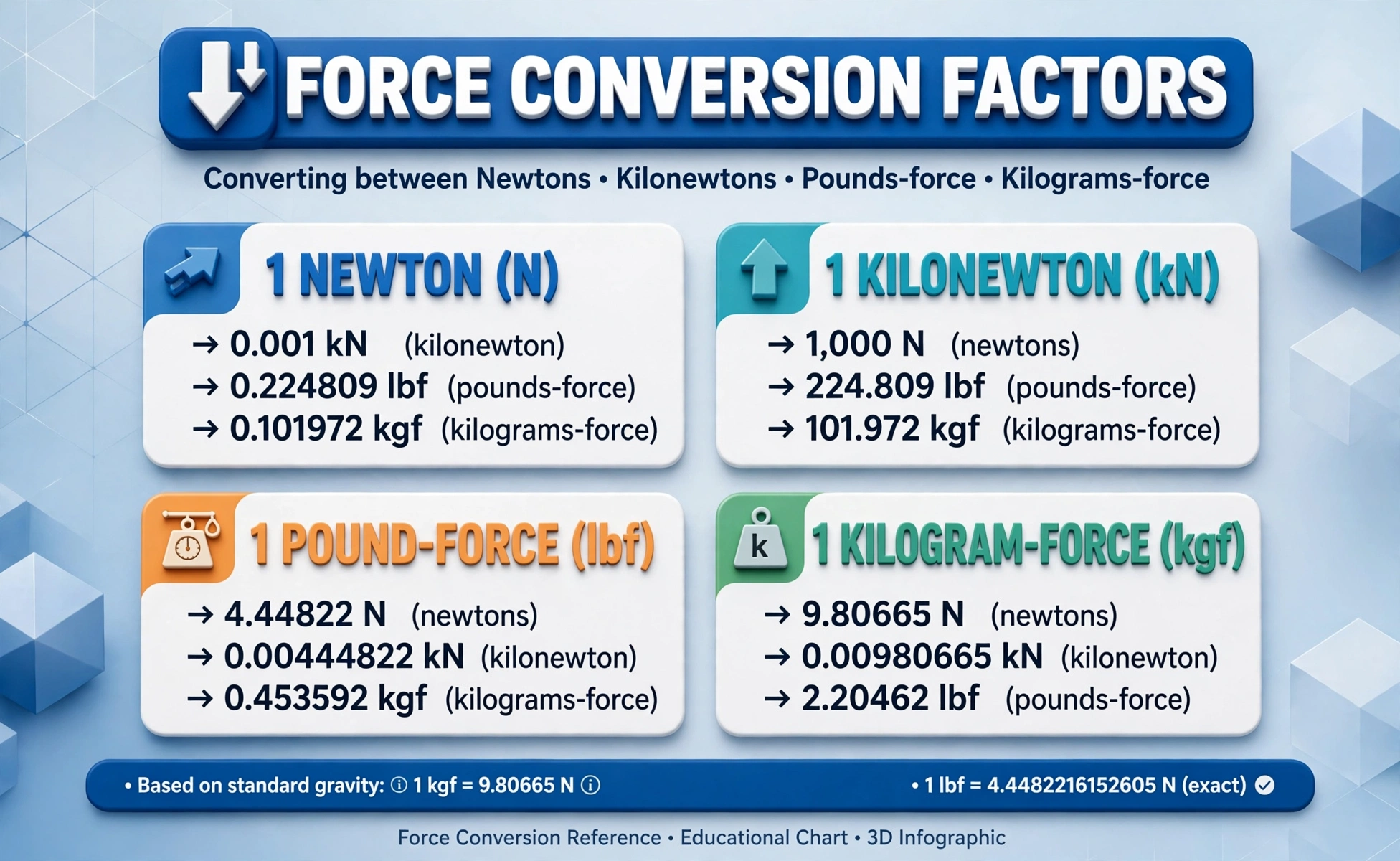
The newton is the base unit, and every other force unit converts through it. One kilonewton is 1,000 newtons. One pound-force is 4.44822 newtons, the weight of one pound of mass under standard gravity. One kilogram-force is 9.80665 newtons, the weight of one kilogram under standard gravity. One dyne is a tiny metric unit, 0.00001 newtons, and one ounce-force is 0.27801 newtons.
To convert, first convert to newtons, then divide by the target unit's factor. For example, 100 newtons divided by 4.44822 gives 22.48 pounds-force. For a related mass change, a weight converter converts kilograms and pounds as mass, not force, which is a different quantity.
| Unit | Symbol | Newtons per unit |
|---|---|---|
| Newton | N | 1 |
| Kilonewton | kN | 1,000 |
| Pound-force | lbf | 4.44822 |
| Kilogram-force | kgf | 9.80665 |
| Dyne | dyn | 0.00001 |
| Ounce-force | ozf | 0.27801 |
Worked Examples
Example 1: 100 newtons is 22.48 pounds-force, because 100 divided by 4.44822 is 22.48. Example 2: 1 kilogram-force is 9.80665 newtons by definition, and 10 kilograms-force is 98.07 newtons. Example 3: 1,000 newtons is 1 kilonewton, and 500 pounds-force is 2,224.11 newtons, because 500 times 4.44822 is 2,224.11.
Example 4: 1,000,000 dynes is 10 newtons, because a dyne is 0.00001 newtons. Dynes appear in older physics texts and in centimeter-gram-second calculations, where small forces are common. Converting through newtons keeps every pair consistent, so no separate factor table is needed.
| From | To | Result |
|---|---|---|
| 100 N | Pounds-force | 22.48 lbf |
| 1 kgf | Newtons | 9.80665 N |
| 500 lbf | Newtons | 2,224.11 N |
| 1,000,000 dyn | Newtons | 10 N |
Weight, Mass, and Force
Mass is measured in kilograms and does not change with location. Weight is a force, measured in newtons, and it changes with gravity: the same mass weighs less on the Moon, where gravity is about one sixth of Earth's. Kilograms-force and pounds-force blur this distinction by naming a force after the mass that produces it under Earth gravity.
That is why a scale that reads in kilograms is really measuring a force and converting it. In everyday use the distinction rarely matters, but in physics, engineering, and space work it matters a lot: a rocket's thrust is a force in newtons, not a mass, and a bridge load is a force, not a weight in kilograms.
Common Mistakes
The most common mistake is treating kilograms as a force unit. Kilograms measure mass; kilograms-force measures force, and the two differ by the factor 9.80665. A second mistake is using pounds for both mass and force: pounds-force is the force unit, while pounds as mass needs the same gravity conversion.
A third mistake is rounding the pound-force factor to 4.45 and then reporting many decimal places, which pretends to more precision than the factor supports. A fourth is converting force like length, with a simple scale factor that ignores gravity: force conversions always go through the standard gravity value, 9.80665, for the mass-based units.
Practical Uses
Engineers specify bolt tension, engine thrust, and structural loads in newtons or kilonewtons. A car engine might produce a few hundred newtons of tractive force, while a bridge cable carries millions of newtons, which is why kilonewtons and meganewtons appear in structural work. Laboratory instruments often read in dynes or millinewtons for delicate forces.
In sports and fitness, force appears in jump and sprint analysis, where ground reaction forces can exceed body weight several times over. Converting those figures between newtons and pounds-force lets coaches compare data from metric and imperial equipment without error.
Frequently asked questions
How many pounds-force is 100 newtons?
22.48 pounds-force. Divide newtons by 4.44822, the newtons per pound-force.
What is a kilogram-force?
The force exerted by one kilogram of mass under standard Earth gravity: 9.80665 newtons.
Is a newton a mass or a force?
A force. One newton accelerates one kilogram by one meter per second squared.
How many newtons are in a kilonewton?
1,000 newtons. Kilo means one thousand in the metric system.
What is a dyne?
A small metric force unit equal to 0.00001 newtons, used in centimeter-gram-second physics.
Why do pounds-force and pounds differ?
Pounds measure mass, while pounds-force measures the force that mass exerts under gravity. They differ by the gravity factor.
How do I convert force through newtons?
Multiply by the from-unit factor to get newtons, then divide by the to-unit factor. This converter does both steps for you.