Pressure Converter: psi, bar, kPa, atm and More
Convert any pressure value between psi, bar, kilopascals, atmospheres and more — with the full conversion table, exact factors and real-world examples.
How to use the pressure converter
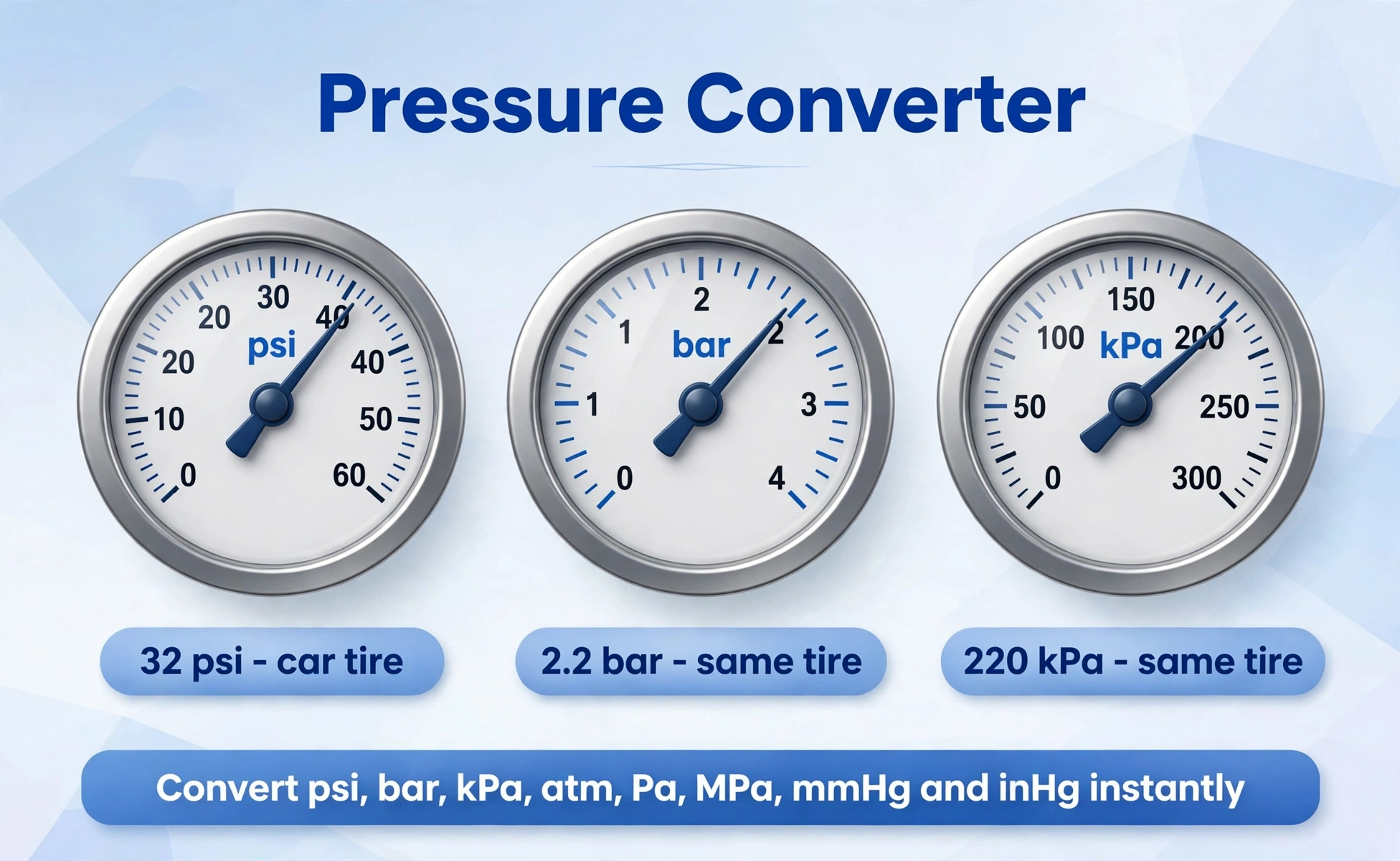
Pressure shows up in many units because different industries settled on their own standards: tire gauges read psi in the US and bar in Europe, weather reports use inHg or hectopascals, doctors measure blood pressure in mmHg, and scientists use pascals. This converter moves a value between any of the 8 units instantly.
Step by step
- Enter the value you want to convert, for example 35.
- Choose the unit it is in — the "from" unit, such as psi.
- Choose the unit you want — the "to" unit, such as kPa.
- Press Convert. The result appears with the calculation steps shown.
- Optional: use Swap units to flip the direction, or check the "all 8 units" table to see your value in every unit at once.
What you get
- The converted result with the multiplication and division steps
- Your value in all 8 units in one table — handy when a datasheet mixes units
- Exact factors relative to the pascal, the SI pressure unit
For example, a tire gauge reading of 32 psi becomes 220.632 kPa: the calculator multiplies 32 by 6,894.757293168 to get 220,632.23 Pa, then divides by 1,000 for kPa.
The pressure conversion formula
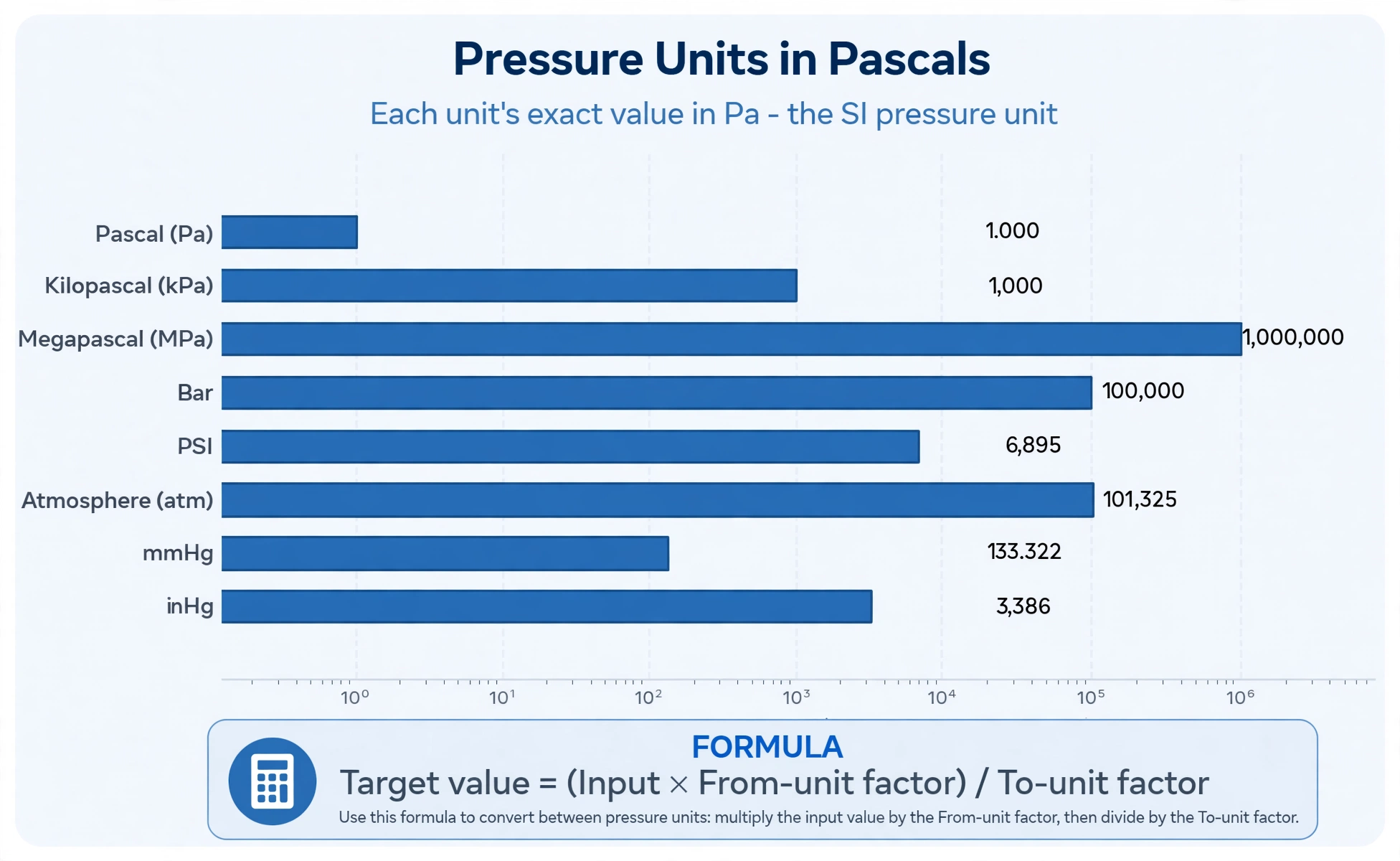
Every pressure conversion runs through the pascal. Each unit has an exact factor telling how many pascals one of it equals, so converting is a two-step multiply-then-divide:
Target value = (input value × from-unit factor) ÷ to-unit factor
The pascal is the SI derived unit of pressure — one newton of force spread over one square metre (see the NIST reference on SI units). The factors below are exact by definition, which is why this converter stays accurate no matter how many places you carry.
Conversion factors in pascals
| Unit | Symbol | Factor (Pa per unit) |
|---|---|---|
| Pascal | Pa | 1 |
| Kilopascal | kPa | 1,000 |
| Megapascal | MPa | 1,000,000 |
| Bar | bar | 100,000 |
| Pound per square inch | psi | 6,894.757293168 |
| Atmosphere | atm | 101,325 |
| Millimeter of mercury | mmHg | 133.322387415 |
| Inch of mercury | inHg | 3,386.389 |
Worked example: 35 psi to kPa
Say a road bike tire is inflated to 35 psi and the sidewall chart lists limits in kilopascals. Here is how the converter handles it:
- Look up the from-unit factor: 1 psi = 6,894.757293168 Pa.
- Multiply: 35 × 6,894.757293168 = 241,316.505 Pa.
- Look up the to-unit factor: 1 kPa = 1,000 Pa.
- Divide: 241,316.505 ÷ 1,000 = 241.316505 kPa.
So 35 psi equals 241.3165 kPa. The same two steps work for any pair — for instance, 35 psi is also 2.413165 bar (241,316.505 ÷ 100,000) or 0.344738 atm (241,316.505 ÷ 101,325).
Common pressure values, side by side
These everyday benchmarks show how the units relate. Scan for the one you recognize — the rest follow from the same factors.
| Common value | Equivalent in other units |
|---|---|
| 1 atm (standard atmosphere) | 101,325 Pa = 101.325 kPa = 1.01325 bar = 14.6959 psi = 760 mmHg = 29.9213 inHg |
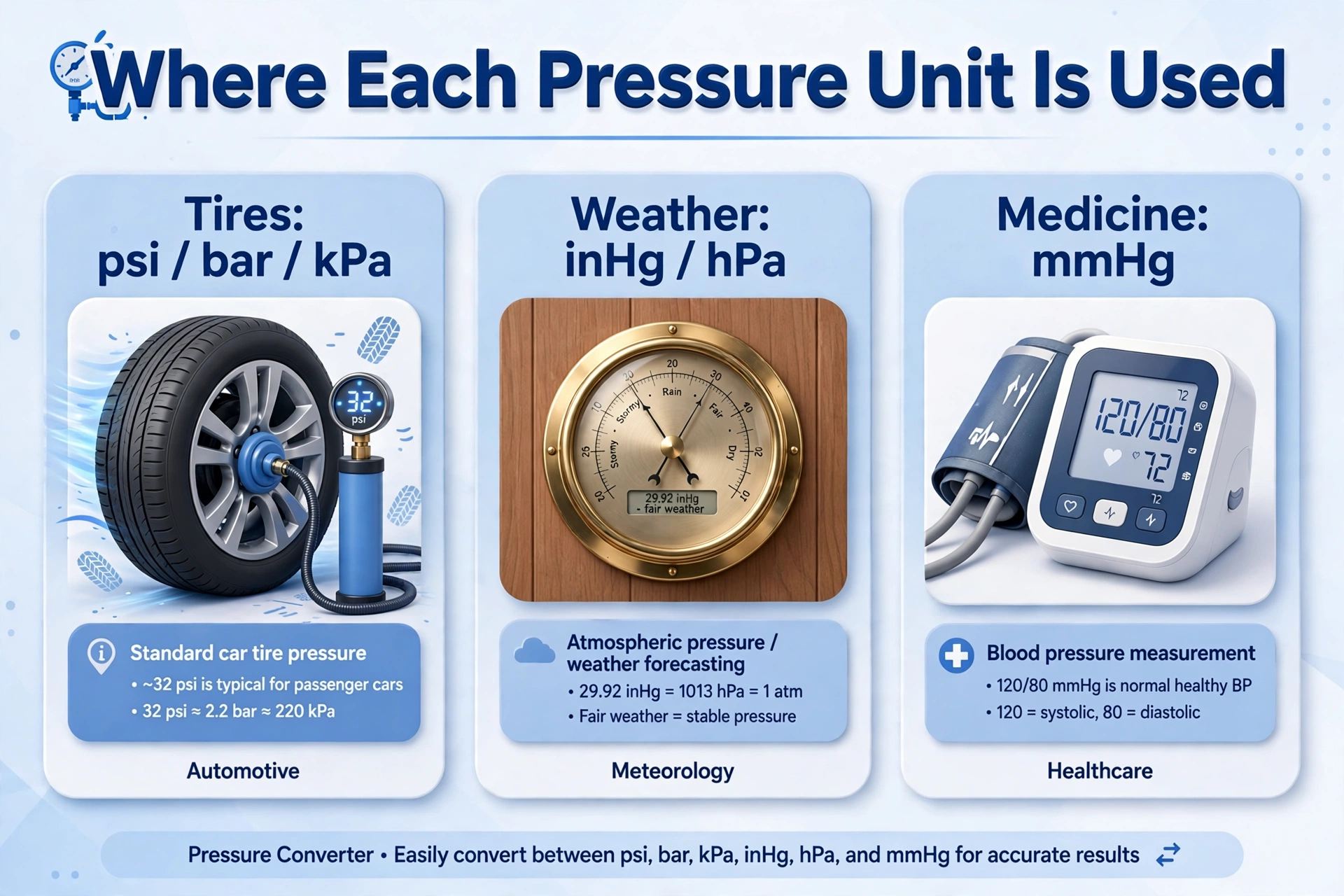
| 32 psi (typical car tire) | 220.632 kPa = 2.20632 bar = 2.17747 atm = 1,654.81 mmHg |
| 29.92 inHg (fair-weather reading) | 101.3208 kPa = 1.013208 bar = 14.6953 psi = 759.97 mmHg |
| 120 mmHg (healthy systolic blood pressure) | 15.9987 kPa = 0.157895 atm = 2.32041 psi |
| 3,000 psi (full scuba tank) | 20.6843 MPa = 206.843 bar = 204.138 atm |
| 9 bar (espresso extraction) | 900 kPa = 130.534 psi = 8.88231 atm |
Numbers in the table are rounded for readability; the converter itself carries the full factor precision.
When to use each pressure unit
No single unit rules everywhere. The right one depends on the trade, the country and the size of the pressure being measured.
| Unit | Where you will see it |
|---|---|
| Pascal (Pa) | Science and physics — the SI base, but tiny, so everyday values use its multiples. |
| Kilopascal (kPa) | Engineering, tire placards in Australia and much of Asia, gas pressures. |
| Megapascal (MPa) | Hydraulics, material strength and high-pressure industrial equipment. |
| Bar | European tire gauges, weather (millibar), scuba diving and compressors. |
| PSI (psi) | US tire pressure, pneumatic tools and plumbing — the everyday imperial unit. |
| Atmosphere (atm) | Chemistry gas laws and diving, where pressures are counted in multiples of sea-level air. |
| mmHg | Medicine — blood pressure readings like 120/80 — and vacuum measurements. |
| inHg | US weather reports and aviation altimeters, a legacy of mercury barometers. |
Meteorologists pair pressure with temperature when tracking weather systems — our temperature converter covers the degree scales they use alongside pressure charts.
Scuba divers think in pressure too: a tank is rated in bar or psi, while its gas capacity is given in liters. If you need to move between volume units for the capacity side of that math, our volume converter handles liters, gallons and cubic feet.
Frequently asked questions
What is the formula to convert pressure units?
Convert through the pascal: multiply the input by the from-unit factor in pascals, then divide by the to-unit factor in pascals. For example, 35 psi to kPa is (35 × 6,894.757293168) ÷ 1,000 = 241.316505 kPa.
How many psi is 1 bar?
One bar equals 14.5038 psi. Conversely, 1 psi equals 0.0689476 bar. A car tire at 32 psi is about 2.2063 bar.
How do I convert atm to kPa?
Multiply atmospheres by 101.325. One standard atmosphere is exactly 101,325 pascals, so 1 atm = 101.325 kPa and 2 atm = 202.65 kPa.
What is the difference between gauge pressure and absolute pressure?
Gauge pressure ignores the atmosphere around you; absolute pressure includes it. A tire gauge showing 32 psi (gauge) is actually about 46.7 psi absolute at sea level, since one atmosphere (14.7 psi) pushes on everything.
Is mmHg the same as torr?
Almost, but not exactly. The mmHg used in medicine is defined as 133.322387415 Pa, while the torr is 101,325/760 = 133.322368421 Pa. The difference is about one part in 7 million — irrelevant for blood pressure cuffs, but this converter uses the medical mmHg definition.
Why do weather reports use inHg or hPa instead of psi?
Atmospheric pressure changes are small relative to psi, so the numbers would be cramped — a whole storm fits in a few psi. Mercury-barometer heritage gave inHg in the US, while metric countries report the same range as hectopascals (29.92 inHg = 1,013.25 hPa).
How accurate are these pressure conversions?
The conversion factors are exact by definition relative to the pascal, not measured approximations. Any rounding you see is display-only; the converter carries full factor precision and shows up to 6 decimal places.
Related calculators

Length Converter
Convert between millimeters, centimeters, meters, kilometers, inches, feet, yards and miles.
Use calculatorWeight Converter
Convert weight between kg, grams, pounds, ounces, stone and tons.
Use calculatorTemperature Converter
Convert between Celsius, Fahrenheit, Kelvin and four more temperature scales.
Use calculatorSpeed Converter
Convert mph, km/h, knots and more - plus a speed, distance and time solver.
Use calculatorCooking Converter
Convert cups, tablespoons and grams with ingredient-specific densities for accurate cooking and baking.
Use calculatorVolume Converter
Convert liters, gallons, cups, milliliters and more with a full conversion table.
Use calculator