Speed Converter: mph, km/h, m/s, Knots & More
Speed is distance divided by time, but almost every country and industry reports it in different units. Enter a value, pick the unit you have and the unit you want, and this speed converter returns the converted value with the exact factor it used. Switch to the solver tab to find speed, distance or time when you know the other two.
Conversion factors are standard definitions. Calculator logic tested with verified worked examples. Last reviewed: October 2026. Our methodology
The conversion formulas
Every conversion runs through metres per second (m/s), the SI unit of speed. Each unit has one exact factor to m/s, so converting is a two-step multiplication: divide by the "from" factor to reach m/s, then multiply by the "to" factor to leave m/s.
- Unit conversion: vto = vfrom × (factorfrom ÷ factorto), where each factor is the unit's value in m/s
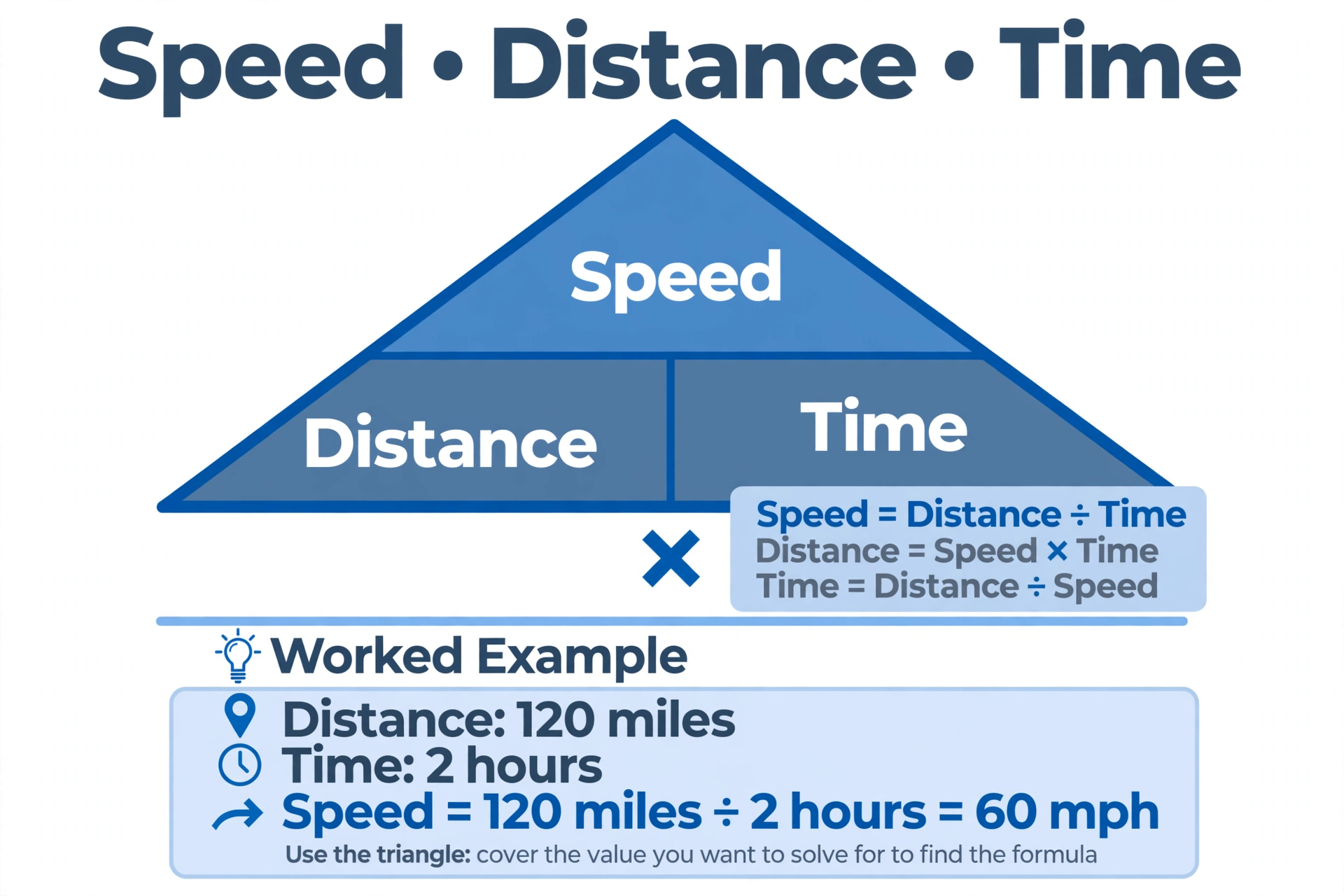
- Speed from distance and time: speed = distance ÷ time
- Distance from speed and time: distance = speed × time
- Time from distance and speed: time = distance ÷ speed
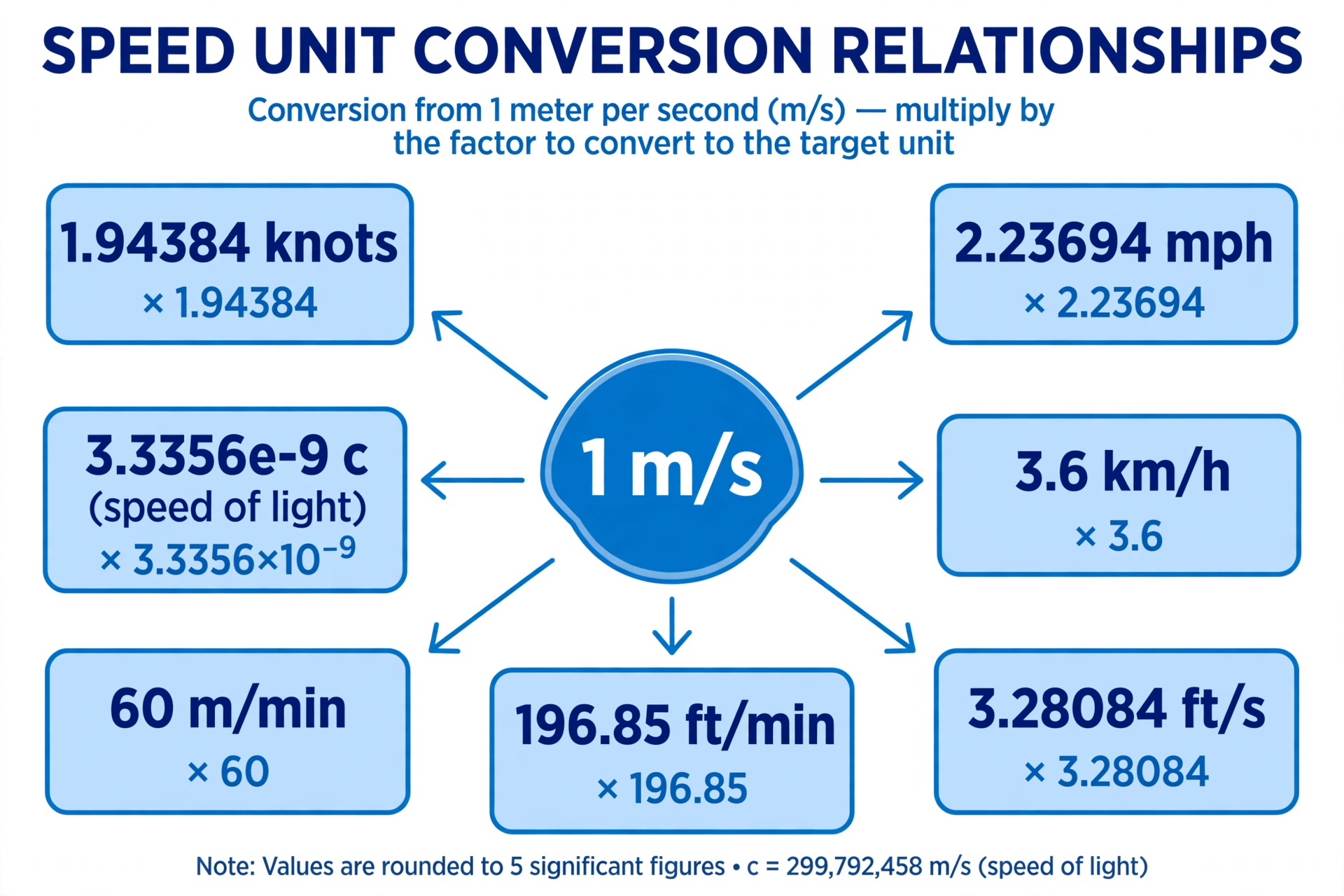
Conversion factors to m/s
| Unit | Symbol | 1 unit in m/s |
|---|---|---|
| Miles per hour | mph | 0.44704 |
| Kilometres per hour | km/h | 0.2777778 |
| Metres per second | m/s | 1 |
| Knots | kn | 0.5144444 |
| Feet per second | ft/s | 0.3048 |
| Feet per minute | ft/min | 0.00508 |
| Metres per minute | m/min | 0.0166667 |
| Speed of light | c | 299,792,458 |
Sources: NIST Special Publication 811 (SI units); the international yard and pound agreement of 1959 (1 inch = 2.54 cm, hence 1 mph = 0.44704 m/s exactly); the nautical mile fixed at 1,852 m (1 knot = 1 nautical mile per hour); the metre defined via the speed of light, fixed at 299,792,458 m/s.
Worked example
Convert 60 mph to km/h. First turn 60 mph into m/s: 60 × 0.44704 = 26.8224 m/s. Then turn m/s into km/h by dividing by 0.2777778 (or multiplying by 3.6): 26.8224 ÷ 0.2777778 = 96.5606 km/h. The factor used was 1 mph = 1.609344 km/h, so you could also have gone straight: 60 × 1.609344 = 96.5606.
Where each unit is used
Different industries settled on different units long before anyone could standardise them, and the habits stuck. Miles per hour rules the roads of the USA and the UK, while kilometres per hour covers almost everywhere else. Physics and engineering use metres per second, the SI unit, because it drops straight into equations for energy and momentum.
Knots belong to ships and aircraft: one knot is one nautical mile per hour, and a nautical mile equals one minute of latitude, which makes knots tie distance and position together on a chart. Feet per second and feet per minute show up in American engineering — muzzle velocities, elevator speeds and air-flow rates — while the speed of light, c, is the natural unit for astronomy and physics, where everything else would need absurdly large numbers.
The solver tab mixes units freely: you can enter distance in miles and time in hours to get mph, or kilometres and minutes to get km/h. If your distances need converting first, a length converter handles miles, kilometres, metres and feet in one step.
Converting speed step by step
Hand conversion is a single multiplication once you know the direct factor between two units. The calculator shows the factor it used under every answer, so you can check its arithmetic with a pocket calculator.
Quick conversion recipes
| Conversion | Multiply by | Example |
|---|---|---|
| mph → km/h | 1.609344 | 60 mph = 96.5606 km/h |
| km/h → m/s | 0.2777778 (÷ 3.6) | 100 km/h = 27.7778 m/s |
| m/s → knots | 1.9438445 | 10 m/s = 19.4384 kn |
| mph → ft/s | 1.4666667 | 30 mph = 44 ft/s |
| c → km/h | 1,079,252,848.8 | 1 c ≈ 1.08 billion km/h |
Runners usually think in minutes per kilometre or mile rather than speed at all — if that is your frame of reference, a pace calculator translates between pace and speed directly.
Why the factor is exact, not approximate
Most factors are exact by definition, not rounded measurements. The mile is defined as 5,280 feet and the foot as exactly 0.3048 m, so 1 mph is exactly 0.44704 m/s. The nautical mile is exactly 1,852 m, so 1 knot is exactly 0.514444... m/s. Rounded factors are still fine for everyday use — five significant figures is plenty for speed limits — but the calculator keeps full precision internally.
The speed–distance–time triangle
Speed, distance and time are locked together by three versions of one equation. The classic triangle puts speed on top with distance and time underneath: cover the quantity you want to solve for and the triangle reads out the formula.
Flip to the solver tab and the calculator does all three: give it distance and time for speed, speed and time for distance, or distance and speed for time — with unit dropdowns on every input and step-by-step working in the answer. When the "time" in your problem is a duration you need to add or subtract, a time duration calculator works out the hours, minutes and seconds first.
When each version helps
- Speed = distance ÷ time — the road trip: 120 miles in 2 hours means 60 mph.
- Distance = speed × time — the range question: 60 mph for 2.5 hours covers 150 miles.
- Time = distance ÷ speed — the ETA: 300 km at 100 km/h takes 3 hours.
Speed benchmarks
Raw numbers are hard to feel, so here is a ladder of familiar speeds in consistent units. Anything between a brisk walk and a highway cruise converts cleanly on the calculator above.
| Example | km/h | m/s |
|---|---|---|
| Brisk walk | 6 | 1.67 |
| City cycling | 20 | 5.56 |
| Marathon world-record pace | ~21 | ~5.83 |
| Motorway cruising | 120 | 33.33 |
| High-speed train | 320 | 88.89 |
| Cruising airliner | ~900 | ~250 |
| Speed of sound (at 20°C) | ~1,235 | ~343 |
| Speed of light | 1,079,252,848.8 | 299,792,458 |
The speed of sound depends on air temperature — about 343 m/s at 20°C — which is why the "sound barrier" is a band of speeds, not a fixed number. For the full authoritative reference on SI units and conversion factors, see NIST Special Publication 811.
Frequently asked questions
How do you convert mph to km/h?
Multiply mph by 1.609344 to get km/h. The factor is exact: 1 mile is 5,280 feet and 1 foot is 0.3048 metres, so 1 mph equals exactly 1.609344 km/h. For example, 60 mph × 1.609344 = 96.5606 km/h.
How do you convert km/h to m/s?
Divide km/h by 3.6 to get m/s. One kilometre per hour means 1,000 metres every 3,600 seconds, so 100 km/h = 27.7778 m/s.
How many knots is 10 m/s?
10 m/s is 19.4384 knots. One knot is one nautical mile (1,852 m) per hour, which equals 0.5144444 m/s, so multiply m/s by 1.9438445 to get knots.
What is the speed–distance–time formula?
Speed = distance ÷ time, distance = speed × time, and time = distance ÷ speed. The solver tab on this page applies whichever version you need, with step-by-step working.
What is the speed of light in km/h?
The speed of light is 299,792,458 m/s, which is 1,079,252,848.8 km/h — just over one billion kilometres per hour.
Why is m/s the hub for every conversion?
Metres per second is the SI unit of speed, and every other unit on this page has an exact defined factor to it — 1 mph is 0.44704 m/s, 1 knot is 0.5144444 m/s. Converting through m/s keeps every result exact instead of chaining rounded factors.
Can I mix units in the solver?
Yes. Enter distance in miles and time in hours to get mph, or any other mix you like — kilometres with minutes, feet with seconds. The solver converts everything through metres and seconds internally, then presents the answer in the unit you chose.