Acceleration Converter: Every Unit, Instantly
Enter a value, pick the from and to units, and convert instantly. A full table shows your value in all 11 supported units at once.

Formulas verified against standard references. Calculator logic tested with verified worked examples. Last reviewed: October 2026. Our methodology
What Acceleration Units Measure
Acceleration is the rate of change of velocity: how quickly speed increases, decreases, or changes direction. Its SI unit is meters per second squared, m/s2, meaning velocity changes by that many meters per second every second. A car gaining 10 m/s of speed over 5 seconds accelerates at 2 m/s2.
Different fields prefer different units. Physics uses m/s2, US engineering uses ft/s2, pilots and drivers talk in g-force, automotive testers use km/h/s, and geophysicists measuring earthquakes use the gal. Converting between them is pure multiplication once you know each unit's value in m/s2.
The Units and Their Factors
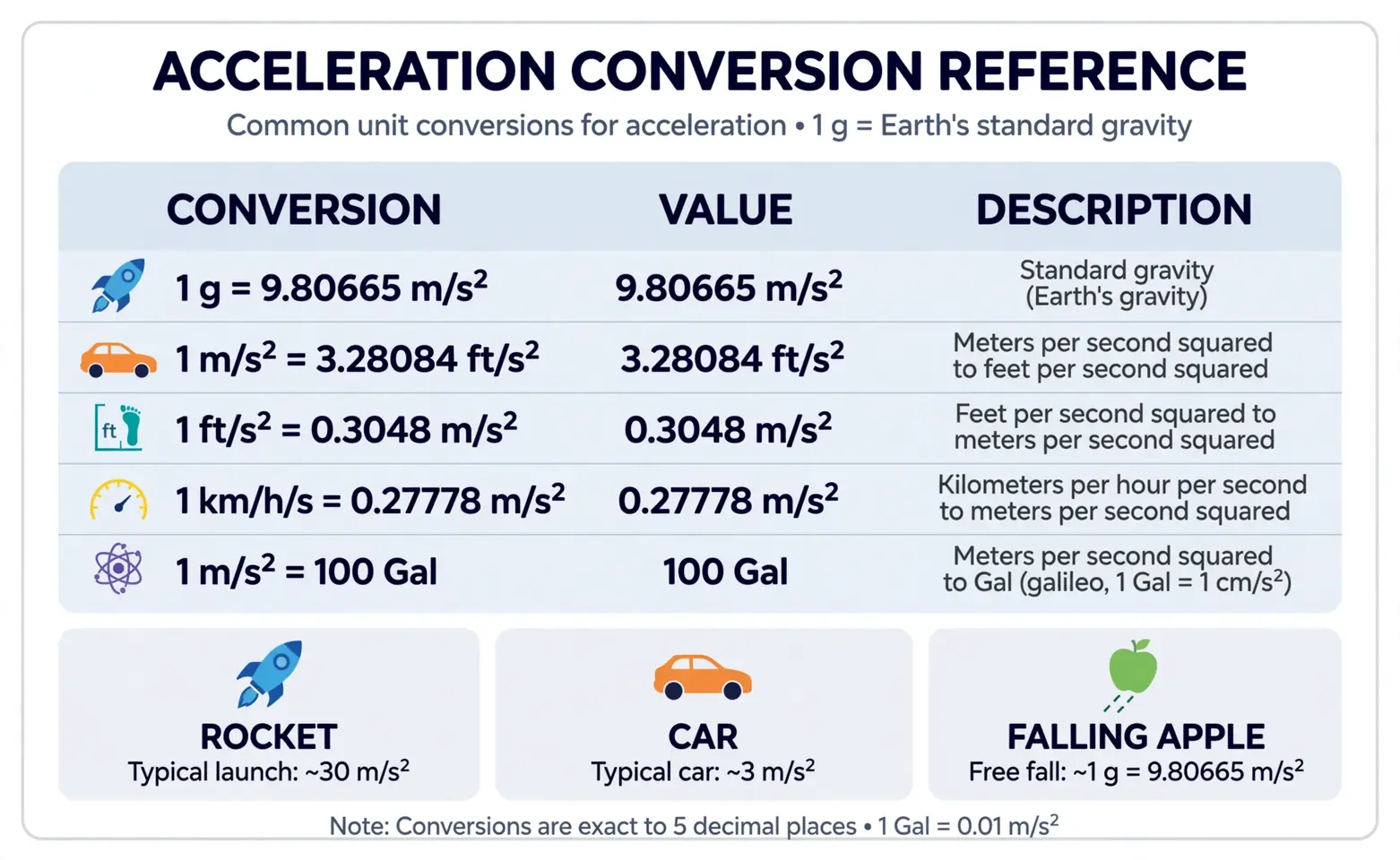
Every unit converts through m/s2 as the common base. Standard gravity g is defined as exactly 9.80665 m/s2. The foot-based units are exact by definition: 1 ft/s2 equals 0.3048 m/s2. The gal, named for Galileo, is 1 cm/s2, used in gravity and seismic work where the numbers are small.
Vehicle units mix distance and time scales: 1 km/h/s equals 0.27778 m/s2, and 1 mph/s equals 0.44704 m/s2. For context on the speed side of these measurements, the speed converter handles mph, km/h, and m/s conversions.
| Unit | Equals | Used in |
|---|---|---|
| m/s2 | 1 m/s2 (base SI) | Physics, engineering |
| g | 9.80665 m/s2 | Aviation, automotive |
| ft/s2 | 0.3048 m/s2 | US engineering |
| km/h/s | 0.27778 m/s2 | Vehicle testing |
| Gal | 0.01 m/s2 | Geophysics, seismology |
| in/s2 | 0.0254 m/s2 | Vibration analysis |
Worked Examples
Example 1: 1 g to m/s2. Multiply by 9.80665 to get 9.80665 m/s2, the familiar acceleration of gravity. Example 2: 10 m/s2 to g. Divide by 9.80665 to get 1.0197 g, about what a hard-braking car produces.
Example 3: 32.174 ft/s2 to m/s2. Multiply by 0.3048 to get 9.80665 m/s2, confirming that 1 g is 32.174 ft/s2. Example 4: 5 km/h/s to m/s2. Multiply by 0.27778 to get 1.3889 m/s2, a brisk but comfortable car acceleration.
| From | To | Result |
|---|---|---|
| 1 g | m/s2 | 9.80665 |
| 10 m/s2 | g | 1.0197 |
| 32.174 ft/s2 | m/s2 | 9.80665 |
| 5 km/h/s | m/s2 | 1.3889 |
G-Force in Plain Terms
One g is the acceleration you feel from Earth's gravity right now. A roller coaster pulling 3 g presses you into the seat with three times your weight. Fighter pilots train to handle 9 g, and a car crash can spike past 50 g for milliseconds, which is why crash testing reports deceleration in g.
Humans tolerate brief high g far better than sustained g, and direction matters: g pushing you back into the seat is easier to take than g pulling blood from your head. The converter turns any g figure into m/s2 or ft/s2 for engineering math, where the force converter continues into newtons and pounds-force.
Common Mistakes
The most common mistake is confusing acceleration with speed: 60 mph is a speed, while reaching it in 6 seconds is about 4.47 m/s2 of acceleration. The second is mixing up g as a unit with grams, also abbreviated g: 5 g of acceleration is not 5 grams of mass.
A third mistake is forgetting that deceleration is just negative acceleration; the magnitude converts the same way. A fourth is rounding g to 10 too early in multi-step calculations, which bakes in a 2 percent error from the start.
Where Conversions Matter
Aerospace engineers convert g to m/s2 for structural loads, automotive testers convert km/h/s figures from spec sheets into m/s2 for braking models, and seismologists read ground acceleration in gal before converting for structural codes. Elevator designers work in m/s2 to keep rides comfortable under about 1.5 m/s2 of change.
Even phone sensors report acceleration in m/s2 or g depending on the app, so converting matters when comparing a fitness tracker's impact numbers against published safety thresholds. Keep the factor table from your result handy: most real conversions are one multiplication away.

Frequently asked questions
How many m/s2 is 1 g?
Exactly 9.80665 m/s2. That is the standard acceleration of gravity adopted internationally, and the converter uses the exact figure.
How do I convert ft/s2 to m/s2?
Multiply by 0.3048. For example, 10 ft/s2 x 0.3048 = 3.048 m/s2.
What is a gal in acceleration?
1 gal (galileo) equals 1 cm/s2, or 0.01 m/s2. It is used in geophysics and seismology where accelerations are small.
What is the difference between speed and acceleration?
Speed is how fast something moves; acceleration is how quickly that speed changes. Reaching 60 mph in 6 seconds is about 4.47 m/s2 of acceleration.
How many g can a human handle?
Brief exposures of several g are tolerable, trained fighter pilots handle up to about 9 g, and sustained comfort limits are around 1 to 2 g. Direction and duration matter greatly.
Is deceleration negative acceleration?
Yes. Braking is acceleration in the opposite direction of motion, so it carries a negative sign in equations but converts with the same factors.
Why does the converter show all units?
Seeing every unit at once catches unit mistakes and saves repeated conversions when a spec sheet mixes g, ft/s2, and m/s2.