Energy Converter: Joules, Calories, kWh and BTU
Enter an energy value, choose its unit, and get the value in joules, kilojoules, calories, kilocalories, watt-hours, kilowatt-hours, BTU, and foot-pounds.
Formulas verified against standard references. Calculator logic tested with verified worked examples. Last reviewed: October 2026. Our methodology
One Quantity, Many Units
Energy is measured in different units because different fields adopted different standards before the metric system unified them. Physics uses joules, nutrition uses kilocalories, electricity billing uses kilowatt-hours, and heating uses BTU. They all measure the same physical quantity, so any value in one unit has an exact equivalent in every other.
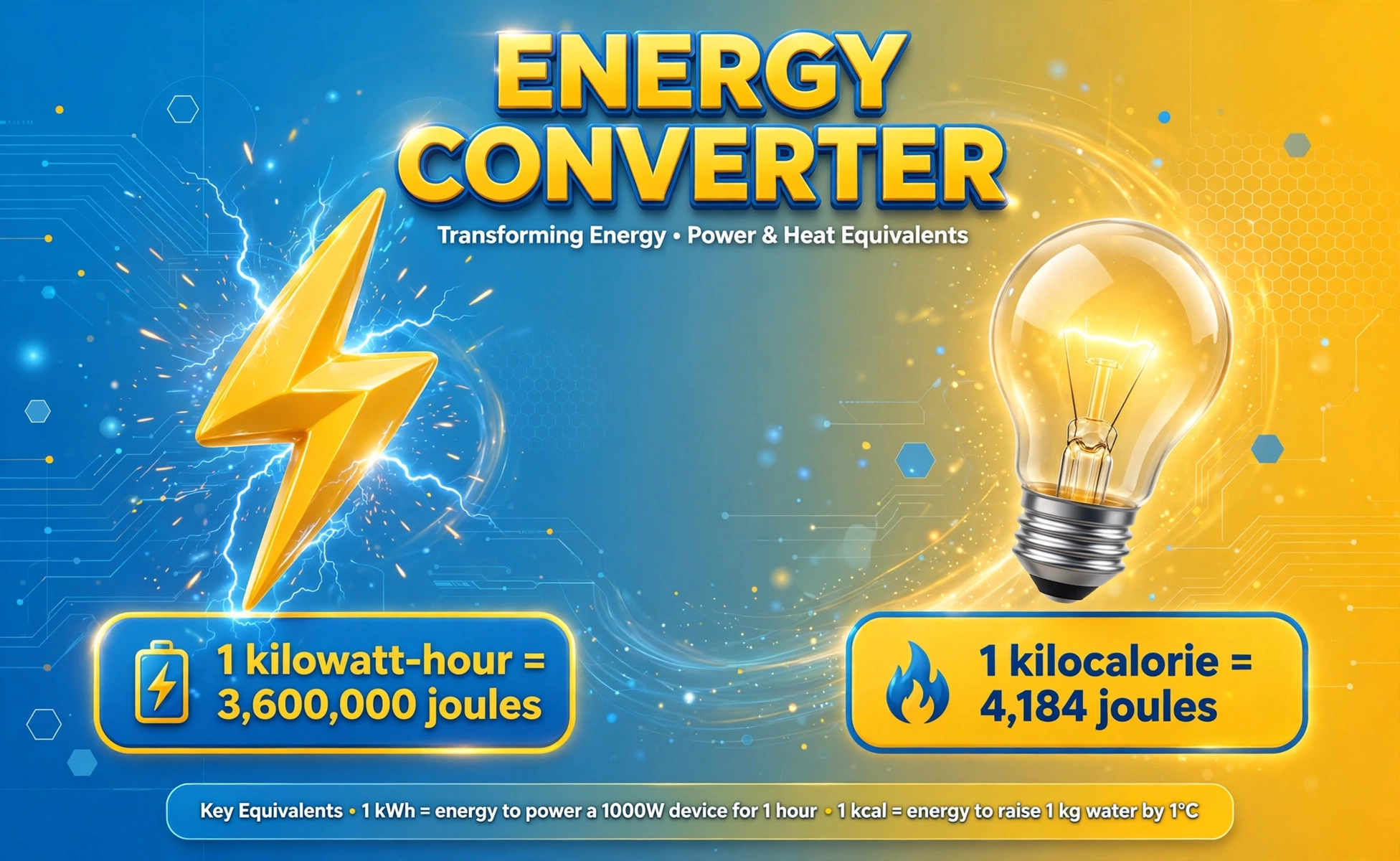
The joule is the SI unit: one joule is the work of a one-newton force moving one metre. A kilowatt-hour is the energy of one kilowatt running for one hour, which is 3,600,000 joules. A food calorie, properly a kilocalorie, is 4184 joules. A BTU is about 1055 joules, the heat needed to warm one pound of water by one degree Fahrenheit.
For power, which is energy per unit time, a power converter converts watts, kilowatts, and horsepower.
The Conversion Factors
Every conversion in this calculator goes through joules. Multiply the input by its factor to get joules, then divide by the target unit factor. That two-step route avoids rounding drift from chaining conversions, and it makes the factors easy to audit: each factor below is the number of joules in one unit.
Watch the calorie trap: a small calorie is 4.184 joules, while a food Calorie with a capital C is a kilocalorie, 4184 joules, a thousand times larger. Nutrition labels use kilocalories even when they print Calorie, so a 200 Calorie snack holds 200 kilocalories, which is 836,800 joules.
| Unit | Joules in one unit | Used for |
|---|---|---|
| Joule (J) | 1 | Physics, SI work |
| Kilojoule (kJ) | 1000 | Food energy in metric labels |
| Calorie (cal) | 4.184 | Chemistry, heat |
| Kilocalorie (kcal) | 4184 | Nutrition, food labels |
| Watt-hour (Wh) | 3600 | Small electrical energy |
| Kilowatt-hour (kWh) | 3600000 | Electricity billing |
| BTU | 1055.06 | Heating and cooling |
| Foot-pound (ft-lb) | 1.3558 | Mechanical work |
Worked Examples
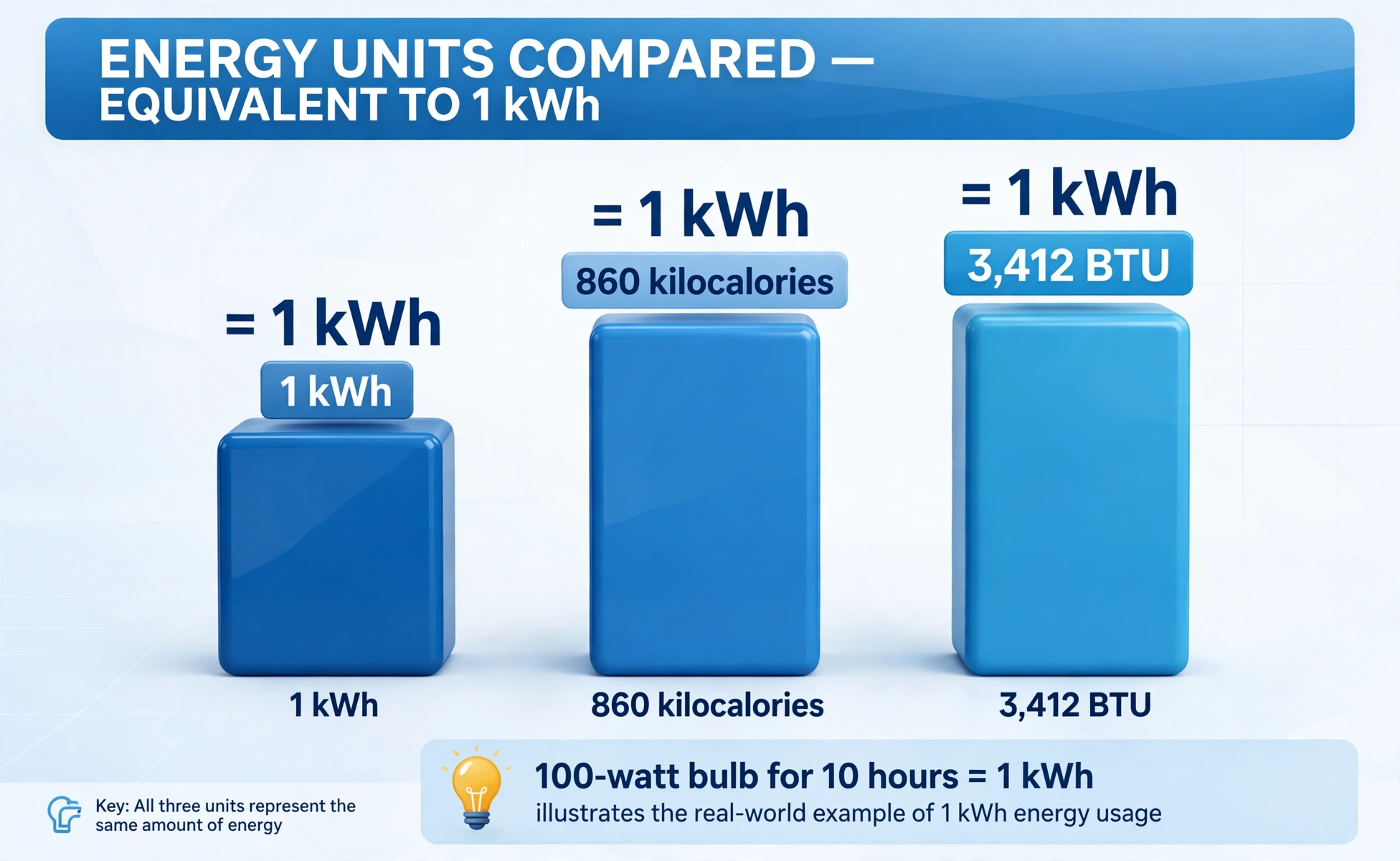
Example 1: convert 1 kilowatt-hour. In joules that is 3,600,000, in BTU about 3412.14, and in kilocalories about 860.42. Example 2: convert 2000 kilocalories, a typical daily diet. In kilojoules that is 8368, and in kilowatt-hours about 2.324, which is the energy a 100-watt bulb uses in about 23 hours.
Example 3: convert 100 BTU to joules. Multiply 100 by 1055.06 to get 105,506 joules, or about 105.5 kilojoules. Example 4: convert 500 joules to calories. Divide 500 by 4.184 to get about 119.5 small calories, or about 0.12 kilocalories.
| Input | Joules | Kilocalories | Kilowatt-hours | BTU |
|---|---|---|---|---|
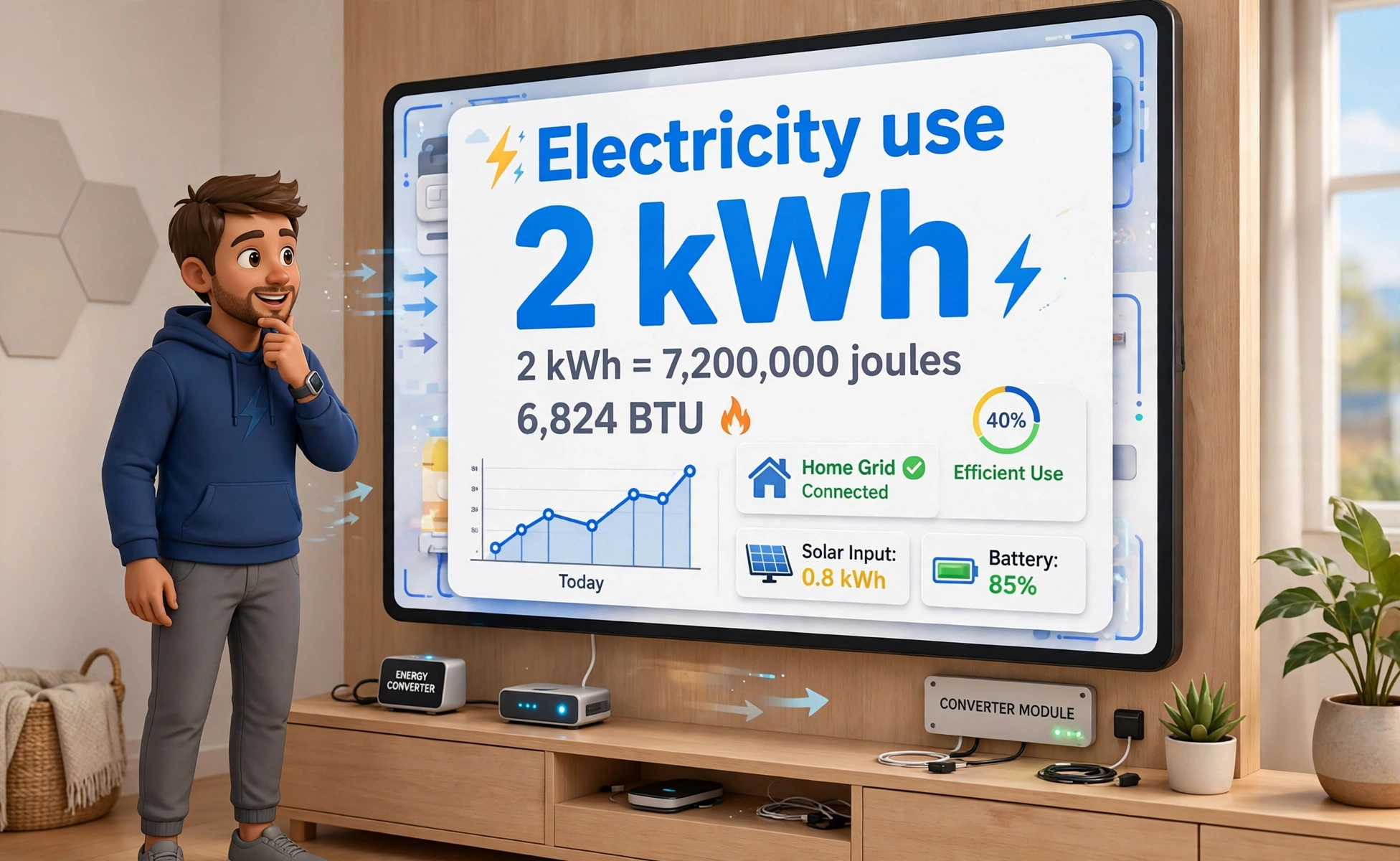
| 1 kWh | 3,600,000 | 860.42 | 1 | 3412.14 |
| 2000 kcal | 8,368,000 | 2000 | 2.324 | 7932 |
| 100 BTU | 105,506 | 25.22 | 0.0293 | 100 |
Energy in Daily Life
A 100-watt bulb running for 10 hours uses 1 kilowatt-hour. A phone battery holds roughly 0.01 to 0.02 kilowatt-hours. A litre of petrol holds about 9 kilowatt-hours of chemical energy, though an engine turns only part of it into motion. A typical home uses tens of kilowatt-hours per day, and the bill multiplies that total by the price per kilowatt-hour.
On the nutrition side, a gram of carbohydrate or protein holds about 4 kilocalories, a gram of fat about 9, and a gram of alcohol about 7. Those are the Atwater factors behind food labels, and they explain why fat-heavy foods carry more energy per gram than other foods.
| Item | Energy | In kilowatt-hours |
|---|---|---|
| 100 W bulb, 10 hours | 1 kWh | 1 |
| Phone charge | About 0.015 kWh | 0.015 |
| Daily diet, 2000 kcal | 8368 kJ | 2.324 |
| Litre of petrol | About 34 MJ | About 9 |
Common Mistakes
The most expensive mistake is confusing watts and watt-hours: a watt is a rate, while a watt-hour is an amount. A 100-watt bulb uses 100 watts at every moment, and after 10 hours it has used 1000 watt-hours, which is 1 kilowatt-hour. Multiplying power by time gives energy, and dividing energy by time gives power.
The second mistake is the calorie versus kilocalorie confusion above, a factor of 1000. The third is treating BTU as a power unit: BTU measures energy, while BTU per hour measures power, which is the rating printed on heaters and air conditioners.
Choosing the Right Unit
Use joules and kilojoules for physics and for metric food labels. Use kilocalories for nutrition in countries that label food that way, and calories only for small chemistry quantities. Use watt-hours and kilowatt-hours for anything electrical, from batteries to bills. Use BTU for heating, cooling, and fuel ratings in imperial contexts, and foot-pounds for mechanical work such as torque-adjacent energy in older engineering texts.
For temperature conversions, which are often needed alongside energy work, a temperature converter covers Celsius, Fahrenheit, and Kelvin.
Frequently asked questions
How many joules are in a kilowatt-hour?
3,600,000 joules. A kilowatt is 1000 watts, and an hour is 3600 seconds, so 1000 times 3600 is 3,600,000.
What is the difference between a calorie and a kilocalorie?
A factor of 1000. A small calorie is 4.184 joules, while a kilocalorie, the Calorie on food labels, is 4184 joules.
How many BTU are in a kilowatt-hour?
About 3412.14 BTU. Divide 3,600,000 joules by 1055.06 joules per BTU.
What is a joule?
The SI unit of energy: the work done by a force of one newton moving one metre, equal to one watt-second.
How do I convert watts to kilowatt-hours?
Multiply watts by hours, then divide by 1000. A 100-watt bulb for 10 hours uses 1000 watt-hours, which is 1 kilowatt-hour.
Is BTU a unit of power?
No. BTU measures energy. BTU per hour measures power, and that is the unit printed on heaters and air conditioners.
How many kilocalories are in a kilowatt-hour?
About 860.42 kilocalories. Divide 3,600,000 joules by 4184 joules per kilocalorie.