Macro Calculator: Daily Protein, Carb & Fat Targets
Macronutrients — protein, carbohydrates and fat — supply almost all of your daily calories. This macro calculator estimates your calorie needs from your body stats and activity level, then converts them into gram targets for protein, carbs and fat based on your goal: lose, maintain or gain weight.
Formulas verified against standard nutrition and exercise references. Calculator logic tested with verified worked examples. Last reviewed: October 2026. Our methodology
The macro formulas
Every macro target starts from the same chain: estimate how many calories you burn (your total daily energy expenditure, or TDEE), adjust for your goal, then split those calories across the three macros.
- BMR (Mifflin-St Jeor): men: 10 × weight(kg) + 6.25 × height(cm) − 5 × age + 5; women: same, but − 161 instead of + 5
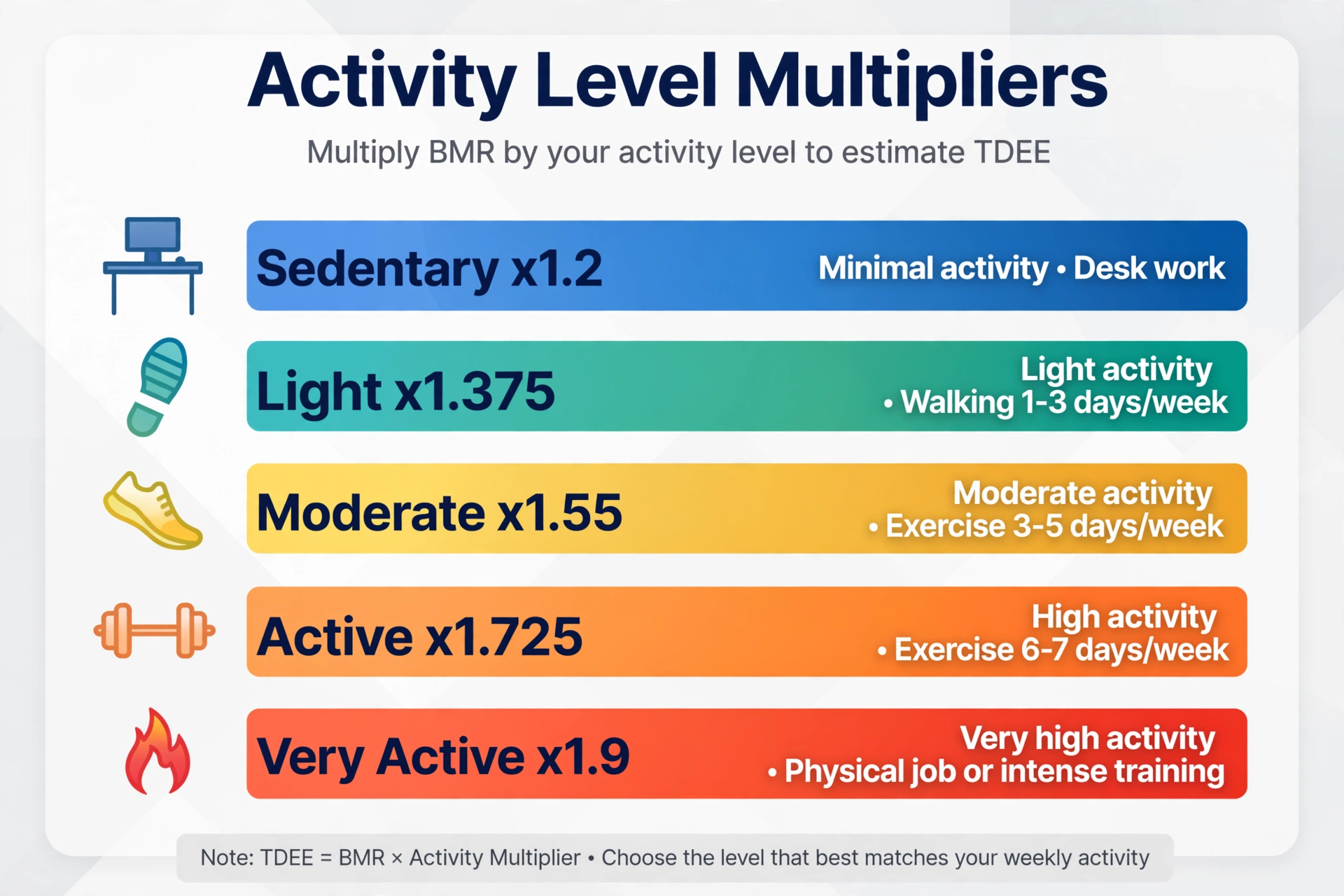
- TDEE: BMR × activity multiplier (1.2 for sedentary up to 1.9 for extra active)
- Target calories: TDEE − 500 to lose weight, TDEE to maintain, TDEE + 500 to gain
- Protein: 2.0 g × body weight in kg (640 kcal for an 80 kg person)
- Fat: 25% of target calories ÷ 9 kcal per gram
- Carbs: (target calories − protein kcal − fat kcal) ÷ 4 kcal per gram
Sources: Mifflin et al., American Journal of Clinical Nutrition (1990); CDC nutrition guidance at cdc.gov/nutrition.
Worked example
Take a 30-year-old man, 180 cm tall, 80 kg, moderately active, whose goal is to maintain weight.
- BMR = 10 × 80 + 6.25 × 180 − 5 × 30 + 5 = 1,780 kcal/day
- TDEE = 1,780 × 1.55 = 2,759 kcal/day
- Protein = 2.0 × 80 = 160 g (640 kcal)
- Fat = 0.25 × 2,759 ÷ 9 = 77 g (690 kcal)
- Carbs = (2,759 − 640 − 690) ÷ 4 = 357 g
So his daily targets are 160 g protein, 357 g carbs and 77 g fat — adding to 2,759 kcal.
How to use the macro calculator
Six inputs are all it takes. Use your current weight and height, and be honest about your activity level — most people overestimate it.
Step by step
- Enter your age, sex, height and weight. These feed the Mifflin-St Jeor equation, which estimates your basal metabolic rate — the calories you burn at rest.
- Choose your activity level. Sedentary means a desk job with no exercise; each step up multiplies your BMR to estimate total daily burn.
- Pick your goal. Losing weight subtracts 500 kcal/day (about 0.5 kg of fat loss per week); gaining adds 500; maintaining leaves your TDEE unchanged.
- Press Calculate. Read your target calories, then the gram targets for protein, carbs and fat, with the working shown underneath.
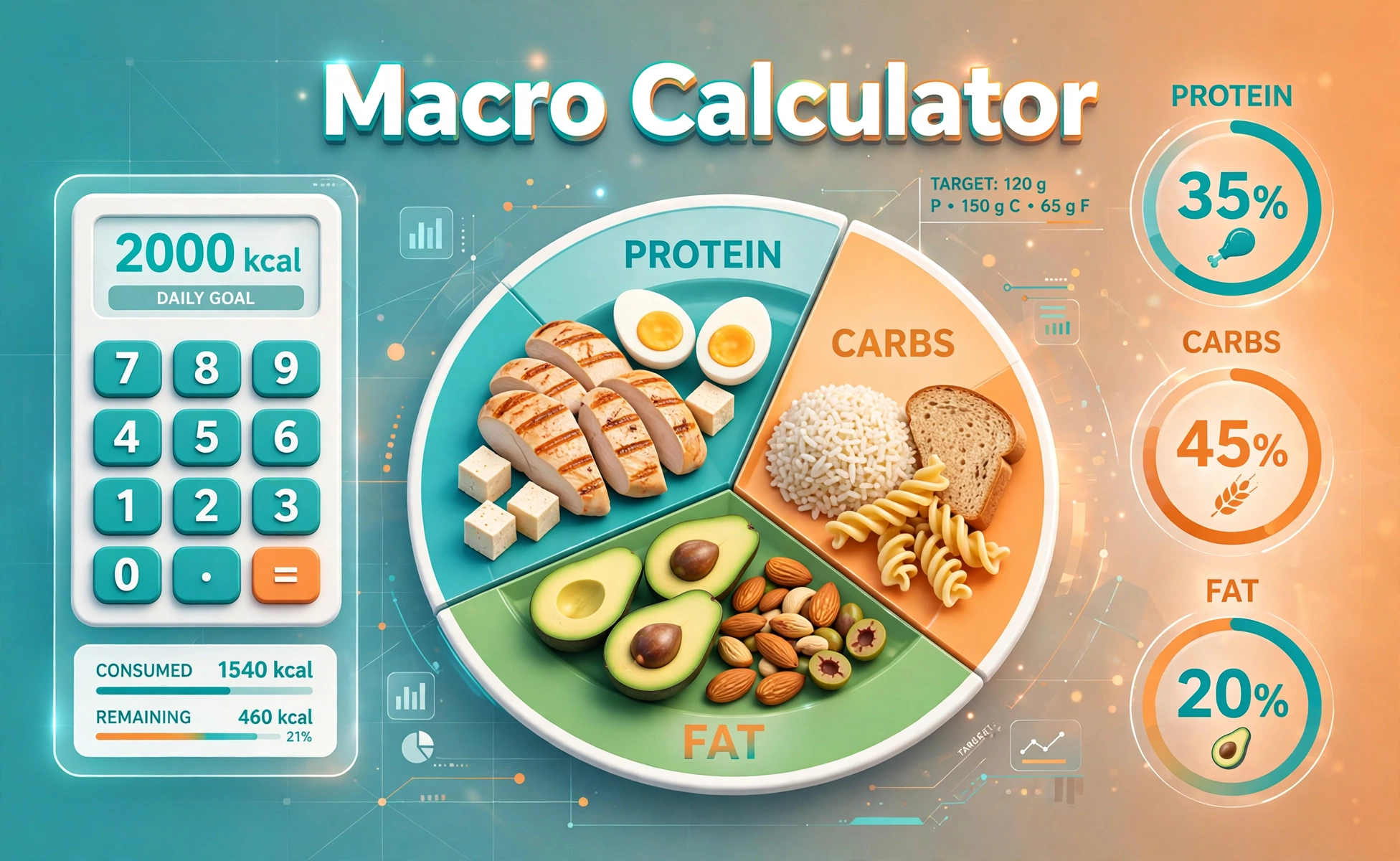
What protein, carbs and fat actually do
The three macros are not interchangeable: each has jobs the others cannot do, which is why a gram target beats a calories-only approach.
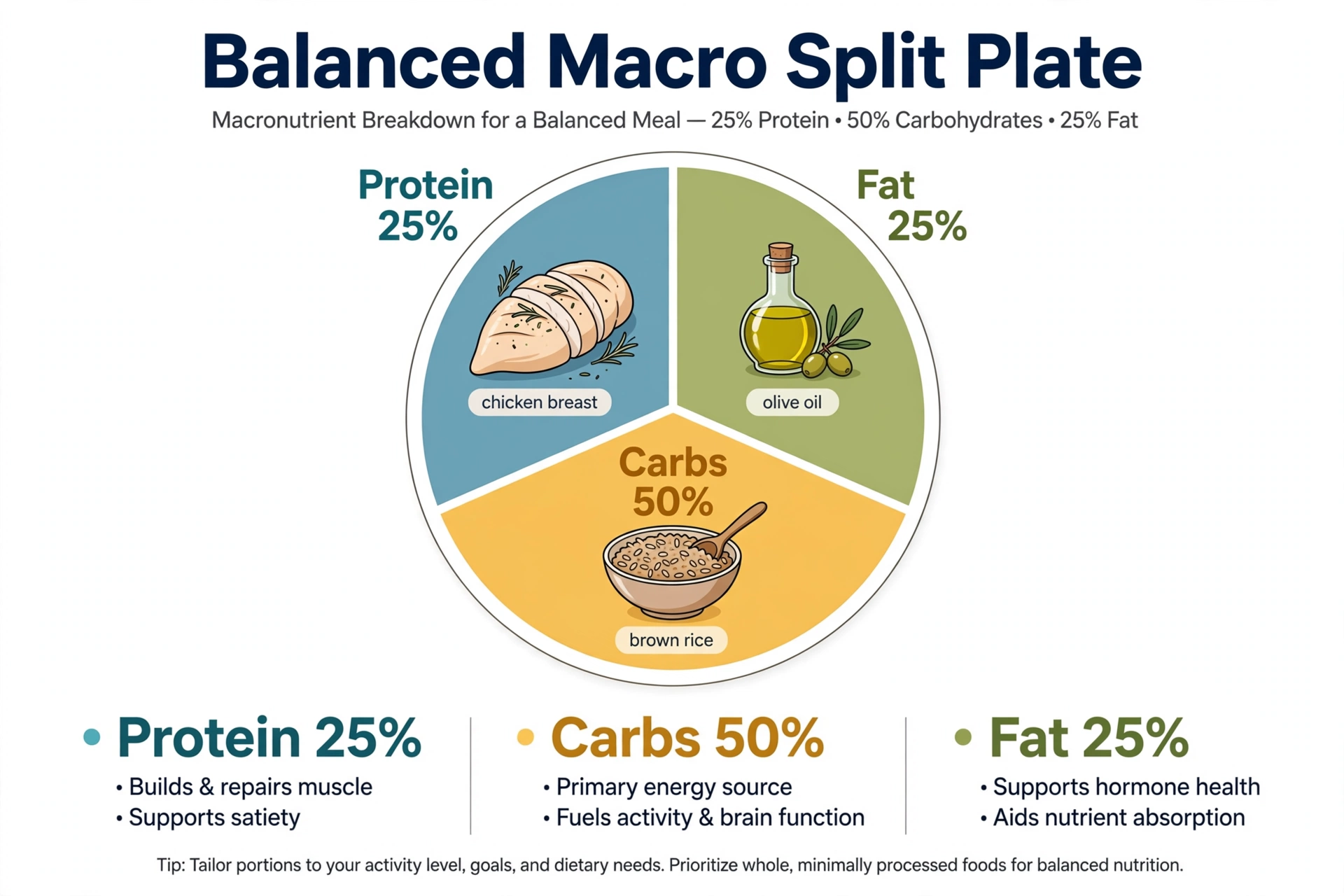
| Macro | Calories per gram | Main jobs | Good sources |
|---|---|---|---|
| Protein | 4 | Muscle repair and growth, enzymes, immune function | Eggs, chicken, fish, Greek yogurt, lentils |
| Carbohydrates | 4 | Brain fuel, workout energy, fiber for digestion | Oats, rice, potatoes, fruit, beans |
| Fat | 9 | Hormone production, vitamin absorption, satiety | Olive oil, nuts, avocado, fatty fish |
Protein deserves special attention when you train: it is the macro most directly tied to preserving muscle while dieting. If you want to fine-tune protein alone, a protein intake calculator breaks down daily protein needs by body weight and training intensity.
Activity level and weight goals
The activity multiplier is the biggest lever in the whole calculation — moving from sedentary to very active nearly doubles your calorie target for the same body.
| Activity level | Multiplier | What it means |
|---|---|---|
| Sedentary | 1.2 | Desk job, little or no exercise |
| Lightly active | 1.375 | Light exercise 1-3 days per week |
| Moderately active | 1.55 | Moderate exercise 3-5 days per week |
| Very active | 1.725 | Hard exercise 6-7 days per week |
| Extra active | 1.9 | Very hard exercise or a physical job |
Your goal then shifts the TDEE up or down. If you only need the calorie number without the macro split, a calorie calculator gives you daily energy needs from the same inputs. For deeper nutrition background, the CDC nutrition guidance covers healthy eating patterns that these targets fit into.
What macro targets cannot do
Macro targets are a planning tool, not a prescription. A few honest limitations:
- They are estimates. The Mifflin-St Jeor equation is typically within about 10 percent of measured metabolic rate — your true burn may differ.
- Protein needs vary. This calculator uses 2.0 g/kg, a solid middle of the 1.6-2.2 g/kg range for active people; sedentary adults need less, and athletes may need more.
- Muscle needs training, not just protein. A surplus plus high protein only builds muscle alongside progressive resistance exercise.
- Food quality still counts. 2,759 kcal of whole foods and 2,759 kcal of ultra-processed snacks affect hunger, health and adherence very differently.
- Not medical advice. Pregnancy, illness, medications and some conditions change calorie and protein needs — check with a clinician if any apply.
Frequently asked questions
What are macros?
Macros — short for macronutrients — are protein, carbohydrates and fat, the three nutrients that supply energy (calories). Almost everything you eat is made of them, plus water, fiber and micronutrients, which are not counted as macros.
How do you calculate macros?
Estimate your BMR with the Mifflin-St Jeor equation, multiply by your activity level to get TDEE, then adjust up or down 500 kcal for your goal. Protein gets 2.0 g per kg of body weight, fat gets 25 percent of calories, and carbs get whatever calories remain.
How much protein do I need per day?
Active people do well on 1.6-2.2 g of protein per kg of body weight per day — this calculator uses 2.0 g/kg. Sedentary adults can get by on the minimum of about 0.8 g/kg, while hard-training athletes sometimes go above 2.2 g/kg.
Should I count macros to lose weight?
Counting macros helps, but the calorie deficit does the fat loss: 500 kcal below maintenance typically means about 0.5 kg of fat loss per week. High protein is worth prioritizing while dieting because it helps preserve muscle and keeps you full.
Are carbs bad for weight loss?
No. Carbs provide 4 kcal per gram and fuel your brain and workouts. Fat loss comes from a sustained calorie deficit — low-carb diets work by cutting calories, not because carbs are uniquely fattening.
How accurate is the Mifflin-St Jeor equation?
It is the most validated predictive BMR equation available, usually landing within about 10 percent of lab-measured metabolic rate. Individual differences in muscle mass, hormones and genetics mean the true value can still differ — treat the targets as a starting point and adjust after 2-3 weeks of tracking.
Can I use this macro calculator for bulking?
Yes — choose the Gain weight goal, which adds 500 kcal per day for roughly 0.5 kg of weight gain per week. To make that gain mostly muscle, pair the surplus with progressive resistance training and keep protein at the top of the range.