Easter Date Calculator
The next Western Easter is Sunday, March 28, 2027, and the next Orthodox Easter is Sunday, May 2, 2027. Enter any year from 1583 to 9999 to get both Easter dates with weekdays, a live countdown, the full computus breakdown, and the movable feasts.
The rule. Easter is the first Sunday after the Paschal full moon, the ecclesiastical full moon on or after March 21. Western churches reckon it with the Gregorian computus; Orthodox churches reckon it with the Julian computus and read the result in Gregorian dates.

Formulas verified against standard references. Calculator logic tested with verified worked examples. Published: November 4, 2026 | Last updated: November 4, 2026. Our methodology
When Is Easter?
Easter 2026 has passed. It fell on Sunday, April 5 in the Western churches and Sunday, April 12 in the Orthodox churches. The dates to plan around now are in 2027. Western Easter comes first on Sunday, March 28, 2027, and Orthodox Easter follows five weeks later on Sunday, May 2, 2027.
The calculator above counts down the exact days remaining until each date for any year you enter. The full table of upcoming dates is in the next section.

Easter Dates 2025-2035
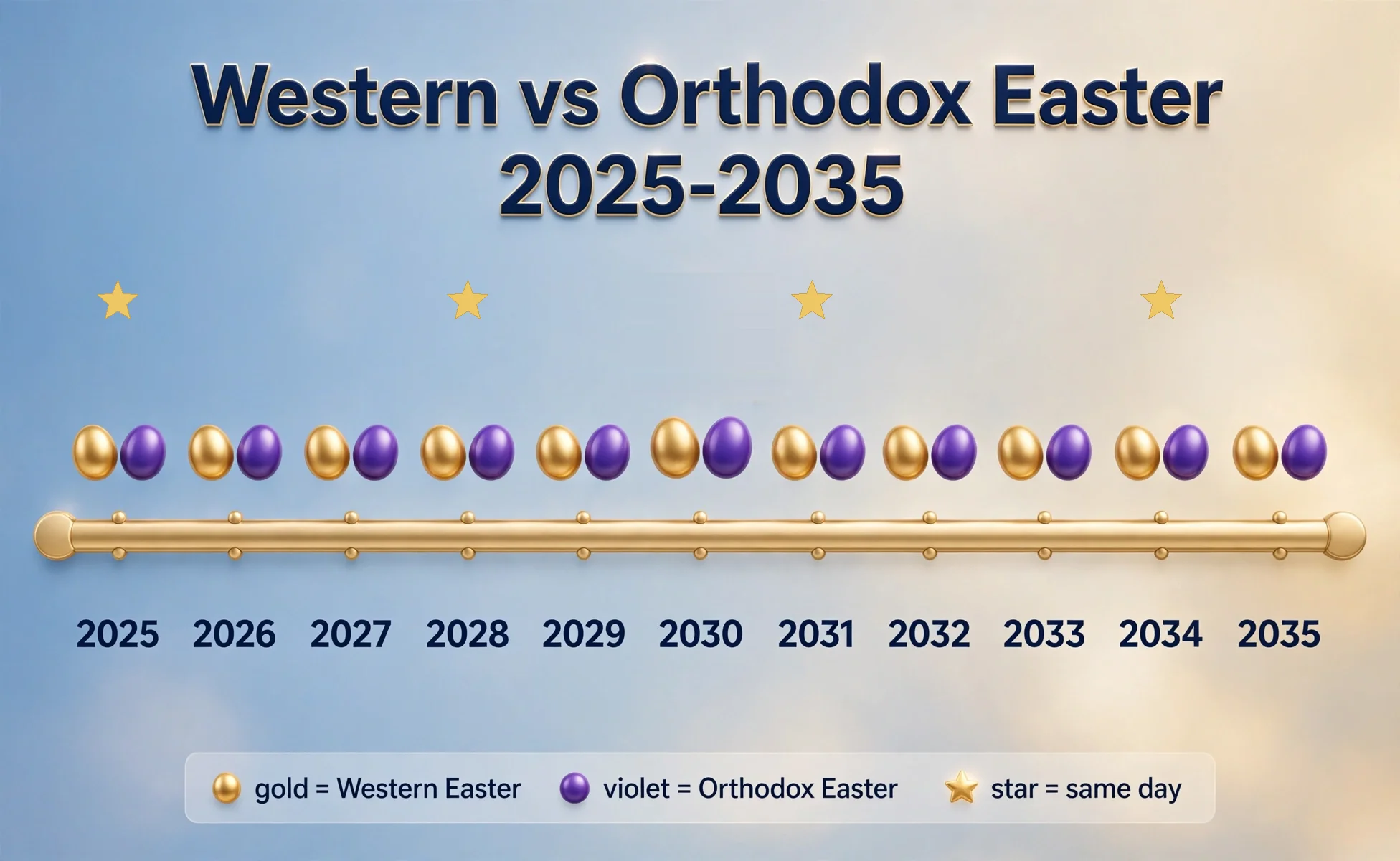
Every date below is computed with the algorithms described on this page and cross-checked against published tables (source: Wikipedia's List of dates for Easter). The "Same day?" column marks the coincidence years when both traditions celebrate on one Sunday.
| Year | Western Easter | Orthodox Easter | Same day? |
|---|---|---|---|
| 2025 | April 20 | April 20 | Yes |
| 2026 | April 5 | April 12 | |
| 2027 | March 28 | May 2 | |
| 2028 | April 16 | April 16 | Yes |
| 2029 | April 1 | April 8 | |
| 2030 | April 21 | April 28 | |
| 2031 | April 13 | April 13 | Yes |
| 2032 | March 28 | May 2 | |
| 2033 | April 17 | April 24 | |
| 2034 | April 9 | April 9 | Yes |
| 2035 | March 25 | April 29 |
The two Easters coincide in 2025, 2028, 2031, and 2034. In all other years shown, Orthodox Easter falls one to five weeks after Western Easter.
How the Date of Easter Is Calculated
The rule: first Sunday after the Paschal full moon
Easter is the first Sunday after the Paschal full moon. The Paschal full moon is the ecclesiastical full moon that falls on or after March 21, which the churches fix as the date of the March equinox. Note the word ecclesiastical. This is a calculated moon from church tables, not the moon you see in the sky, and it can differ from the astronomical full moon by a day or two.
The Gregorian computus, step by step
Western churches use the Gregorian computus, published anonymously in Nature in 1876 and popularized by the astronomer Jean Meeus. For any year from 1583 onward, with every division rounded down, the steps are:
a= year mod 19. The year's remainder in the 19-year Metonic cycle.b= year / 100 rounded down,c= year mod 100. The century and the year within it.d=b/ 4 rounded down,e=bmod 4. Leap-year corrections for the century.f= (b+ 8) / 25 rounded down.g= (b-f+ 1) / 3 rounded down. The lunar correction.h= (19a+b-d-g+ 15) mod 30. Days from March 21 to the Paschal full moon.i=c/ 4 rounded down,k=cmod 4.l= (32 + 2e+ 2i-h-k) mod 7. The push forward to Sunday.m= (a+ 11h+ 22l) / 451 rounded down. Almost always 0, and 1 in rare correction years.- month = (
h+l- 7m+ 114) / 31 rounded down, where 3 means March and 4 means April. - day = ((
h+l- 7m+ 114) mod 31) + 1.
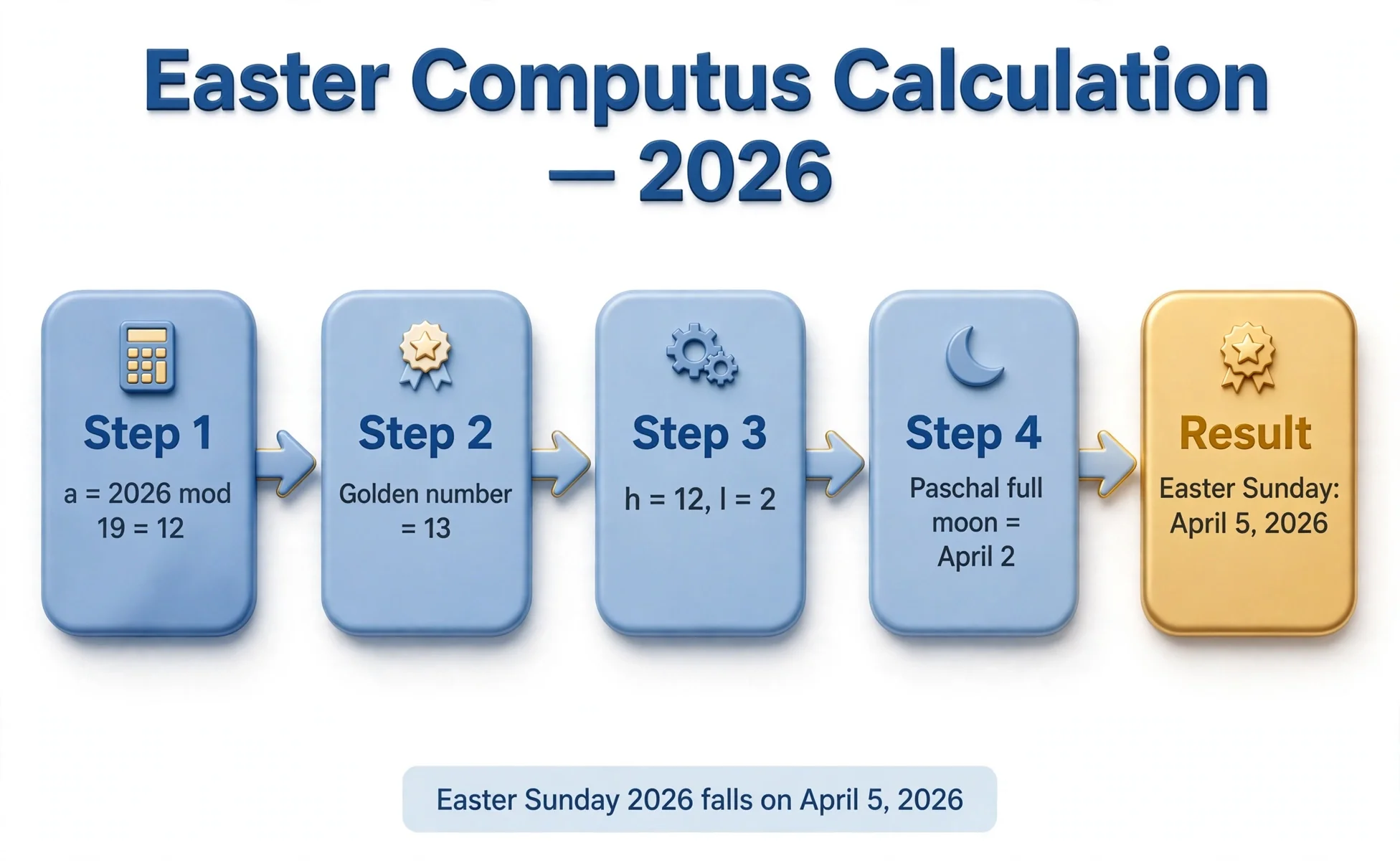
Worked example: Easter 2026
For 2026 the steps give a = 12, b = 20, c = 26, d = 5, e = 0, f = 1, g = 6, h = 12, i = 6, k = 2, l = 2, m = 0. Then month = (12 + 2 + 114) / 31 rounded down = 4, and day = (128 mod 31) + 1 = 5. Easter Sunday 2026 was April 5. The golden number is a + 1 = 13, the epact is 11, and the Paschal full moon fell on April 2, three days before Easter Sunday.
The Orthodox calculation
Orthodox churches reckon Easter in the older Julian calendar, using Meeus's Julian algorithm. With a = year mod 4, b = year mod 7, and c = year mod 19, compute d = (19c + 15) mod 30 and e = (2a + 4b - d + 34) mod 7. The Julian month is (d + e + 114) / 31 rounded down and the Julian day is ((d + e + 114) mod 31) + 1. For 2026 this gives a = 2, b = 3, c = 12, d = 3, e = 5, or March 30 in the Julian calendar. Add the 13 days by which the Julian calendar currently trails the Gregorian calendar to reach Sunday, April 12, 2026. For background on both algorithms, see Wikipedia's article on the date of Easter.
Western vs Orthodox Easter: Why Two Dates?
Both Easters follow the same rule, the first Sunday after the Paschal full moon. They differ because the two traditions reckon that moon and that Sunday in different calendars. Western churches use the Gregorian calendar, in civil use since October 1582. Orthodox churches use the Julian calendar for the reckoning, even where they use the Gregorian calendar in daily life, and then read the result as a Gregorian date.
The Julian calendar currently trails the Gregorian calendar by 13 days, so the Orthodox Paschal full moon usually lands later and the Sunday after it lands later too. Western Easter can fall on 35 possible dates from March 22 to April 25. Orthodox Easter, read in Gregorian dates, falls from April 4 to May 8. The gap ranges from zero in coincidence years like 2025 and 2028 to five weeks, as in 2027 and 2032.
Easter always falls on a Sunday, by definition. If you want to check the weekday of any Easter date in the table above, our day of week calculator confirms it in one step.
Key Terms
- Computus. The calculation of Easter's date, from the Latin computus paschalis, Easter computation.
- Paschal full moon. The ecclesiastical full moon on or after March 21. For 2026 it was April 2.
- Golden number. The year's position in the 19-year Metonic cycle, computed as (year mod 19) + 1. For 2026 it is 13.
- Epact. The moon's age on January 1, in days. For 2026 it is 11.
- Metonic cycle. The 19-year cycle in which 235 lunar months very nearly equal 19 solar years, so the moon's phases repeat on nearly the same calendar dates.
Movable Feasts Counted from Easter
Once Easter Sunday is fixed, the other movable feasts are simple day counts from it. The table below uses Western Easter 2026, which was April 5.
| Feast | Days from Easter Sunday | Date in 2026 |
|---|---|---|
| Ash Wednesday | -46 days | February 18, 2026 |
| Good Friday | -2 days | April 3, 2026 |
| Easter Monday | +1 days | April 6, 2026 |
| Ascension Day | +39 days | May 14, 2026 |
| Pentecost | +49 days | May 24, 2026 |
To count forward or backward from any Easter date yourself, use our date calculator to add or subtract days from the date.
Frequently asked questions
When is Easter 2026?
Western Easter 2026 was Sunday, April 5, and Orthodox Easter 2026 was Sunday, April 12. Both dates are now past. The next Easter is Sunday, March 28, 2027 in the Western churches and Sunday, May 2, 2027 in the Orthodox churches.
When is Orthodox Easter 2026?
Orthodox Easter 2026 was Sunday, April 12. That is the Julian reckoning, March 30 in the Julian calendar, expressed as a Gregorian date by adding the 13-day gap between the calendars.
Why do Western and Orthodox Easter fall on different dates?
Western churches reckon the Paschal full moon in the Gregorian calendar, while Orthodox churches reckon it in the older Julian calendar, which currently trails the Gregorian calendar by 13 days. The later moon usually pushes the Sunday after it later as well, by one to five weeks.
How is the date of Easter calculated?
Easter is the first Sunday after the Paschal full moon, the ecclesiastical full moon that falls on or after March 21. The full calculation is called the computus, and the step-by-step algorithm is shown in the How the Date of Easter Is Calculated section above.
What is the earliest and latest date Easter can fall on?
Western Easter always falls between March 22 and April 25. Orthodox Easter, read in Gregorian dates, always falls between April 4 and May 8.
Do Western and Orthodox Easter ever fall on the same day?
Yes. In the table above they coincide in 2025, 2028, 2031, and 2034, when the two reckonings land on one Sunday.
What is the computus?
The computus, from the Latin computus paschalis, is the calculation that sets the date of Easter: the first Sunday after the Paschal full moon, worked out with the Gregorian algorithm for Western churches and the Julian algorithm for Orthodox churches.
How far back or forward can this calculator go?
From 1583 to 9999. The Gregorian calendar took effect in October 1582, so 1583 is the first Easter reckoned in it. Dates before that varied by country, since adoption of the new calendar spread over centuries.
Related calculators

Date Calculator
Add or subtract years, months, and days from any date, with weekday.
Use calculatorDay of Week Calculator
Find the weekday for any date, past or future.
Use calculatorMoon Phase Calculator
Find the moon phase and illumination for any date.
Use calculatorWeek Number Calculator
Find the ISO week number, ISO year, and week range for any date.
Use calculatorAge Calculator
Find your exact age in years, months and days from your birth date.
Use calculatorBirthday Calculator
Exact age, days lived, weekday born, and next birthday countdown.
Use calculatorAnniversary Calculator
Time together, next anniversary, and countdown.
Use calculatorCountdown Calculator
Pick a target date and time to see the exact time left.
Use calculatorDate Difference Calculator
Find the days, weeks and months between two dates with visual calendars.
Use calculatorTime Duration Calculator
Find the exact hours, minutes and seconds between two dates and times.
Use calculator