Day of Week Calculator: What Day of the Week Was Any Date
Pick any date — a birthday, a wedding, a deadline, or a date centuries away — and instantly see which day of the week it falls on, with extra calendar facts.
How the day of the week is found
The day of the week is not looked up — it is calculated. The calendar follows fixed arithmetic, so any Gregorian date converts to a weekday with a formula published in 1882 by the German scholar Christian Zeller, known as Zeller's congruence.
Treat January and February as months 13 and 14 of the previous year, then compute:
h = ( q + ⌊13(m+1) ÷ 5⌋ + K + ⌊K ÷ 4⌋ + ⌊J ÷ 4⌋ + 5J ) mod 7
Here q is the day of the month, m the month number, K the last two digits of the year, and J the century. The result h maps to a weekday: 0 = Saturday, 1 = Sunday, 2 = Monday, 3 = Tuesday, 4 = Wednesday, 5 = Thursday, 6 = Friday.
What the formula assumes
Zeller's congruence answers in proleptic Gregorian terms — it extends the Gregorian calendar backward and forward without limit. Dates from before a country switched from the Julian calendar (1582 in Catholic Europe, 1752 in Britain and its colonies) were recorded differently, so very old dates can sit several days away from the historical record. The calculation also ignores time zones: the weekday comes from the calendar date alone, never from a moment in time.
Worked example
Find the weekday of October 24, 2026. With q = 24, m = 10, K = 26 and J = 20:
- ⌊13 × (10 + 1) ÷ 5⌋ = ⌊143 ÷ 5⌋ = 28
- ⌊26 ÷ 4⌋ = 6 and ⌊20 ÷ 4⌋ = 5
- 5J = 100
- h = (24 + 28 + 26 + 6 + 5 + 100) mod 7 = 189 mod 7 = 0
- 0 maps to Saturday — and indeed, October 24, 2026 was a Saturday.
How to use the day of week calculator
A day of week calculator answers one question: which weekday does a date land on? Birthdays, anniversaries, project deadlines and historical dates all work. Here is each step.
Step by step
- Tap the date field. The calendar picker opens — tap anywhere in the field, not just the icon.
- Choose any date, past or future.
- Press “Find Day”. The weekday appears at once, with the calendar facts below.
What you get
- Day of the week — e.g. Saturday
- Full formatted date — Saturday, October 24, 2026
- Day of the year — 297 of 365
- ISO week number — Week 43
- Days from today — “42 days ago” or “in 42 days”
- Same date next year — with its weekday (February 29 maps to March 1)
- Leap year status — whether the year is a leap year
If you want the distance between two dates rather than the weekday, our date difference calculator covers that.
Why your birthday shifts weekdays every year
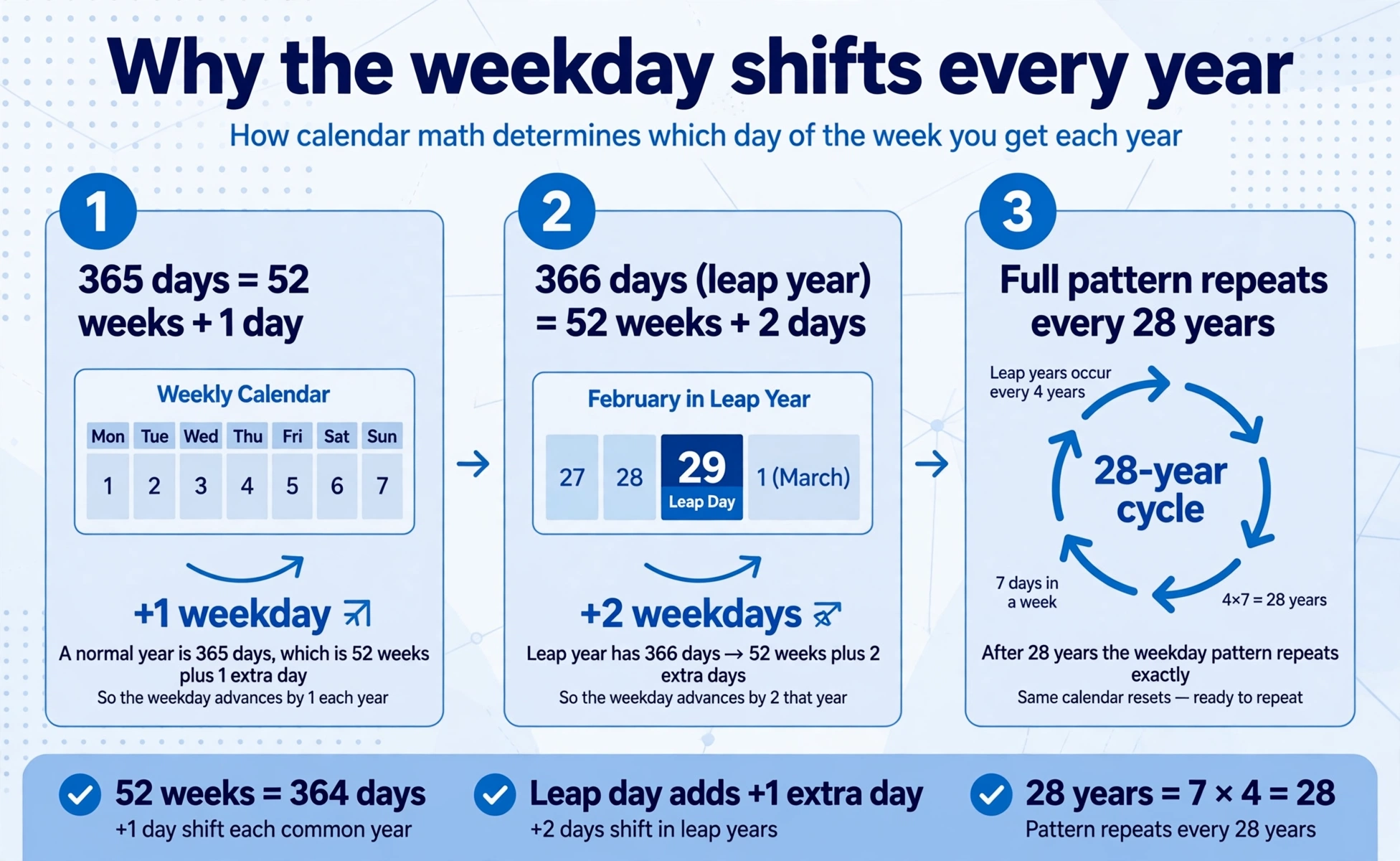
A common year has 365 days, which is exactly 52 weeks plus one day. That extra day pushes every date one weekday forward the following year. A leap year has 366 days — 52 weeks plus two days — so dates after February 29 jump two weekdays. The full pattern repeats every 28 years.
| Date | Weekday | Shift |
|---|---|---|
| October 24, 2026 | Saturday | — |
| October 24, 2027 | Sunday | +1 (common year) |
| October 24, 2028 | Tuesday | +2 (leap day crossed) |
| October 24, 2029 | Wednesday | +1 (common year) |
| October 24, 2030 | Thursday | +1 (common year) |
A birthday can never stay on the same weekday two years running — it always steps forward by one, or by two when a February 29 falls in between. To see your exact age alongside the weekday you were born on, try our age calculator.
Leap years and the Gregorian calendar
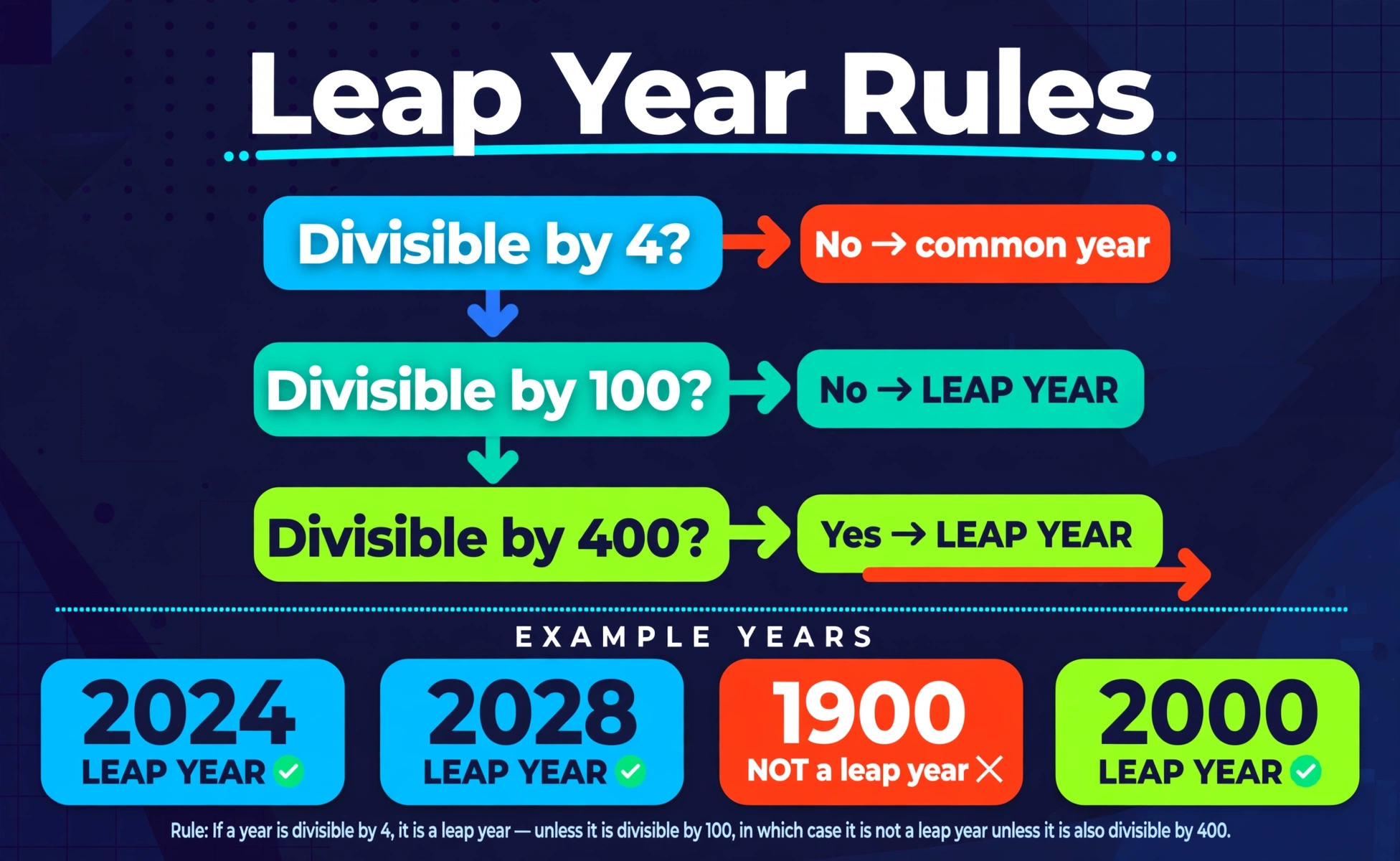
The weekday math only works because leap years are placed by strict rules. A year is a leap year if it is divisible by 4 — except century years, which must also be divisible by 400.
| Rule | Example years | Leap year? |
|---|---|---|
| Divisible by 4 (not a century) | 2024, 2028, 2032 | Yes |
| Divisible by 100 but not by 400 | 1900, 2100, 2200 | No |
| Divisible by 400 | 2000, 2400 | Yes |
Leap year facts
- The last leap day was February 29, 2024; the next is February 29, 2028.
- People born on February 29 celebrate on February 28 or March 1 in common years — the calculator maps their next occurrence to March 1.
- Over 400 years there are exactly 97 leap years, which keeps the calendar within a day of the solar year.
- 2026 is not a leap year.
timeanddate.com keeps a full list of leap years and explains the astronomy behind them.
Frequently asked questions
How do I find what day of the week I was born?
Pick your birth date in the date field and press Find Day — the weekday appears instantly. For example, July 20, 1969, the day of the Apollo 11 Moon landing, was a Sunday.
Why does my birthday fall on a different weekday each year?
A common year is 52 weeks plus one day, so every date moves one weekday forward each year — two when a February 29 falls in between. The full cycle repeats every 28 years.
How far back or forward can I check a date?
As far as the Gregorian calendar rules extend. Note that dates from before a country adopted the Gregorian calendar (1582 in Catholic Europe, 1752 in Britain and its colonies) were recorded in the Julian calendar, which can differ by several days.
Does my time zone change the answer?
No. The weekday is computed from the calendar date itself, not from a moment in time, so time zones do not affect the result. All math runs in UTC to avoid off-by-one errors near midnight.
What is Zeller's congruence?
A formula from 1882 that converts any Gregorian date into a weekday number using only division and remainders: h = (q + ⌊13(m+1)/5⌋ + K + ⌊K/4⌋ + ⌊J/4⌋ + 5J) mod 7, where 0 means Saturday and 6 means Friday. This calculator uses the same arithmetic.
What day of the week was October 24, 2026?
Saturday. It was day 297 of the year and fell in ISO week 43.
How do I know if a year is a leap year?
Divide by 4: if it divides evenly, it is a leap year — unless it is a century year, in which case it must also divide evenly by 400. So 2024 and 2028 are leap years, 1900 was not, and 2000 was.
What is the ISO week number in the results?
ISO weeks start on Monday, and week 1 is the week containing the first Thursday of the year. Most years have 52 ISO weeks; some have 53.
Related calculators

Age Calculator
Find your exact age in years, months and days from your birth date.
Use calculatorTime Duration Calculator
Find the exact hours, minutes and seconds between two dates and times.
Use calculatorCountdown Calculator
Free countdown calculator: pick a target date and time to see the exact days, hours, minutes and seconds left, plus...
Use calculatorWorkdays Calculator
Count business days between two dates, minus weekends and holidays.
Use calculatorDate Difference Calculator
Find the days, weeks and months between two dates with visual calendars.
Use calculatorTime Zone Converter
Convert any time between time zones with fixed UTC offsets and date handling.
Use calculator