Time Zone Converter: Convert Local Times
Convert a time from one time zone to another in seconds. Enter the time and date, choose the from and to zones from the fixed UTC offset list, and this time zone converter shows the exact local time and date in the target zone — with the offset difference spelled out. Fixed standard offsets are used; daylight saving time is not applied.
Formulas verified against standard time and calendar references. Calculator logic tested with verified worked examples. Calculator logic tested with verified worked examples. Last reviewed: October 2026. Our methodology
How the time zone conversion works
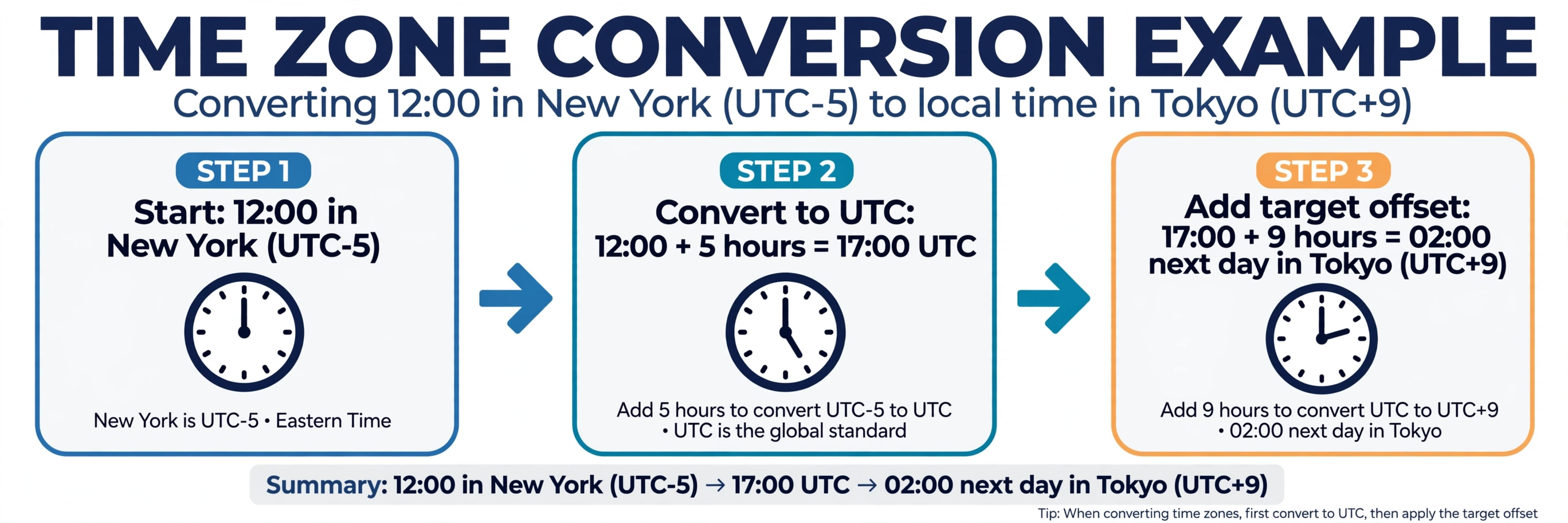
The conversion always passes through UTC. Your local time is shifted back to UTC using the from-zone’s offset, then shifted forward again using the to-zone’s offset. The date rolls over automatically when the shift crosses midnight.
- UTC time: local time − from-offset
- Target time: UTC time + to-offset
- Offset difference: to-offset − from-offset
Sources: timeanddate.com — time zone and daylight saving references.
Worked example
It is 9:00 AM on October 19 in Karachi (UTC+5) — what time is it in London (UTC+0)? First go back to UTC: 09:00 − 5 hours = 04:00 UTC. Then apply the target offset: 04:00 + 0 hours = 04:00 in London, same day. The offset difference is 0 − 5 = −5 hours: London is 5 hours behind Karachi. Going the other way, 12:00 in London (UTC+0) is 12:00 UTC, which is 12:00 + 9 = 21:00 the same day in Tokyo (UTC+9).
How to use the time zone converter
Enter a time, optionally a date, pick two zones and press Calculate. The result always shows the full local time and date in the target zone, so midnight crossings never catch you out.
Step by step
- Enter the time. Either 24-hour format (14:30) or 12-hour with AM/PM (2:30 PM).
- Enter the date as YYYY-MM-DD — or leave it blank to use today’s date.
- Choose the from and to zones. Each option shows the fixed UTC offset plus a representative city, for example “UTC+5 — Karachi”.
- Press Calculate. Read the converted time and date, the target zone and the offset difference, with the step-by-step working underneath.

Understanding UTC offsets
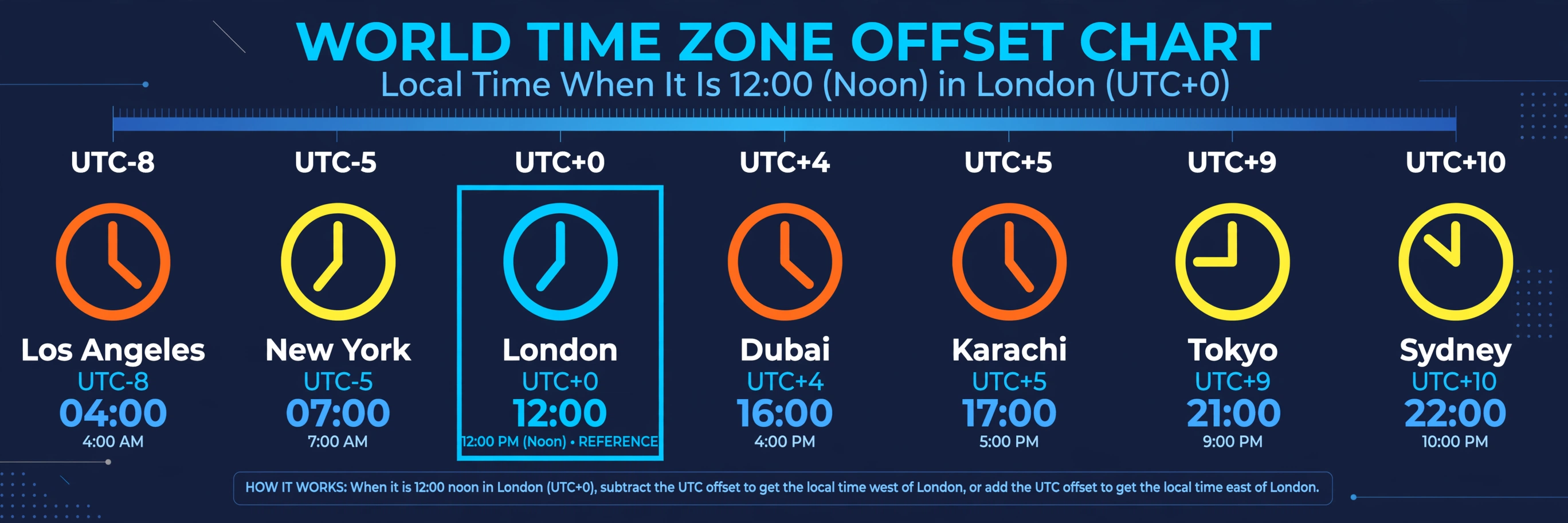
A UTC offset tells you how far a zone’s standard time sits from Coordinated Universal Time. Positive offsets are east of Greenwich (ahead), negative offsets are west (behind). The converter covers every whole-hour offset from UTC-11 to UTC+14.
| Offset | Example cities | Noon in London (UTC+0) is… |
|---|---|---|
| UTC-8 | Los Angeles | 04:00 |
| UTC-5 | New York | 07:00 |
| UTC+0 | London | 12:00 |
| UTC+4 | Dubai | 16:00 |
| UTC+5 | Karachi | 17:00 |
| UTC+9 | Tokyo | 21:00 |
| UTC+10 | Sydney | 22:00 |
Offsets are fixed standard values here — the real world complicates them with daylight saving, which is covered next.
Daylight saving: the one thing this converter does not do
Many zones shift by one hour for part of the year — London moves from UTC+0 to UTC+1 (British Summer Time), New York from UTC-5 to UTC-4. This converter deliberately uses fixed standard offsets only, so it never guesses wrong about a date it cannot verify.
- If the zone is on daylight saving, add one hour to the result for zones that spring forward (most of North America and Europe).
- Half-hour zones such as India (UTC+5:30) or Adelaide’s summer time are not listed — convert to the nearest whole hour, then add or subtract the extra 30 or 45 minutes.
- When in doubt, check the current offset for your exact date on an authoritative reference before scheduling anything critical.
Once you have both local times, the time duration calculator measures the exact gap between them in days, hours, minutes and seconds.
Scheduling across time zones
Time zone mistakes cause missed meetings more often than any technical failure. A few habits prevent almost all of them.
- Agree in UTC first. “15:00 UTC” is unambiguous everywhere; local times are each person’s second step.
- Always state the date with the time. A 9-hour gap means “3 PM Tuesday” in one city is “12 AM Wednesday” in another.
- Watch the date line. Crossing the International Date Line (between UTC+14 and UTC-11) changes the date by a full day even when the clock barely moves.
- Confirm daylight saving explicitly for meetings more than a few weeks out — zones change their clocks on different dates.
A single UTC time lands at a different local hour everywhere. Here is 12:00 UTC translated with standard offsets:
| City (zone) | Local time at 12:00 UTC |
|---|---|
| New York (UTC-5) | 07:00 |
| London (UTC+0) | 12:00 |
| Paris (UTC+1) | 13:00 |
| Dubai (UTC+4) | 16:00 |
| Karachi (UTC+5) | 17:00 |
| Tokyo (UTC+9) | 21:00 |
| Sydney (UTC+10) | 22:00 |
Counting the days between two dates in different zones is a separate job for the date difference calculator.
Frequently asked questions
What is UTC?
UTC — Coordinated Universal Time — is the global reference clock that all time zones are measured against. It never observes daylight saving time, which makes it the reliable fixed point for converting between zones.
Does this converter handle daylight saving time?
No. This converter uses fixed standard UTC offsets and does not apply daylight saving time. If a zone is currently on daylight saving (for example London on BST at UTC+1 in summer), add or subtract that one hour yourself after converting.
Why did the date change in the result?
Because the target zone is far enough ahead or behind that the converted time falls on a different calendar day. Converting 9:00 PM in New York (UTC-5) to Tokyo (UTC+9) lands at 11:00 AM the next day — a 14-hour jump crosses midnight.
What about half-hour time zones like India (UTC+5:30)?
This converter uses whole-hour offsets from UTC-11 to UTC+14, so half-hour and 45-minute zones are not listed separately. For those, convert to the nearest whole-hour zone and then add or subtract the extra 30 or 45 minutes.
How do I read an offset like UTC-5?
UTC-5 means the zone is 5 hours behind UTC: when it is 12:00 UTC, it is 07:00 there. UTC+9 means 9 hours ahead of UTC: 12:00 UTC is 21:00 there. The offset difference between two zones is simply the to-offset minus the from-offset.
Is the conversion accurate?
Yes, within the stated assumption: fixed standard offsets with no daylight saving applied. The math is exact — UTC time equals local time minus the from-offset, and target time equals UTC time plus the to-offset. For dates far in the past or future, historical offset changes are not modeled.
What is the best way to schedule a meeting across time zones?
Agree on the time in UTC first, then let everyone convert to local time — it removes all ambiguity about daylight saving and date changes. This converter does the second step: enter the UTC time with the from-zone set to UTC+0 and convert to each attendee's zone.