Moon Phase Calculator: Phase and Illumination for Any Date
Find the moon phase and illumination for any date, plus the moon age in days and the next full moon date.
Formulas verified against standard references. Calculator logic tested with verified worked examples. Last reviewed: October 2026.Our methodology
How the moon phase is calculated
The moon returns to the same phase every synodic month, about 29.53058867 days. Counting days from a known new moon gives the moon age, and the moon age decides the phase name and how much of the moon looks lit.
The reference new moon used here is 6 January 2000 at 18:14 UTC. Moon age is the number of days since that moment, wrapped into one 29.53058867-day cycle.
Moon phase formula
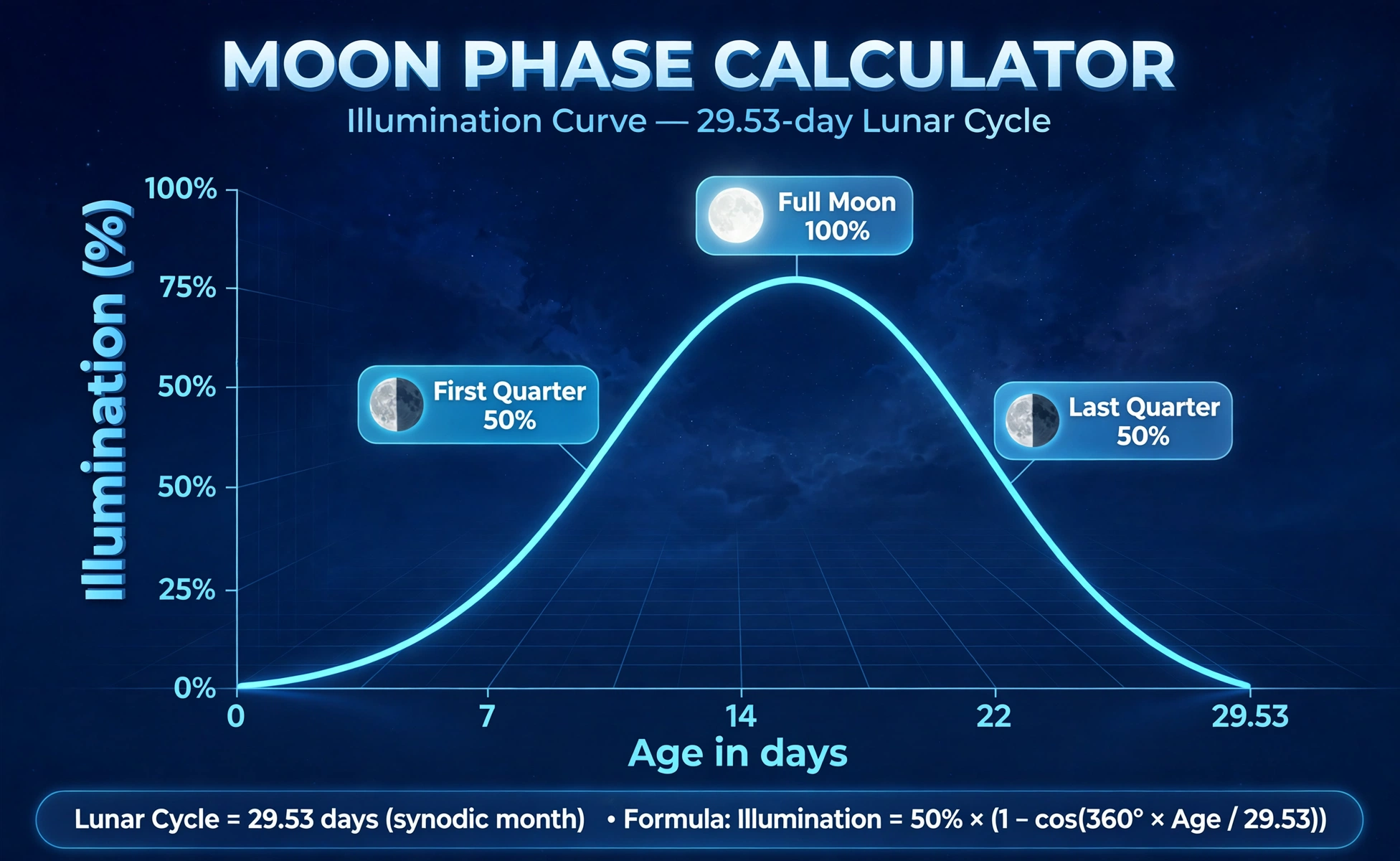
Moon age = (days since 6 January 2000, 18:14 UTC) mod 29.53058867. Illumination = (1 − cos(2 × pi × moon age ÷ 29.53058867)) ÷ 2 × 100.
Illumination is 0% at new moon, about 50% at the quarter phases and 100% at full moon. Because the cycle is not a whole number of days, the same calendar date can fall in a different phase from year to year.
To check the weekday for the same date, use the day of week calculator.
Worked examples
For 6 January 2000, the reference new moon date, the calculator reports New Moon with illumination close to 0%. The date falls in the New Moon band because it is the reference date itself.
For 21 January 2000, about 14.3 days after the reference new moon, the moon age falls in the 12.91–16.61 day Full Moon band, so the result is Full Moon with illumination close to 100%.
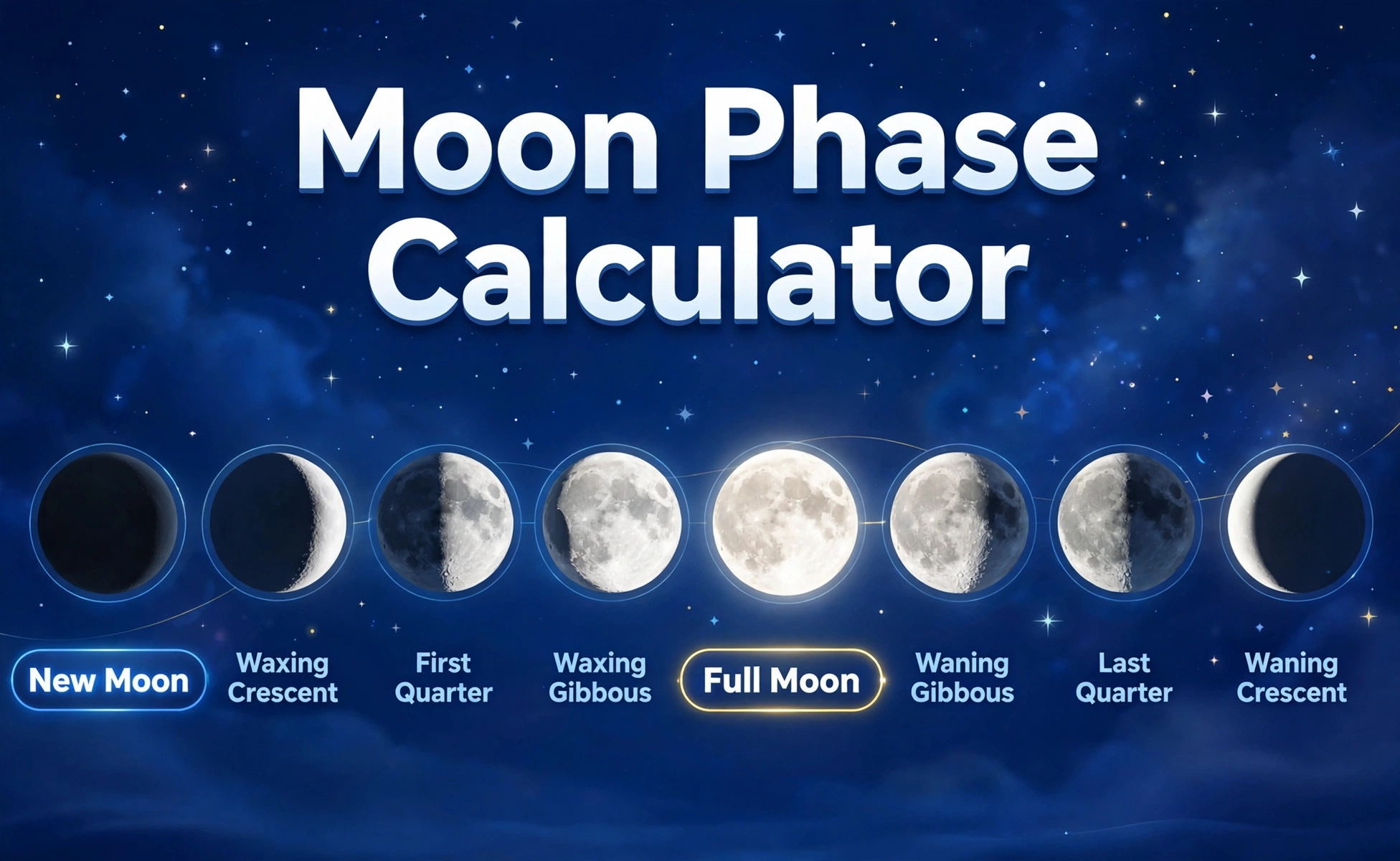
Moon phase table
Each phase covers a band of moon ages. A moon age just past a boundary belongs to the next phase.
| Phase | Moon age (days) | Illumination |
|---|---|---|
| New Moon | 0–1.84 | 0–10% |
| Waxing Crescent | 1.84–5.53 | 10–50% |
| First Quarter | 5.53–9.22 | 50% |
| Waxing Gibbous | 9.22–12.91 | 50–100% |
| Full Moon | 12.91–16.61 | 100% |
| Waning Gibbous | 16.61–20.30 | 100–50% |
| Last Quarter | 20.30–23.99 | 50% |
| Waning Crescent | 23.99–27.68 | 50–10% |
| New Moon | 27.68–29.53 | 10–0% |
Illumination at key points in the cycle
The illumination formula gives exact values at the main points of the cycle, and the table below shows those points.
| Point in cycle | Moon age (days) | Illumination |
|---|---|---|
| New Moon | 0.00 | 0% |
| First Quarter | 7.38 | 50% |
| Full Moon | 14.77 | 100% |
| Last Quarter | 22.15 | 50% |
To measure the gap between two dates in the same cycle, use the date difference calculator.
Frequently asked questions
What is moon age?
Moon age is the number of days since the most recent new moon, on a cycle of about 29.53 days. A moon age of 0 is new moon and about 14.77 is full moon.
How is illumination calculated?
Illumination equals (1 minus cos(2 times pi times moon age divided by 29.53058867)) divided by 2, times 100. It is 0% at new moon and 100% at full moon.
Why is the phase sometimes different on the same date each year?
The lunar cycle is 29.53 days, not a whole number of days or months, so phases shift against the calendar from year to year.
What is the next full moon date shown by the calculator?
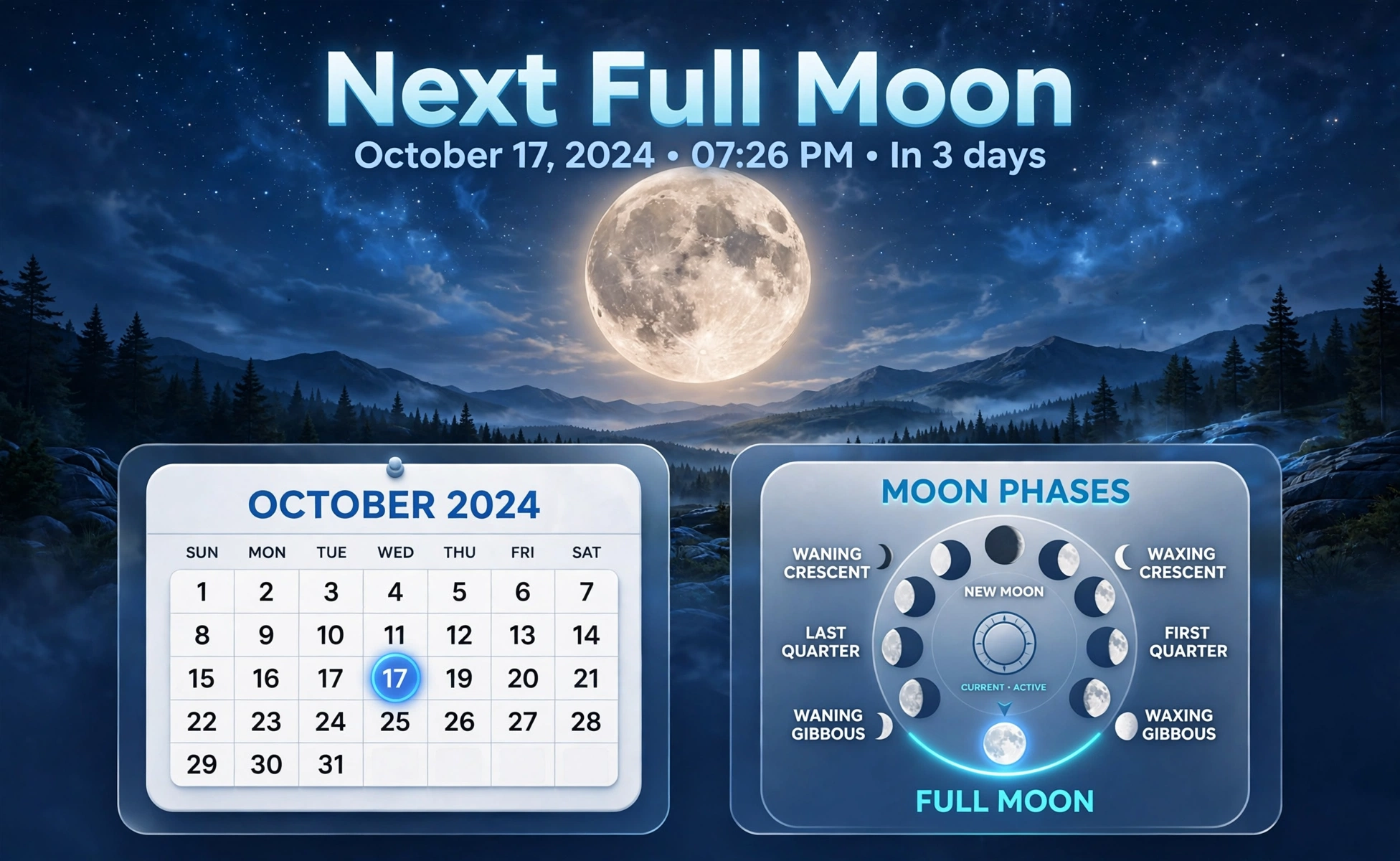
It adds the days remaining until moon age 14.75 to your date, using the same synodic cycle, and shows the resulting calendar date.
Is the moon phase the same everywhere on Earth?
The phase is essentially the same worldwide on a given date, although the exact time it appears and how the moon looks in the sky vary by location.
What is the difference between waxing and waning?
Waxing means the lit part is growing toward full moon; waning means it is shrinking toward new moon.
Can I use this for dates far in the past or future?
Yes. The calculation is a simple cycle count from the reference new moon, so it works for any date, though real astronomical tables are more precise for exact event times.