Week Number Calculator: Find the ISO Week of Any Date
Pick a date to get its ISO week number and ISO year, the Monday-to-Sunday range of that week, the weekday, and the day of the year.
Formulas verified against standard references. Calculator logic tested with verified worked examples. Last reviewed: October 2026. Our methodology
What an ISO Week Is
The ISO week system, defined by ISO 8601, numbers the weeks of a year from 1 to 52 or 53. Every week starts on Monday and ends on Sunday, and week 1 is the week containing the first Thursday of the year, which is the same as the week containing January 4. That rule keeps every week at exactly seven days, with no partial weeks at the edges of a year.
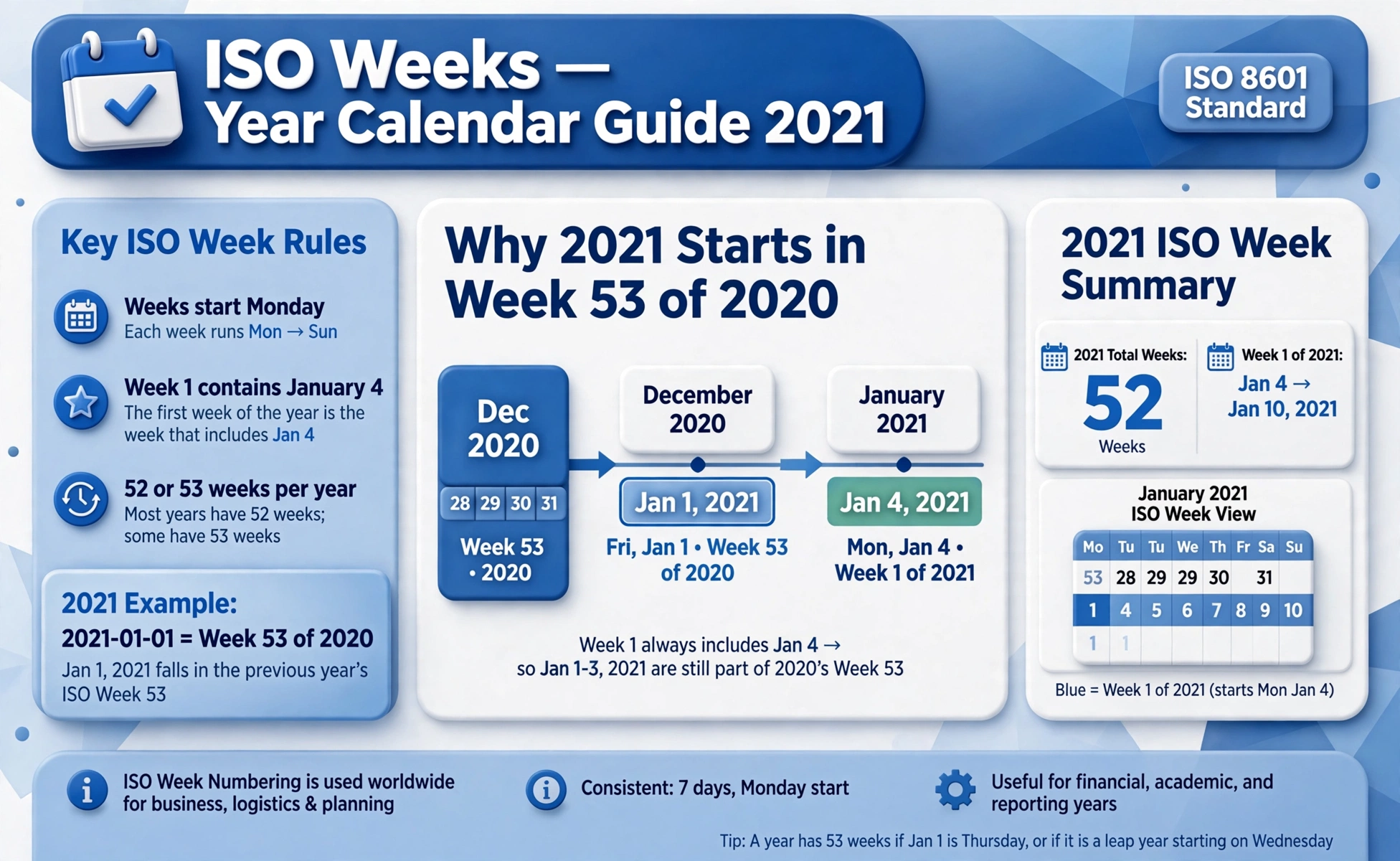
The practical consequence is that the ISO year and the calendar year sometimes differ at the edges. January 1, 2021 was a Friday, and it belonged to week 53 of ISO year 2020, not to week 1 of 2021. December 31, 2025 belongs to week 1 of ISO year 2026. If you plan by week numbers, always quote the ISO year with the week number, as in week 44 of 2026.
For the weekday of a date without the week number, a day of week calculator gives the day name directly.
How the ISO Week Is Calculated
To find the ISO week of a date, shift the date to the Thursday of its week, because the Thursday decides which year the week belongs to. The year of that Thursday is the ISO year. Then count how many Thursdays have passed since the first Thursday of that year, and add one for week 1.
In practice, the first Thursday of an ISO year always falls between January 1 and January 7, and week 1 is the week containing January 4. A year has 53 ISO weeks when it starts on a Thursday, or when it is a leap year starting on a Wednesday; otherwise it has 52. The calculator applies that rule exactly, so edge dates come out right.
| Date | ISO week | Why |
|---|---|---|
| 2026-01-01 (Thursday) | Week 1 of 2026 | Thursday is in week 1 |
| 2021-01-01 (Friday) | Week 53 of 2020 | Week belongs to 2020, since its Thursday was in 2020 |
| 2025-12-31 (Wednesday) | Week 1 of 2026 | Thursday of that week is in 2026 |
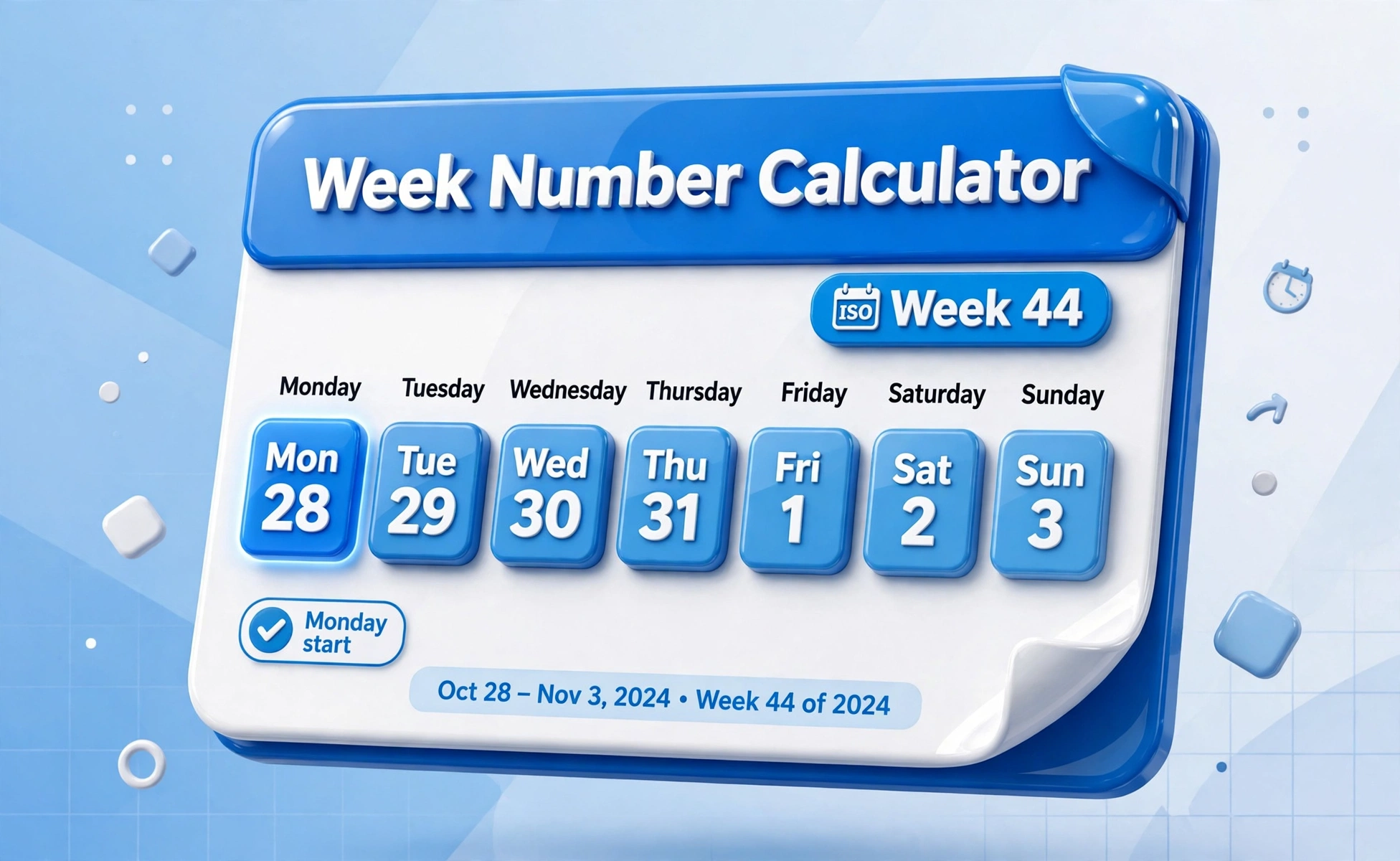
| 2026-10-26 (Monday) | Week 44 of 2026 | Monday starts week 44 |
Worked Examples
Example 1: October 26, 2026 is a Monday, and it starts week 44 of 2026, which runs from October 26 to November 1, 2026. It is day 299 of the year. Example 2: January 1, 2021 is a Friday in week 53 of 2020, which runs from December 28, 2020 to January 3, 2021. Quoting it as week 1 of 2021 would be wrong under ISO 8601.
Example 3: December 31, 2025 is a Wednesday in week 1 of 2026, because the Thursday of its week, January 1, 2026, belongs to 2026. Example 4: a date in the middle of a year is straightforward: June 15, 2026 is a Monday, and it starts week 25 of 2026.
| Date | ISO week | Week range |
|---|---|---|
| 2026-10-26 | Week 44 of 2026 | 26 Oct to 1 Nov 2026 |
| 2021-01-01 | Week 53 of 2020 | 28 Dec 2020 to 3 Jan 2021 |
| 2025-12-31 | Week 1 of 2026 | 29 Dec 2025 to 4 Jan 2026 |
ISO Weeks Versus Other Week Counts
Not every week count follows ISO 8601. In the United States, many calendars start weeks on Sunday and call the week containing January 1 week 1, even if that week has only one day in the new year. Spreadsheets also offer a week number function with several counting modes, and the result for an edge date depends on the mode chosen.
The difference only matters near January 1 and December 31, but that is exactly when year-end reports and schedules go wrong. If a system says a date is in week 1 while another says week 53, check which rule each system uses before merging the data. For international planning, ISO 8601 is the safe default, because it is the same in every country that uses it.
| System | Week starts | Week 1 rule |
|---|---|---|
| ISO 8601 | Monday | Week containing January 4 |
| US common | Sunday | Week containing January 1 |
| Spreadsheet default modes | Varies | Depends on the mode chosen |
Common Mistakes
The most common mistake is assuming the week number matches the calendar year for early January dates. January 1 to 3 can belong to the previous ISO year, and December 29 to 31 can belong to the next one. Always carry the ISO year with the week number in reports.
Another mistake is counting weeks from January 1 by dividing the day of the year by 7. That method breaks at year edges and on years where January 1 is not a Monday, because it creates a short first week. A third mistake is starting the week on Sunday while quoting an ISO week number: the ISO week always starts on Monday, so a Sunday belongs to the week that started six days earlier.
Planning by Week Number
Week numbers are the backbone of production schedules, school terms, payroll periods, and release plans, because a week number is shorter and less ambiguous than a date range. A plan that says week 44 is understood across teams without converting dates, and it survives year boundaries as long as the ISO year travels with it.
For gaps between two dates in days or weeks, a date difference calculator counts the interval directly. Use this calculator when the question is which numbered week a single date falls in, and what that week spans.

Frequently asked questions
What is an ISO week?
A week under ISO 8601: it starts on Monday, ends on Sunday, and week 1 is the week containing January 4, which is the week with the first Thursday of the year.
What week is October 26, 2026?
Week 44 of 2026. October 26, 2026 is a Monday, and week 44 runs from October 26 to November 1, 2026.
Can a date belong to a different ISO year?
Yes. January 1, 2021 belongs to week 53 of ISO year 2020, and December 31, 2025 belongs to week 1 of ISO year 2026.
How many weeks are in an ISO year?
52 or 53. A year has 53 weeks when it starts on a Thursday, or when it is a leap year starting on a Wednesday.
Does an ISO week start on Monday or Sunday?
Monday, always. A Sunday belongs to the ISO week that started the previous Monday.
How is week 1 defined?
Week 1 is the week containing the first Thursday of the year, which is the same as the week containing January 4.
Is the ISO week the same as the US week number?
Not always. US calendars often start weeks on Sunday and call the week containing January 1 week 1, which differs from ISO at year edges.