Birthday Calculator: Your Exact Age and Next Birthday
Enter your date of birth and get your exact age today, total days lived, the weekday you were born on, and a countdown to your next birthday.

Formulas verified against standard references. Calculator logic tested with verified worked examples. Last reviewed: October 2026. Our methodology
How Exact Age Is Calculated
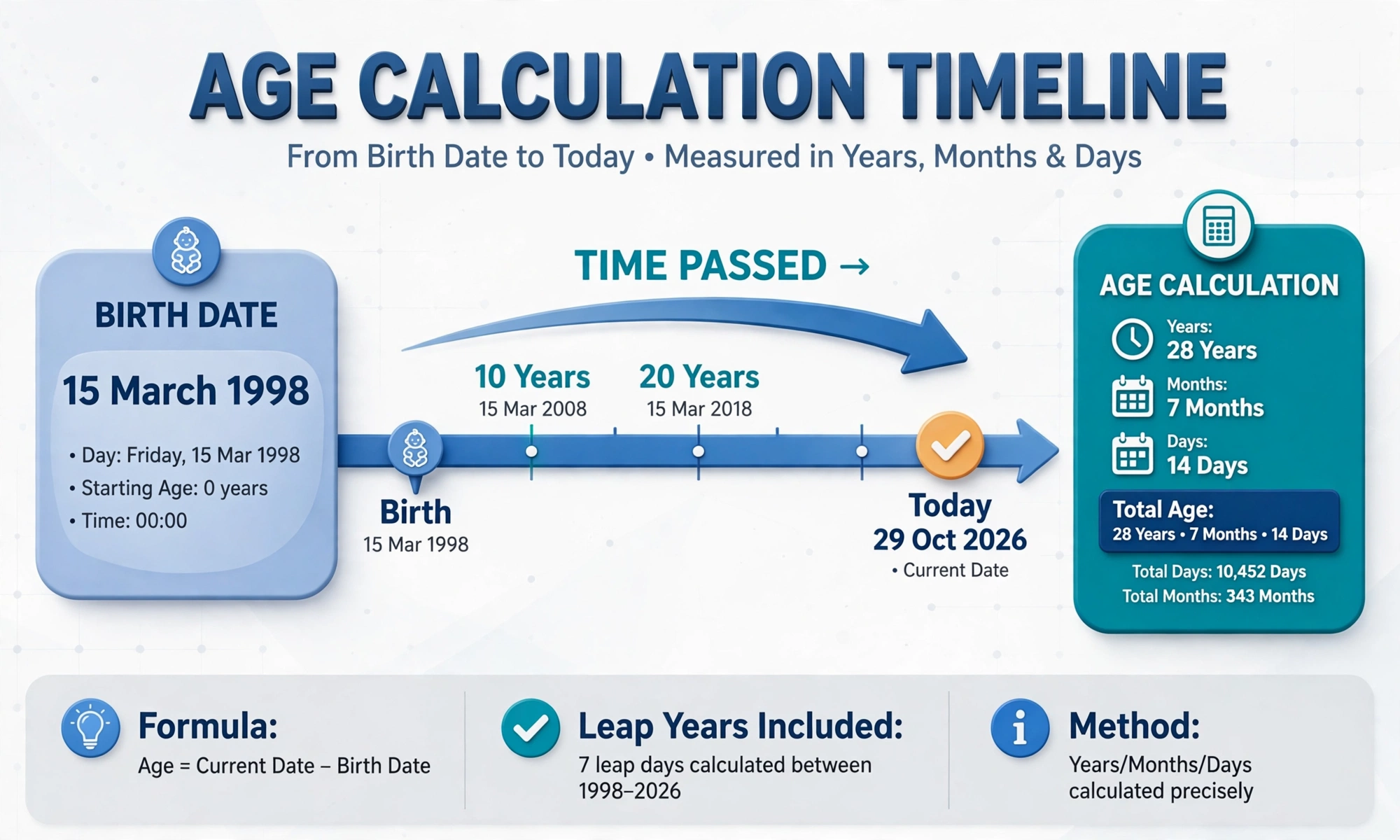
Exact age counts completed years, then completed months, then remaining days. If you were born on 15 May 1990, then on 29 October 2026 you are 36 years, 5 months, and 14 days old: 36 full years to 15 May 2026, then 5 full months to 15 October 2026, then 14 days to 29 October. Simply subtracting years gives the age in years, but months and days need the borrow steps when the current day is earlier than the birth day.
Days lived is simpler: it is the number of days between the birth date and today, which for 15 May 1990 to 29 October 2026 is 13,316 days. That count includes leap days, which is why dividing by 365 alone gives a slightly wrong answer over decades. For a straight date difference, a date calculator handles any two dates, not just birthdays.

Birthdays, Leap Years, and Weekdays
A birthday repeats every year on the same month and day, except for 29 February birthdays, which occur only in leap years. In non-leap years, people born on 29 February usually celebrate on 28 February or 1 March, by custom, since there is no 29 February that year. This calculator treats the next birthday for a leap-day birth as 29 February in the next leap year for the countdown, following the calendar date itself.
The weekday you were born on comes from the calendar: 15 May 1990 was a Tuesday. Weekdays repeat on a cycle shaped by leap years, so your birthday falls on a different weekday most years, returning to the same weekday roughly every 5 or 6 years, with leap years shifting the pattern.
| Born | Age on 29 October 2026 | Days lived |
|---|---|---|
| 15 May 1990 | 36 years, 5 months, 14 days | 13,316 days |
| 1 January 2000 | 26 years, 9 months, 28 days | 9,798 days |
| 29 February 2000 | 26 years, 8 months, 0 days | 9,739 days |
Worked Examples
Example 1: born 15 May 1990, age on 29 October 2026 is 36 years, 5 months, 14 days, with 13,316 days lived, and the next birthday is 198 days away, on 15 May 2027. Example 2: born 1 January 2000, age on 29 October 2026 is 26 years, 9 months, 28 days, with 9,798 days lived.
Example 3: born 29 February 2000, age on 29 October 2026 is 26 years, 8 months, 0 days in completed months counted to 29 October, with 9,739 days lived. Leap-day ages are the trickiest case, and different calculators disagree on the month count in non-leap years, so treat the day count as the exact figure and the month split as a convention.
Planning Around a Birthday
A next-birthday countdown helps with planning: bookings, gifts, and travel need lead time, and a countdown in days is easier to act on than a month name. For milestone birthdays, such as 18, 21, 30, 50, or 65, the exact age also matters for legal rights, retirement rules, and eligibility, which usually depend on the completed years, not the nearest birthday.
For children, age in months is often more useful than age in years, especially under age 2, where a few months change feeding, vaccination, and development milestones. This calculator's year, month, and day breakdown serves both uses: the years for adults, and the months for young children.
Common Mistakes
The most common mistake is counting the current year as complete before the birthday arrives: someone born in December is still the previous age in October, even though the calendar year is almost over. A second mistake is dividing days lived by 365 to get age, which ignores leap days and drifts by about one day every four years.
A third mistake is assuming a birthday always falls on the same weekday. It does not, because a normal year has 365 days, which is 52 weeks plus 1 day, so each birthday shifts forward by one weekday, or two after a leap day. A fourth is forgetting time zones for births near midnight, though for most purposes the calendar date is enough.
Birthday Facts Worth Knowing
About 1 in 365 people share your birthday in a group of 23, the famous birthday paradox says two people in the room probably share a birthday, because the pairs multiply faster than intuition suggests. With 23 people there are 253 pairs, and the chance of at least one shared birthday passes 50 percent.
Birthdays also cluster by season in many countries, with September births common in the northern hemisphere, reflecting conceptions around the winter holidays. Whatever the pattern, the exact age and day count are what matter for planning, and this calculator gives both without any sign-up or personal data stored.

Frequently asked questions
How old am I exactly today?
Enter your date of birth. The calculator gives completed years, months, and days, for example 36 years, 5 months, 14 days for 15 May 1990 on 29 October 2026.
How many days have I lived?
The count of days from your birth date to today, including leap days. For 15 May 1990 to 29 October 2026, it is 13,316 days.
What day of the week was I born on?
The calculator shows it from the calendar. For example, 15 May 1990 was a Tuesday.
When is my next birthday?
The calculator counts days from today to your next birthday date and names its weekday, so you can plan ahead.
What about 29 February birthdays?
In non-leap years there is no 29 February. People usually celebrate on 28 February or 1 March, while the calendar next birthday is the next 29 February.
Why is age in months different from dividing days by 30?
Because months have different lengths. Exact age counts completed calendar months, not 30-day blocks, so it matches birthdays and legal ages.
Is my date of birth stored?
No. The calculation runs in your browser when you press Calculate, and nothing is sent or stored.