Sod Calculator: How Much Sod You Need
Figure out rolls, pallets, square yards and estimated cost for your lawn. Enter the lawn size, the coverage of one roll and one pallet, and a waste allowance — the sod calculator does the rest.
Formulas verified against standard references. Calculator logic tested with verified worked examples. Last reviewed: October 2026. Our methodology
Formula
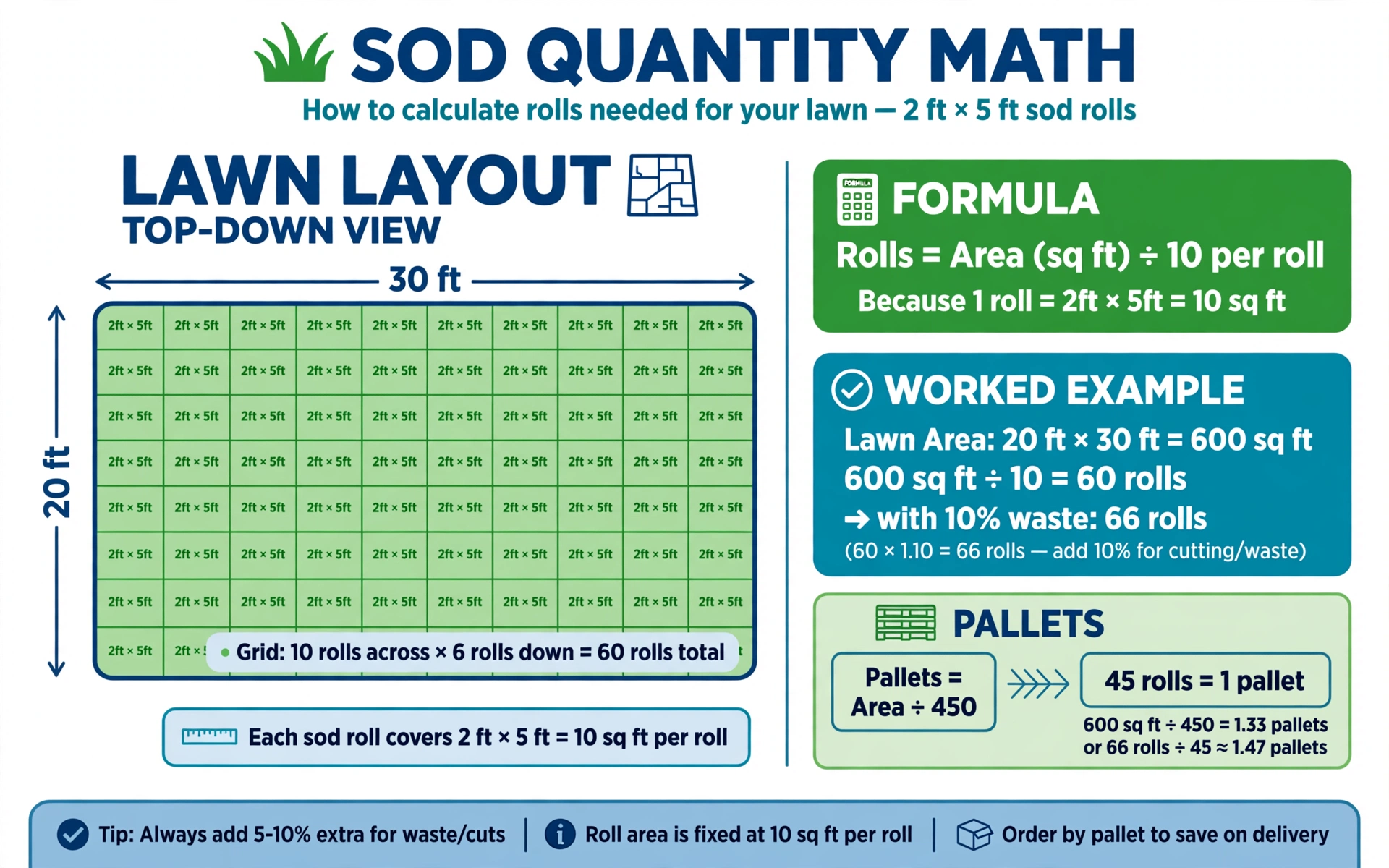
Area = length × width. For a circle, area = π × (diameter ÷ 2)². Total area with waste = area × (1 + waste % ÷ 100). Rolls needed = total area ÷ coverage per roll, rounded up. Pallets needed = total area ÷ coverage per pallet, rounded up. Square yards = total area ÷ 9.
Worked example
A 30 ft × 20 ft rectangular lawn with a 5% waste allowance, using 10 sq ft rolls and 450 sq ft pallets: area = 30 × 20 = 600 sq ft. Waste = 600 × 0.05 = 30 sq ft, so the total to order for is 630 sq ft. Rolls = 630 ÷ 10 = 63 rolls. Pallets = 630 ÷ 450 = 1.4, rounded up to 2 pallets. Square yards = 630 ÷ 9 = 70 sq yd.
How to measure your lawn for sod
Sod is ordered by area, so the first job is turning your lawn into square feet. The sod calculator handles three cases, and each one starts with a tape measure.
Step by step
- Pick the area shape. Rectangle is right for most lawns. Circle fits a round patch. If you already know the total, choose "I know the total area".
- Measure in feet. For a rectangle, measure the longest straight sides for length and width. For a circle, measure straight across the middle for the diameter. Walk the edges twice; short mis-measurements add up fast on a big lawn.
- Handle irregular lawns by splitting them. Break an L-shape into two rectangles and add the areas, or measure the biggest rectangle and choose the direct-area option with the summed total. The waste allowance covers the small offcuts.
- Enter the roll and pallet coverage. The defaults — 10 sq ft per roll and 450 sq ft per pallet — match what most sod farms sell. Change them only if your supplier quotes different numbers.
- Set the waste allowance and press Calculate. The default 5% suits a plain rectangle. Curves, trees and sprinkler heads need more, and the section below explains how much.
What you get
- Rolls needed — rounded up, waste included
- Pallets needed — rounded up to whole pallets, waste included
- Total area in square feet and square yards
- Estimated cost — only if you entered a price per roll or pallet
The formulas
- Rectangle: area = length × width
- Circle: area = π × (diameter ÷ 2)²
- Total with waste = area × (1 + waste % ÷ 100)
- Rolls = ceil(total area ÷ sq ft per roll)
- Pallets = ceil(total area ÷ sq ft per pallet)
If you measured in inches or meters, convert the dimensions to feet first — or run them through our area converter before entering the numbers here.
Waste allowance: how much extra sod to order
Sod is cut to fit around edges, curves, trees, flower beds and sprinkler heads, and the offcuts cannot be reused. Ordering exactly the measured area almost guarantees a shortfall, and a second delivery costs more than a few spare rolls.
Waste guidelines by lawn shape
| Lawn shape | Waste % | When to use it |
|---|---|---|
| Simple rectangle | 5% | Straight edges, no trees, no beds |
| Curved edges or a few obstacles | 10% | Most suburban lawns; beds, trees, paths |
| Complex or irregular | 15% | Many curves, beds, tight corners |
What waste actually costs you
On a 1,000 sq ft lawn with 10% waste, you order for 1,100 sq ft — 10 extra rolls, or about $30–$80 at typical per-roll prices. Running short instead means a second delivery trip, visible color differences between batches, and a half-finished lawn sitting in the sun.
When the default 5% is wrong
The 5% default fits a plain rectangle. If the sod calculator's shape is set to rectangle but the real lawn wraps around a patio or has three trees in the middle, switch to 10%. For an L-shaped lawn measured as one big rectangle, 10% covers the offcuts from the missing corner too.
The waste percentage applies after the area is measured, so an inaccurate measurement plus zero waste is the fastest route to ordering too little. Measure twice, then let the allowance do its job.
Sod roll and pallet sizes explained
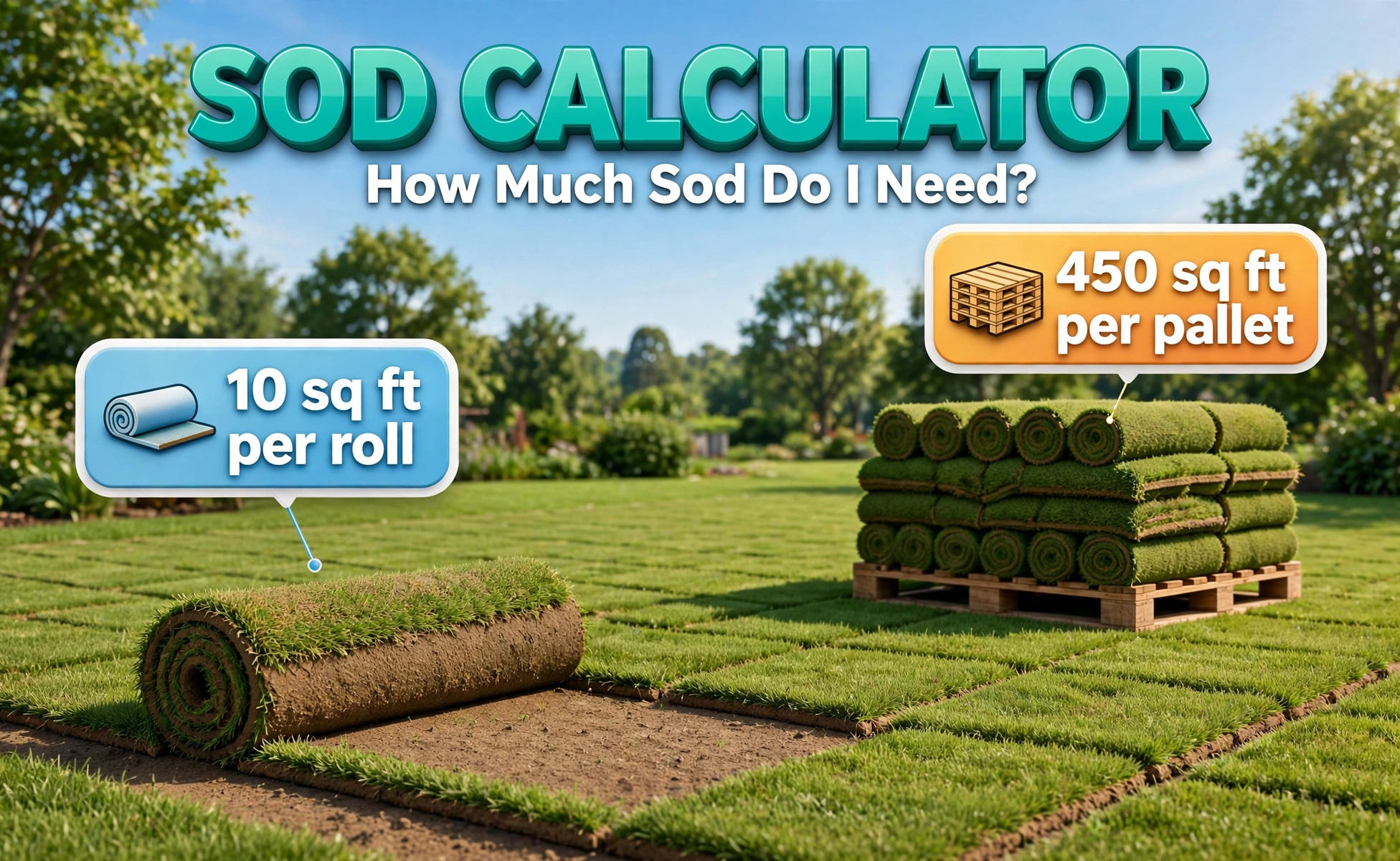
Sod farms harvest rolls in standard sizes, then stack them on pallets. The two numbers that matter for ordering are the coverage of one roll and the coverage of one pallet — everything else follows from those.
Common roll and pallet coverage
| Unit | Coverage | Notes |
|---|---|---|
| Standard roll | 10 sq ft (2 ft × 5 ft) | What this calculator uses by default |
| Small slab | About 2.7 sq ft | Some farms sell these instead of rolls |
| Small pallet | 400 sq ft | 40 standard rolls |
| Standard pallet | 450 sq ft | 45 standard rolls |
| Large pallet | 500 sq ft | 50 standard rolls |
Rolls per pallet
Divide the pallet coverage by the roll coverage: a 450 sq ft pallet of 10 sq ft rolls holds 45 rolls. Farms quote pallets anywhere from 400 to 500 sq ft, so confirm both numbers with your supplier before ordering and update the calculator's coverage fields to match.
Sod quantities for acreage
| Lawn size | Square feet | Pallets (450 sq ft) | Rolls (10 sq ft) |
|---|---|---|---|
| Quarter acre | 10,890 | 25 | 1,089 |
| Half acre | 21,780 | 49 | 2,178 |
| One acre | 43,560 | 97 | 4,356 |
An acre needs 43,560 ÷ 450 = 96.8 pallets, rounded up to 97. For large jobs the pallet count matters more than the roll count, because sod is delivered, priced and often discounted by the pallet.
Once the lawn is measured, other outdoor projects follow the same measure-then-order logic. If the lawn borders a new patio, our paver calculator counts the pavers and base materials for it.
Laying sod so it takes root
Ordering the right quantity is half the job. Fresh sod is perishable — it should go down the day it is delivered — and the first two weeks decide whether it roots or dies.
Installation checklist
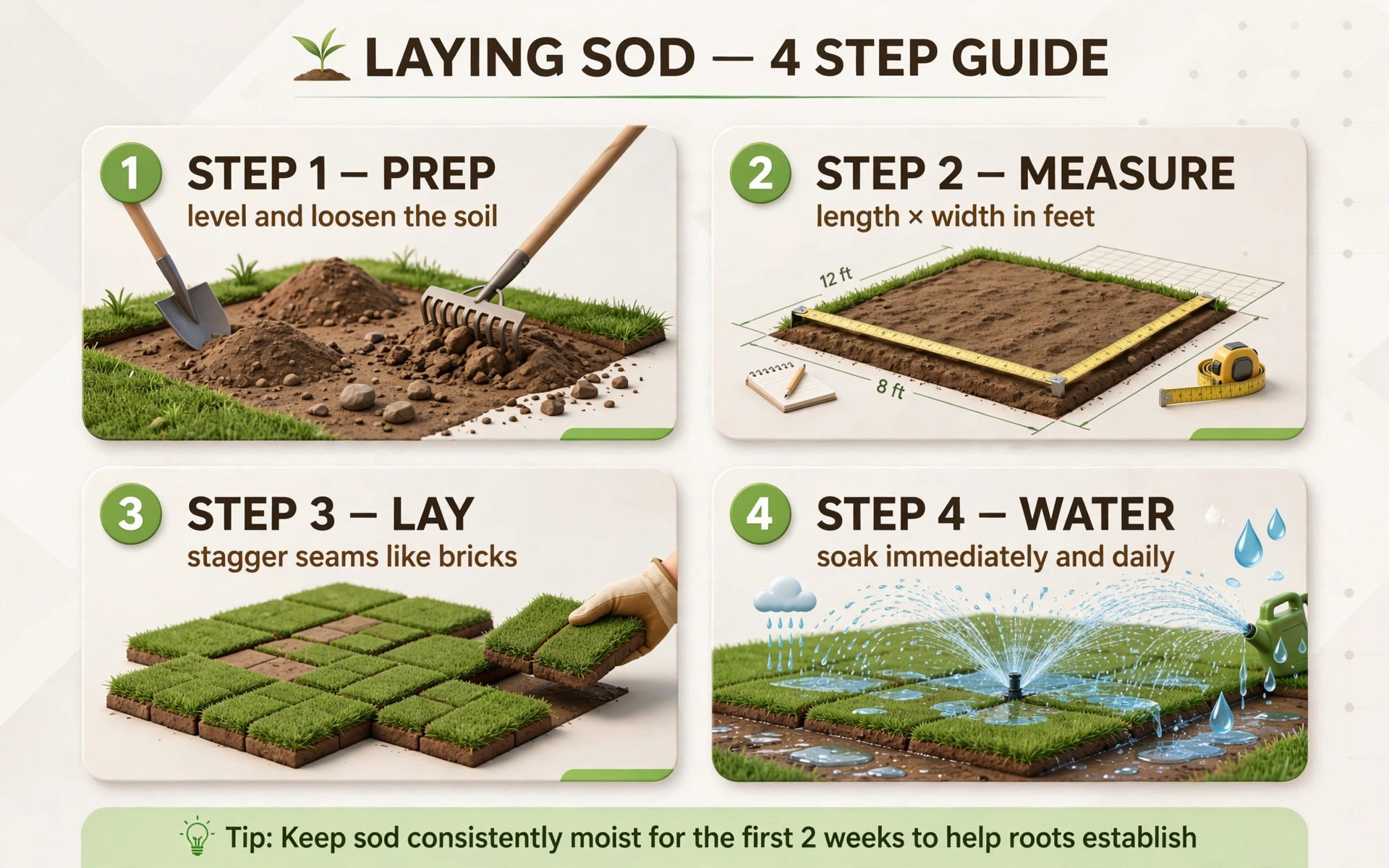
- Prep the soil first. Clear old grass and weeds, loosen the top few inches of soil, and level the surface so the sod sits flat with no air pockets.
- Moisten the soil. Lightly water the bare soil right before laying so the dry ground does not wick moisture out of the sod.
- Start along a straight edge. Lay the first row against a driveway or sidewalk, pressing pieces tightly together without overlapping.
- Stagger the seams. Offset each row like brickwork so the joints do not line up. Cut pieces with a sharp knife to fit curves and edges.
- Water immediately. Soak the new sod thoroughly on day one, then keep it consistently moist for the first two weeks while the roots establish.
What not to do
Do not let delivered rolls sit stacked in the sun — they heat up and can die within a day or two. Do not walk on the sod or mow it until the roots have taken hold; a gentle tug that resists means it is rooted. The University of Maryland Extension's lawn establishment guide has the full breakdown of laying and watering new sod if you want a second opinion.
Roots typically establish in 2 to 3 weeks. Until then, the sod's survival is almost entirely about water — the one thing a calculator cannot order for you.
Frequently asked questions
How do I calculate how much sod I need?
Measure your lawn in feet and multiply length by width to get square feet (for a circle, use pi times radius squared). Add 5 to 15% for waste, then divide by 10 for the number of rolls or by 450 for the number of pallets. Always round up.
How many rolls of sod are on a pallet?
A standard 450 sq ft pallet holds 45 rolls when each roll covers 10 sq ft. Farms sell pallets covering 400 to 500 sq ft, so confirm the pallet and roll coverage with your supplier before ordering.
How many pallets of sod do I need for one acre?
One acre is 43,560 sq ft. Divided by 450 sq ft per pallet, that is 96.8 pallets, so order 97 pallets for full coverage. A half acre needs about 49 pallets and a quarter acre about 25.
How much extra sod should I order for waste?
Order 5% extra for a simple rectangle, 10% for a lawn with curved edges or a few obstacles like trees and beds, and 15% for complex or irregular shapes. The extra covers offcuts from fitting sod around edges and curves.
What size is a roll of sod?
A standard sod roll is 2 ft by 5 ft, covering 10 sq ft. Some farms sell smaller slabs of about 2.7 sq ft instead. Check the roll size with your supplier and enter it in the calculator if it differs from the 10 sq ft default.
How much does sod cost?
Sod typically costs $0.30 to $0.80 per square foot, with premium varieties up to about $1.50. That works out to roughly $3 to $8 per 10 sq ft roll, plus delivery. Enter your local prices in the calculator for an exact estimate.
Can I order a mix of pallets and individual rolls?
Yes. Order whole pallets for the bulk of the area and buy individual rolls for the remainder, since pallets cannot be split. Confirm both the pallet price and the per-roll price, because single rolls usually cost more per square foot.
Related calculators

Mulch Calculator
Estimate mulch in cubic yards and bags for garden beds.
Use calculatorPaver Calculator
Count pavers for patios and walkways, plus base materials.
Use calculatorFence Calculator
Estimate posts, pickets, rails and concrete for a fence.
Use calculatorConcrete Calculator
Estimate concrete volume in cubic yards and count 80, 60 and 40 lb bags.
Use calculatorLumber Calculator
Compute board feet, linear feet and lumber cost.
Use calculatorTile Calculator
Figure tiles and boxes needed for any floor with your waste allowance.
Use calculator