Mulch Calculator: Cubic Yards and Bags for Your Garden Beds
Buying mulch is a volume problem: area times depth. Enter your bed's length and width in feet, pick a depth in inches, and this free mulch calculator tells you the cubic yards to order, the cubic feet, and how many 2 or 3 cu ft bags that equals — so you stop at the garden center exactly once.
Formulas verified against standard references. Calculator logic tested with verified worked examples. Last reviewed: October 2026. Our methodology
The mulch volume formula
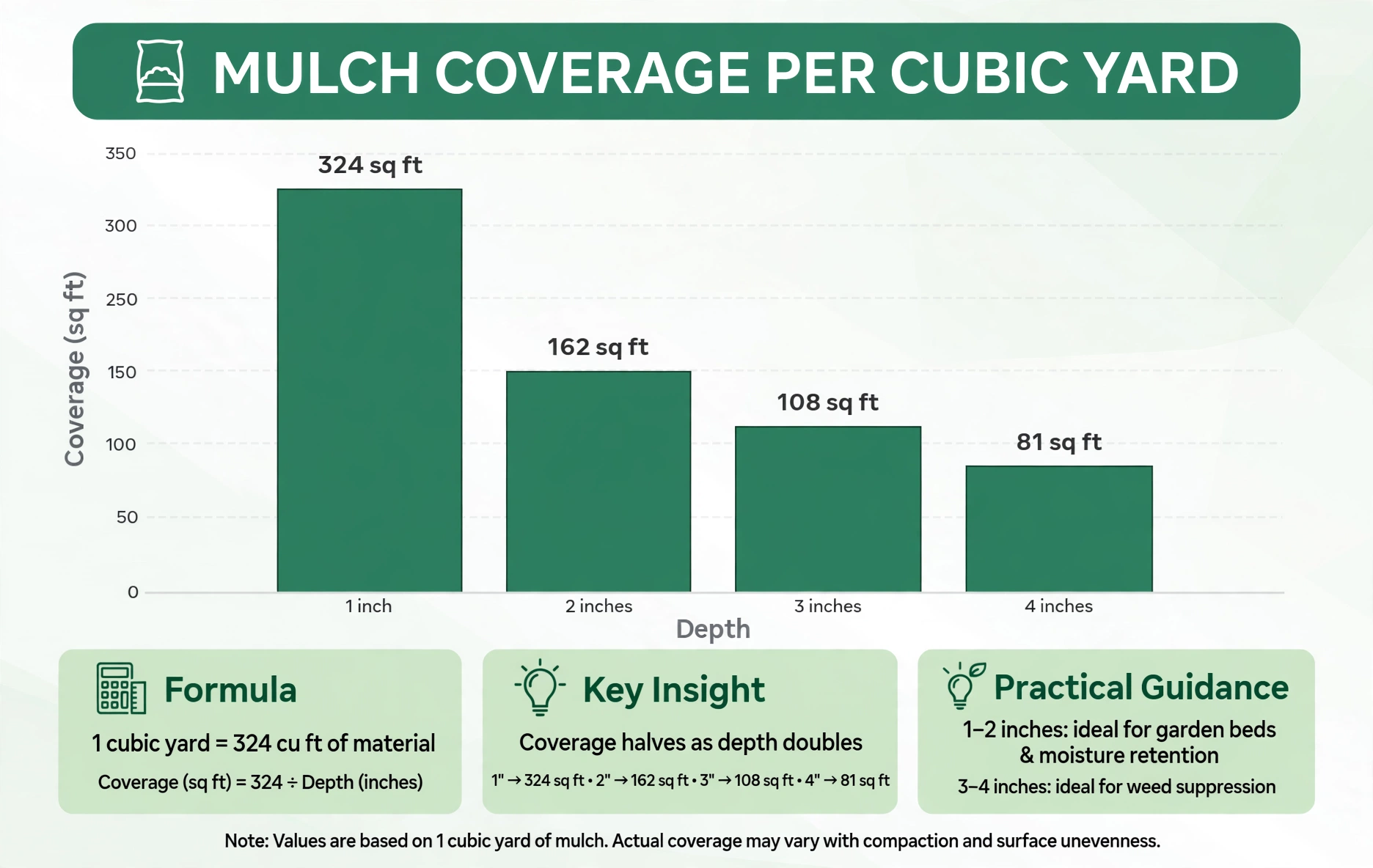
Mulch volume is area times depth, all in the same unit. Depth is usually given in inches, so divide by 12 to get feet; then remember that 27 cubic feet make one cubic yard — the unit bulk mulch is sold in. The shortcut professionals use: cubic yards = (length × width × depth in inches) ÷ 324.
| Depth | One cubic yard covers |
|---|---|
| 1 inch | 324 sq ft |
| 2 inches | 162 sq ft |
| 3 inches | 108 sq ft |
| 4 inches | 81 sq ft |
Stone and gravel beds use exactly the same volume math — a gravel calculator applies it to driveways, paths and drainage areas.
Worked example
A garden bed measures 20 ft by 10 ft, and you want 3 inches of mulch:
- Area: 20 × 10 = 200 sq ft.
- Depth in feet: 3 ÷ 12 = 0.25 ft.
- Cubic feet: 200 × 0.25 = 50 cu ft.
- Cubic yards: 50 ÷ 27 = 1.85 cu yd → round up and order 2 cubic yards.
- Bags: 50 ÷ 2 = 25 bags of 2 cu ft mulch, or 50 ÷ 3 = 16.67 → 17 bags of 3 cu ft mulch.
Enter the same numbers above and the calculator returns every one of these figures.
How to use the mulch calculator
Measure once, buy once.
Step by step
- Measure the bed's length and width in feet. For curved beds, measure the widest points.
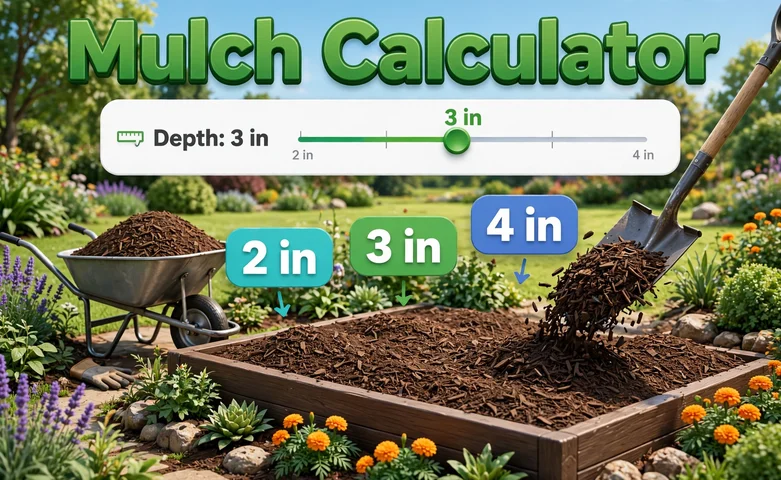
- Pick a depth. Tap a preset (2, 3 or 4 inches) or type your own — 3 inches is the standard.
- Press Calculate. Buy the rounded-up figure: cubic yards for bulk delivery, bags for small jobs.
- For irregular beds, split the bed into rectangles, run each section, and add the totals.
How deep should mulch be?
Depth is the one setting that matters — too thin and weeds walk through, too thick and you suffocate the soil:
| Depth | Best for |
|---|---|
| 1–2 in | Annual refresh, vegetable gardens |
| 3 in | New flower beds — the standard |
| 4 in | Tree rings, heavy weed pressure |
Never pile mulch against tree trunks or plant stems. The "mulch volcano" traps moisture against bark, inviting rot and pests — keep mulch 3–6 inches back from trunks, a rule emphasized in university mulching guidance such as University of Minnesota Extension. Poured borders and edging use the same cubic-yard math as mulch — a concrete calculator handles slabs and footings.
Bags vs. bulk: which should you buy?
Bagged mulch is usually sold in 2 cu ft bags (some brands use 3 cu ft). One cubic yard is 27 cu ft — that is 13.5 two-cubic-foot bags, so think of a yard as roughly 14 bags.
| Bag size | Bags per cubic yard |
|---|---|
| 2 cu ft | 13.5 (buy 14) |
| 3 cu ft | 9 |
Rule of thumb: below about 2–3 cubic yards, bags are simpler — no delivery fee, no driveway pile. Above that, bulk delivery usually costs roughly half as much per yard, but factor in the delivery fee and the wheelbarrow work to move it.
Mulch mistakes that cost money
The expensive errors are all avoidable:
- Ordering the exact volume. Beds are never perfectly level and mulch settles — always round up. You cannot buy half a bag or half a yard.
- Going deeper than 4 inches around plants. Thick mulch turns hydrophobic, shedding water instead of absorbing it, and starves roots of oxygen.
- Volcano mulching trees. Mulch piled against the trunk rots the bark; keep a 3–6 inch mulch-free ring.
- Never refreshing. Organic mulch decomposes into the soil — top up once a year or when the layer drops below about 2 inches.
Measure the bed properly rather than eyeballing it: a "roughly 10 by 10" guess that is really 12 by 11 nearly doubles the volume.
Frequently asked questions
How much mulch do I need for a 10×10 ft bed?
A 100 sq ft bed at 3 inches needs 100 × 3 ÷ 324 = 0.93 cubic yards — order 1 cubic yard. In bags that is 100 × 0.25 = 25 cu ft, or 25 ÷ 2 = 12.5 → 13 bags of 2 cu ft mulch.
How many cubic feet are in a cubic yard?
27. For bagged mulch that means one cubic yard equals 13.5 two-cubic-foot bags (buy 14) or 9 three-cubic-foot bags.
What depth of mulch is best?
3 inches is the standard for flower beds. Use 2 inches for annual refreshes and vegetable gardens, and 4 inches around trees or for heavy weed suppression. Avoid going deeper than 4 inches near trunks and stems.
Should I buy bagged mulch or bulk?
Below about 2–3 cubic yards, bags are simpler with no delivery fee. Above that, bulk delivery is usually much cheaper per yard — but remember the delivery charge and the wheelbarrow work to spread a driveway pile.
How do I mulch an irregularly shaped bed?
Divide the bed into rectangles, run each rectangle through the calculator, and add the cubic yards together. Rounding each section up slightly also covers the curved edges.
How often should I re-mulch?
Organic mulch decomposes into the soil, so top it up about once a year or whenever the layer thins below roughly 2 inches.
Can mulch touch tree trunks or plant stems?
No. Keep mulch 3–6 inches back from trunks and stems. Piled-up "mulch volcanoes" trap moisture against bark, causing rot and inviting pests.