Significant Figures Calculator
Count the significant figures in any number, or round a value to the significant figures you need, with the rules and every step shown. Free, no sign-up, and everything runs in your browser.

Formulas verified against standard references. Calculator logic tested with verified worked examples. Published: November 3, 2026 | Last updated: November 3, 2026. Our methodology
What the Significant Figures Calculator Does
This calculator answers two questions about precision. In Count mode it tells you how many significant figures a number has and marks each digit, so you can see exactly which digits count and which are just placeholders. In Round mode it rounds a number to the significant figures you choose, from 1 to 15, with the full working shown.
Type numbers exactly as you wrote them, including trailing zeros. The calculator reads the digits you typed, not a rounded computer value, so 2.500 keeps its 3 significant figures instead of collapsing to 2.5. Everything runs in your browser, free with no sign-up. When you need to round to decimal places instead, the rounding calculator covers that job.
The Rules the Calculator Uses
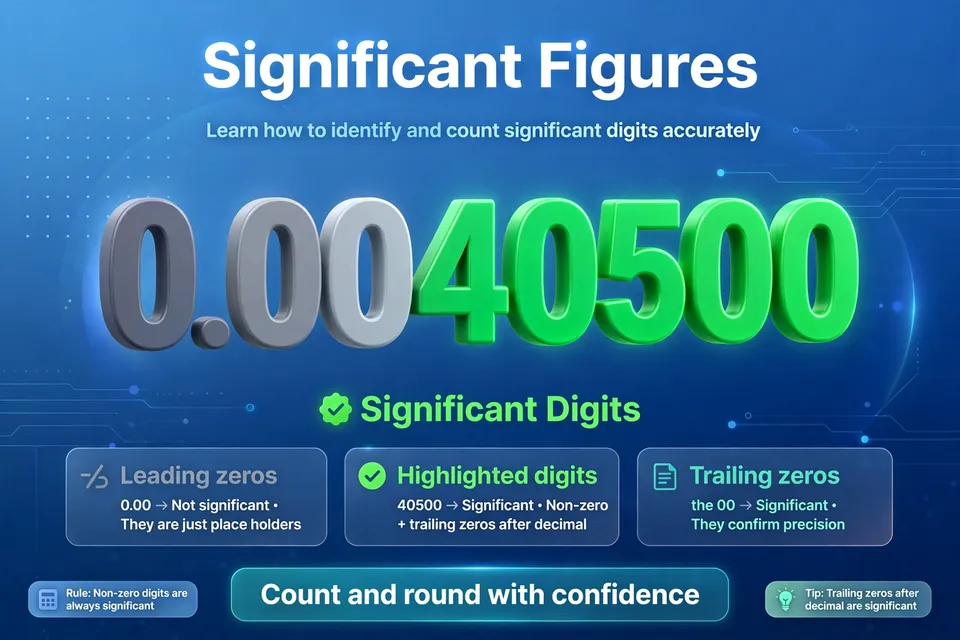
Counting follows the five rules taught in science courses. All non-zero digits count. Zeros between non-zero digits count. Leading zeros never count, because they only place the decimal point. Trailing zeros count only when the number has a decimal point. In scientific notation only the digits of the coefficient count, never the power of ten.
To round a number x to n significant figures, the calculator uses rounded = round(x, n - 1 - floor(log10(|x|))). Here x is the number, n is the significant figures wanted, log10 is the base-10 logarithm, and floor rounds the logarithm down to a whole number. The formula finds the decimal place that holds the nth significant digit. For example, 0.0045678 to 2 sig figs gives floor(log10(0.0045678)) = -3, so the calculator rounds to 2 - 1 - (-3) = 4 decimal places, which is 0.0046. Ties round away from zero, the usual classroom rule, so 2.5 to 1 sig fig becomes 3.
Worked Example: How Many Sig Figs in 0.0040500?
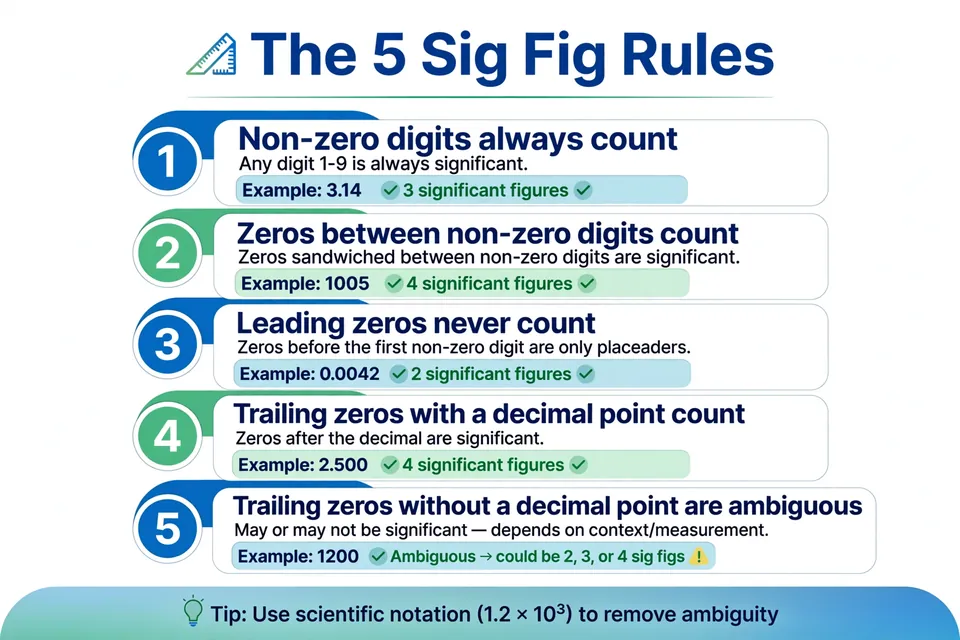
The question is how many significant figures are in 0.0040500.
- Scan from the left. The first non-zero digit is 4. The three zeros before it (0.00) only place the decimal point, so they never count.
- From the 4 onward, every digit counts, because the number has a decimal point. Those digits are 4, 0, 5, 0, and 0.
- Total: 5 significant figures. The calculator shows the same answer with each digit marked.
How to Use the Calculator
- Pick a mode. Choose "Count significant figures" to analyze a number, or "Round to N significant figures" to round one.
- Type your number exactly as written. Keep the trailing zeros you measured, as in 2.500.
- For rounding, enter the significant figures you want, any whole number from 1 to 15.
- Press Calculate. The answer appears first, then the digit marking and the step-by-step working. Reset clears the form.
Why Trailing Zeros Without a Decimal Point Are Ambiguous
The number 1200 is the classic trap. Without a decimal point there is no way to tell whether the zeros were measured or are just placeholders, so 1200 could claim 2, 3, or 4 significant figures. The calculator counts the sure digits and reports 2 to 4, marking the zeros as ambiguous.
Remove the doubt by writing what you mean. Add a decimal point, 1200., to claim all four digits. Or use scientific notation, where 1.2 times 10 to the 3 claims 2, 1.20 times 10 to the 3 claims 3, and 1.200 times 10 to the 3 claims 4. The scientific notation converter switches between the forms.
How Rounding to Significant Figures Works
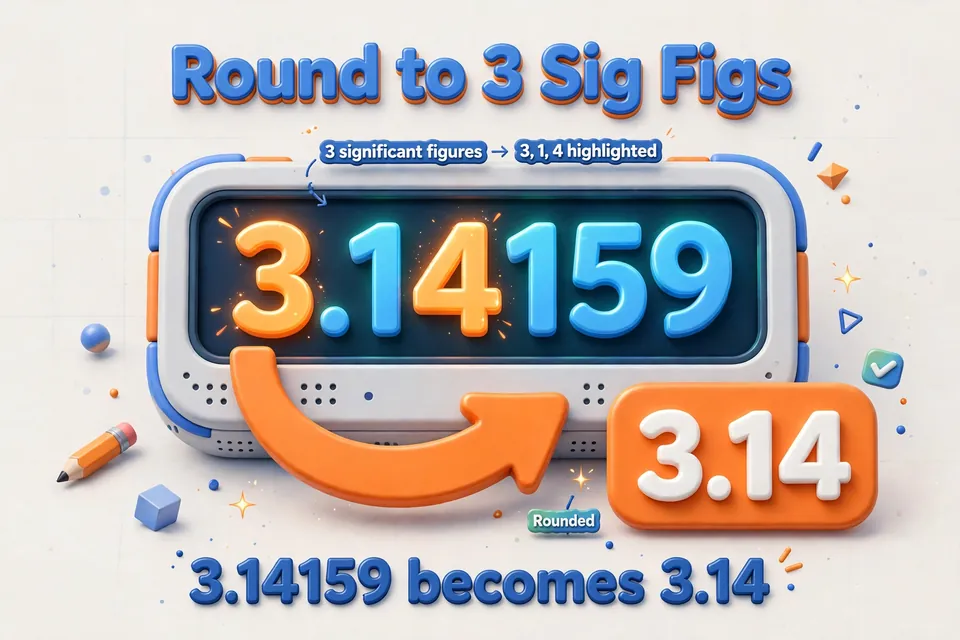
Rounding starts at the first non-zero digit and keeps the digits you asked for, then looks at the next digit. If it is 5 or more, the last kept digit goes up. If it is 4 or less, the kept digits stay. For 0.0045678 to 2 sig figs, the kept digits are 4 and 5, the next digit is 6, so the answer is 0.0046.
Rounding can carry into a new digit. For 9.996 to 3 sig figs, the kept digits 999 round up to 1000, so the answer is 10.0, still three significant figures. An exact half rounds away from zero, so 2.5 to 1 sig fig becomes 3 and -2.5 becomes -3. Some lab software rounds halves to the even digit instead, so check what your course expects.
Significant Figures vs Decimal Places
These two measure different things. Decimal places count every digit after the point, no matter where they start. Significant figures count meaningful digits from the first non-zero one. The number 0.002 has 3 decimal places but only 1 significant figure.
The difference matters in arithmetic. Adding lines up decimal places, while multiplying compares significant figures, which is why this calculator treats them separately. If your result needs a fixed number of decimal places, use the rounding calculator. If you are converting a rounded decimal into an exact fraction, the decimal to fraction converter keeps the working visible.
Frequently asked questions
How many significant figures does 0.00450 have?
Three: the 4, the 5, and the final 0. The leading zeros only place the decimal point, while the trailing zero was measured, so it counts.
How many significant figures are in 1200?
It is ambiguous, so the honest answer is 2 to 4. By the common convention the trailing zeros without a decimal point do not count, which gives 2. Write 1200. or 1.20 times 10 to the 3 to remove the doubt.
What happens when the dropped digit is exactly 5?
The calculator rounds away from zero, the usual classroom rule. So 2.5 to 1 sig fig becomes 3, and -2.5 becomes -3.
What is the difference between significant figures and decimal places?
Decimal places count all digits after the point. Significant figures count meaningful digits from the first non-zero digit. The number 0.002 has 3 decimal places but only 1 significant figure.
Does scientific notation change the number of significant figures?
No, it only removes ambiguity. The number 6.022 times 10 to the 23 has 4 significant figures, exactly the same as 6.022, because the power of ten never adds or removes significance.
Related calculators

Binary Converter
Convert between binary, decimal, octal, and hex.
Use calculatorScientific Notation Converter
Standard form to scientific notation and back.
Use calculatorRounding Calculator
Round to tens, ones, tenths, or significant figures.
Use calculatorModulo Calculator
Remainder of any division, with full working steps.
Use calculatorPercentage Calculator
Find P percent of any number, with steps.
Use calculatorFraction Calculator
Add, subtract, multiply, and divide fractions.
Use calculatorDecimal to Fraction Converter
Turn decimals into simplified fractions, with steps.
Use calculatorHex Converter
Convert between hex, decimal, binary, and octal.
Use calculatorOctal Converter
Convert between octal, decimal, binary, and hex.
Use calculatorExponent Calculator
Raise any base to any exponent, with steps.
Use calculator