SAT Score Calculator
Enter your correct answers for each section of the Digital SAT to estimate your 400-1600 score, with section scores, percentile, and a likely score range. Every result is an estimate, because College Board converts scores with unpublished equating, not a fixed chart.
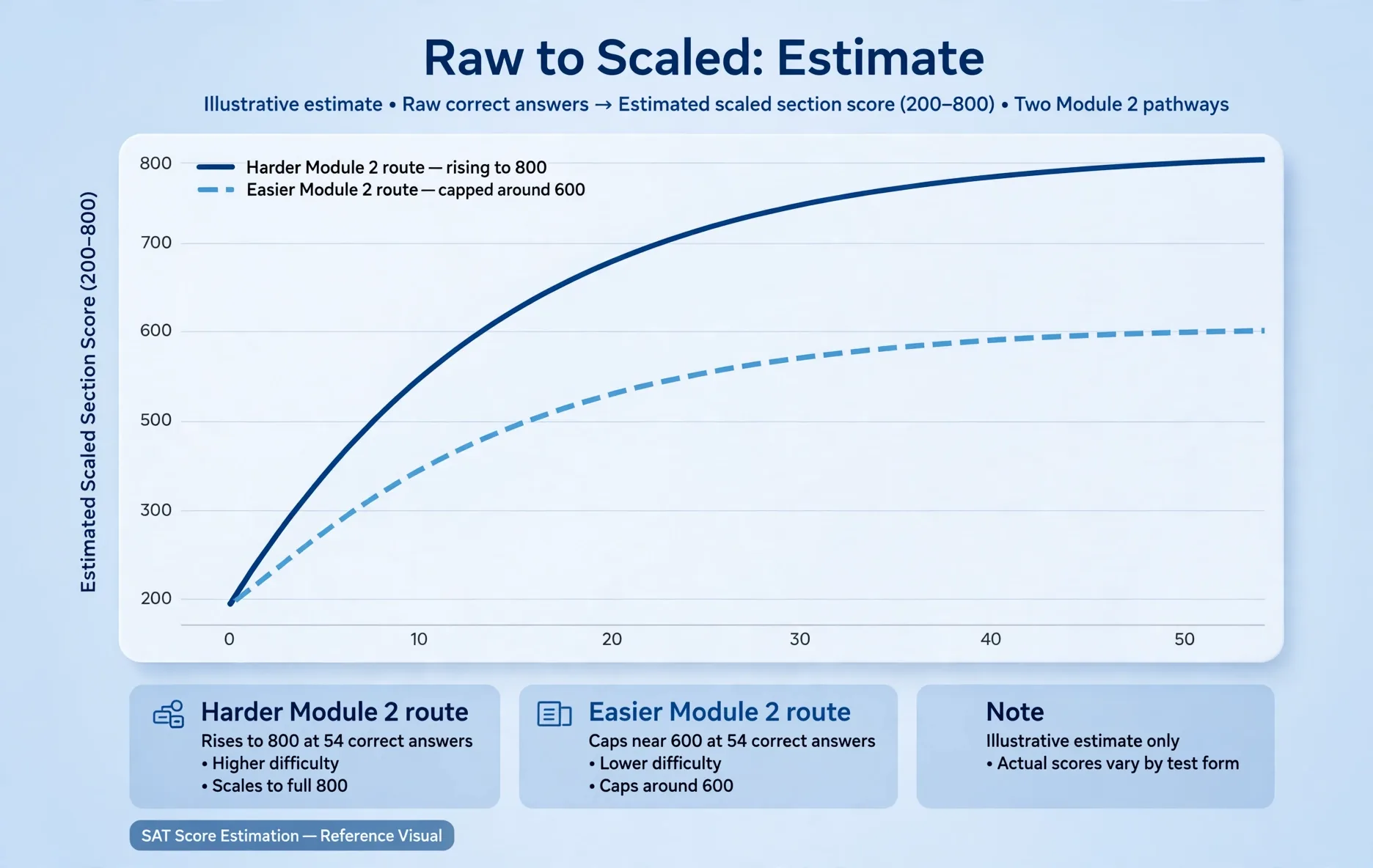
Formula. Estimated section score = 200 + 600 x (correct answers / questions in the section) on the harder Module 2 route, or 200 + 400 x (correct answers / questions in the section) on the easier route, capped at 600. Estimated total = Reading & Writing + Math, with a likely range of plus or minus 40. This is an estimation model for planning, not official College Board scoring.

Formulas verified against standard references. Calculator logic tested with verified worked examples. Published: November 4, 2026 | Last updated: November 4, 2026. Our methodology
How the Digital SAT Is Scored
The Digital SAT has two sections, and each one is scored from 200 to 800. Your total score is the sum of the two section scores, so the full range runs from 400 to 1600.
Raw score to scaled score (and why it is not a fixed chart)
Your raw score is simply the number of questions you answer correctly. There is no penalty for wrong answers, so a guess is never worse than a blank. Each section also contains a few unscored pretest questions you cannot identify, which is one reason raw counts are only a starting point.
College Board converts your raw score to a scaled score using a statistical process called equating. Equating keeps scores fair across test dates, so a 700 earned in March means the same thing as a 700 earned in October. Because every test form is slightly different, the same raw count can produce slightly different scaled scores. That is why no single conversion chart is exact, and why every number from this calculator is an estimate.
Adaptive modules: Module 1 routes your Module 2
The Digital SAT is section-adaptive. Every student takes the same Module 1 in each section. Your Module 1 performance then routes you to a harder or easier Module 2, and that routing decides your scoring ceiling.
The harder Module 2 is the only path to the top of the scale. It can reach the full 800 per section. The easier Module 2 caps your section score near 600, no matter how many of its questions you answer correctly. This is the most important thing to understand about Digital SAT scoring. Doing well on Module 1 unlocks the harder Module 2, and that single routing decision can matter more than a handful of extra correct answers later.

Digital SAT Score Conversion Table (Approximate)
The table below shows what this calculator estimates for each raw count on the harder Module 2 route, which is the track most practice-test takers are on. Every value is an estimate rounded to the nearest 10, because College Board does not publish a fixed conversion chart.
| Reading & Writing correct (of 54) | Estimated score | Math correct (of 44) | Estimated score |
|---|---|---|---|
| 54 | 800 | 44 | 800 |
| 50 | 760 | 40 | 750 |
| 48 | 730 | 36 | 690 |
| 44 | 690 | 32 | 640 |
| 40 | 640 | 28 | 580 |
| 36 | 600 | 24 | 530 |
| 30 | 530 | 20 | 470 |
| 24 | 470 | 16 | 420 |
| 18 | 400 | 12 | 360 |
| 12 | 330 | 8 | 310 |
| 6 | 270 | 4 | 250 |
| 0 | 200 | 0 | 200 |
On the easier Module 2 route the same raw counts score lower and cap at 600. For example, 54 of 54 on the easier route estimates 600, 30 of 54 estimates 420 in Reading & Writing, and 30 of 44 estimates 470 in Math. Published conversion tables based on Bluebook practice tests, such as GradesNova's raw-to-scaled tables, show the same pattern of a lower ceiling on the easy track.
SAT Score Percentiles: Where Do You Rank?
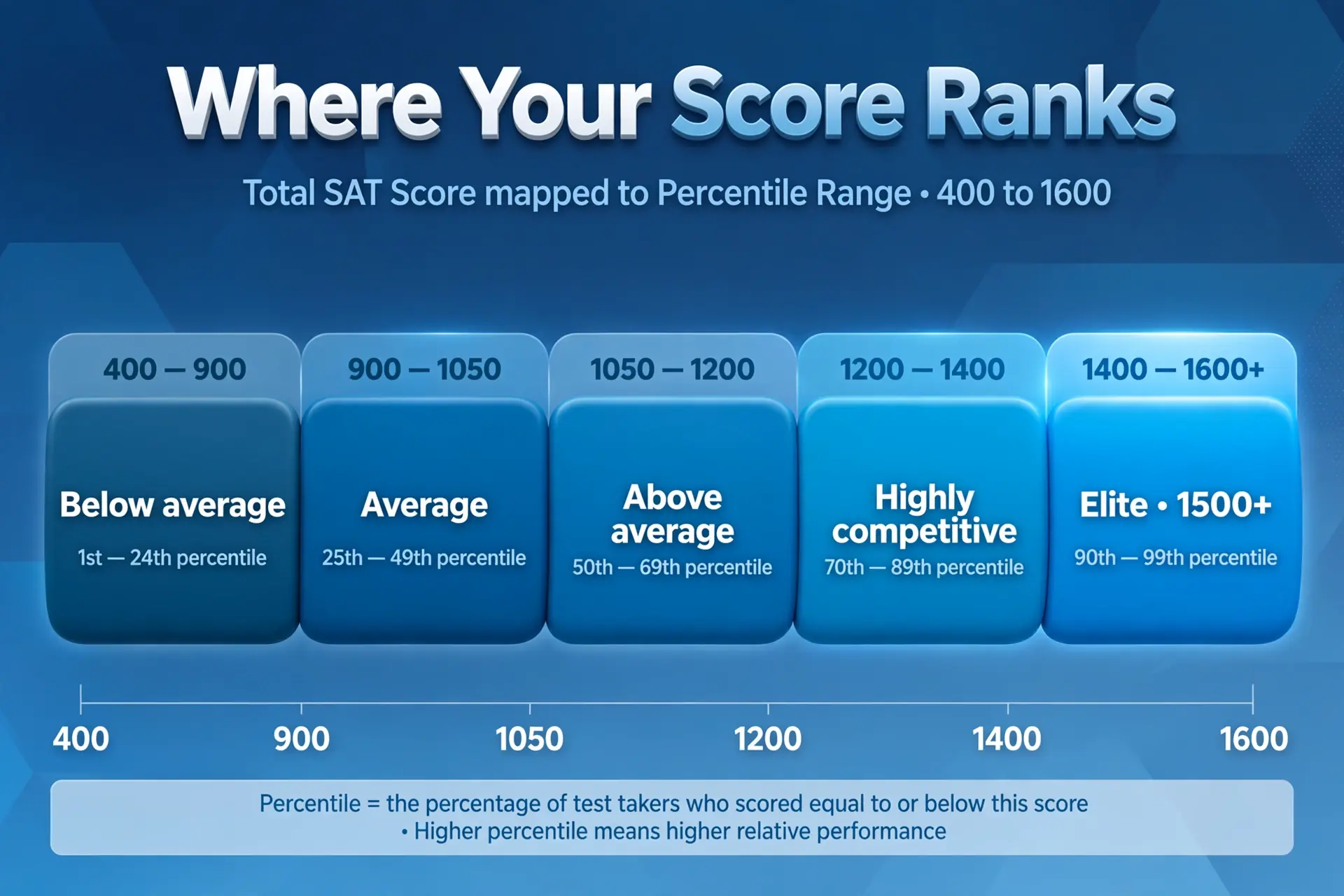
A percentile tells you what share of test takers you scored above. If you are at the 75th percentile, you outscored about 75 percent of the students who took the test. The calculator shows your approximate national user percentile with every estimate.
Total score percentile chart
The figures below are approximate national user percentiles based on published College Board data for the 2025-2026 testing year. The national average sits near 1050.
| Total score | Approximate percentile |
|---|---|
| 1600 | 99th+ |
| 1500 | 97th |
| 1400 | 93rd |
| 1300 | 82nd |
| 1200 | 74th |
| 1100 | 51st |
| 1050 | 43rd |
| 1000 | 35th |
| 900 | 19th |
| 850 | 9th |
Section score percentiles
Section scores follow the same idea. A section score of 700 is strong, a section score of 600 is around average, and a section score of 500 is below average for college-bound students. Because most students score their two sections within 100 points of each other, a big split usually points to one section that needs more prep. Your official College Board score report shows the exact section percentiles for your test date.
What Is a Good SAT Score?
A good SAT score depends on where you are applying, but the national picture gives you a frame. The national average is about 1050, so anything above 1200 is above average and anything at 1400 or higher puts you in the top 6 to 7 percent of test takers.
| Score band | Context |
|---|---|
| 1500-1600 | Elite, top 3 percent nationally. Competitive at Ivy League schools, Stanford, and MIT. |
| 1400-1490 | Highly competitive, top 6 to 7 percent. Strong at highly selective universities. |
| 1200-1390 | Above average, top 18 to 26 percent. Competitive at most state universities. |
| 1050-1190 | Around the national average. Enough for many four-year colleges. |
| 900-1040 | Below average. Fine for community colleges and less selective schools. |
| 400-890 | Well below average. Most students improve a lot with structured prep. |
Is 1200 a good SAT score? Yes, it is a solid above-average score at about the 74th percentile. It is competitive at many four-year universities and qualifies for merit scholarships at some schools. Is 1400 a good SAT score? It is an excellent score at about the 93rd percentile, competitive at highly selective universities. Always check the middle 50 percent range on each target college's admissions page, because that is the number that actually decides whether your score is strong for that school.
Understanding Your Result: How to Raise Your Score
Your estimate is built from two levers, and they are not equal. The first lever is Module 1 routing accuracy. The second lever is accuracy inside Module 2. Routing comes first, because it sets the ceiling that Module 2 accuracy can reach.
Here is a worked example. A student answers 48 of 54 correctly in Reading & Writing on the harder route and 40 of 44 correctly in Math on the harder route. Step 1. Convert the Reading & Writing raw count. 200 + 600 x (48 / 54) = 733.3, which rounds to an estimated 730. Step 2. Convert the Math raw count. 200 + 600 x (40 / 44) = 745.5, which rounds to an estimated 750. Step 3. Add the sections. 730 + 750 = an estimated total of 1480. Step 4. Read the context. 1480 sits at about the 95th percentile, which is the highly competitive band, with a likely range of 1440 to 1520.
Now imagine the same student had been routed to the easier Module 2 in both sections. The Math estimate would drop from 750 to about 560, because the easier route caps near 600 no matter how many questions are correct. That one routing decision costs roughly 190 points in Math alone. This is why careful work in Module 1 pays more than rushing. Slow down on the first module, protect your accuracy, and earn the harder Module 2. Then push your raw count inside it.
If your two sections are far apart, prep the weaker one first. Closing a 120-point section gap is usually faster than squeezing 30 more points out of your stronger section.
Superscoring: Combine Your Best Sections
Superscoring means combining your best section scores from different test dates into one composite. If you scored 690 in Reading & Writing and 520 in Math on your first sitting, then 640 in Reading & Writing and 750 in Math on your second sitting, your superscore is 690 + 750 = 1440. You keep the best of each section and drop the rest.
Many colleges superscore the SAT, including most highly selective schools and the vast majority of state universities. But not every school does, so check each college's testing policy before you plan a retake around superscoring. Some schools want all your scores, and a few consider only a single sitting.
The calculator above has a superscore mode for exactly this planning. Switch to two sittings, enter both sets of raw counts, and it shows which sitting supplies each section of your estimated superscore. If you want to double-check the percentage behind each section estimate first, the test score calculator turns correct answers into a raw percentage you can sanity-check against your practice test answer key.
SAT to ACT Score Conversion
The College Board and ACT publish an official 2018 concordance table that maps SAT totals to ACT composite scores. The calculator shows your ACT equivalent automatically. Use the conversion when you are deciding which test score to submit, because colleges accept both tests equally.
| SAT total | ACT composite |
|---|---|
| 1600 | 36 |
| 1500 | 34 |
| 1400 | 31 |
| 1300 | 28 |
| 1200 | 25 |
| 1100 | 22 |
| 1000 | 19 |
| 900 | 17 |
| 850 | 15 |
One rule of thumb. If you have taken both tests, submit the one with the higher percentile, not the higher raw number. A 1400 SAT and a 31 ACT are the same achievement in the eyes of admissions offices.
From Practice Test to Test Day (Bluebook)
The best practice material is the College Board's own Bluebook app. Its full-length practice tests use the same adaptive format as the real exam, and their published score curves are the closest thing to an official conversion that exists.
Treat your practice estimate as the center of a range, not a promise. The calculator shows a likely range of plus or minus 40 points for a reason. Test-day nerves, a harder form, or a different Module 2 route can all move your official score inside that band. If your practice estimate is 1480 with a range of 1440 to 1520, plan your college list around the lower half of the range and celebrate the upper half.
One practical tip. When you finish a Bluebook practice test, note which Module 2 you received in each section before you close the app. That one detail makes your estimate here much more honest, because the route selector can then match what actually happened instead of guessing.
PSAT Scores and the Path to the SAT
The PSAT uses the same digital, adaptive format as the SAT, but on a smaller scale of 320 to 1520. Think of it as a rehearsal with real stakes. It qualifies you for National Merit recognition through the Selection Index, and it previews the exact adaptive mechanics you will meet on the SAT.
A rough rule is that your PSAT score maps to a similar SAT score plus the growth you add through prep. A 1200 PSAT often grows into the high 1200s or low 1300s on the SAT after a few months of focused study, because the PSAT is slightly easier. The Selection Index that decides National Merit is a separate calculation from your PSAT score, and the cutoff changes by state each year.
Colleges weigh your SAT score alongside your grades, so keep both strong together. Use the GPA calculator to see where your grades stand while you plan your test prep, because a strong GPA plus a strong SAT score is the combination admissions offices notice first.
SAT Scores: Release Dates, Sending, and Retakes
When do SAT scores come out?
Digital SAT scores arrive fast. College Board typically releases them within 2 to 5 business days of your test date, much quicker than the old paper test. You view them in your College Board student account, which also shows your section scores, percentiles, and a score band around each number.
Sending scores is separate from seeing them. Score Choice lets you pick which test dates colleges see, unless a school's policy asks for all sittings. Send scores at least two weeks before application deadlines, and use the countdown calculator to track the days between your test date and each deadline.
Should you retake the SAT?
Retake when the math favors you. Three questions decide it. First, does your target college superscore, so your best sections combine? Second, how far is your estimate from your target score? Third, where are you on the curve? Students below 1400 often gain 50 to 100 points with focused prep, while gains above 1550 get much harder and smaller.
A practical framework. Retake if your estimate is within 100 points of your target and your dream school superscores. Skip the retake if you are already at or above the college's middle 50 percent range, because your time earns more in essays and coursework at that point. Never retake more than three times without a new prep plan, because repeating the same approach repeats the same score.
Frequently asked questions
How accurate is this SAT score calculator?
It is a planning estimate, not an official score. College Board scores the Digital SAT with unpublished IRT equating, so the same raw count can map to slightly different scores by test form. Expect your official score to land within about 40 points of the estimate shown here.
How is the Digital SAT scored?
Each section, Reading and Writing and Math, is scored from 200 to 800, and the two are added for a 400 to 1600 total. The test is section-adaptive: your Module 1 performance routes you to a harder or easier Module 2, which sets your scoring ceiling. There is no penalty for wrong answers.
What is a good SAT score?
It depends on your target colleges. Nationally, 1050 is about average, 1200 is above average at roughly the 74th percentile, 1400 is excellent at about the 93rd percentile, and 1500 or higher is elite at the 97th percentile or above. Check each college's middle 50 percent range for the real answer.
Is 1200 a good SAT score? Is 1400 a good SAT score?
A 1200 is a solid above-average score at about the 74th percentile, competitive at many four-year universities. A 1400 is an excellent score at about the 93rd percentile, competitive at highly selective universities and strong for merit scholarships.
What happens if I get routed to the easier Module 2?
Your section score is capped near 600, even with a perfect raw count on that module. The harder Module 2 is the only path to scores above roughly 650 to 700 per section. This is why accuracy on Module 1 matters so much: it decides which Module 2 you receive.
Do colleges superscore the SAT?
Many do, including most highly selective schools and the vast majority of state universities, combining your best Reading and Writing and Math sections across test dates. Some schools do not superscore or ask to see all sittings. Check each college's testing policy before planning retakes around a superscore.
How do I convert my SAT score to an ACT score?
Use the official 2018 College Board and ACT concordance table. Common conversions are 1600 to 36, 1500 to 34, 1400 to 31, 1300 to 28, 1200 to 25, 1100 to 22, and 1000 to 19. The calculator above shows your ACT equivalent automatically.
When will I get my official SAT score?
College Board typically releases Digital SAT scores within 2 to 5 business days of the test date. You view them in your College Board student account, which also shows your section scores, percentiles, and a precision score band around each number.
Related calculators

Test Score Calculator
Convert correct answers into a test score percentage.
Use calculatorGPA Calculator
Compute your semester GPA from course grades and credit hours.
Use calculatorFinal Grade Calculator
Find the grade you need on the final to reach your target.
Use calculatorGrade Calculator
Turn raw scores into letter grades and percentages fast.
Use calculatorAttendance Calculator
Track class attendance and see how absences affect your record.
Use calculatorCGPA Calculator
Calculate your cumulative GPA across all semesters.
Use calculatorQuiz Grade Calculator
Grade quizzes quickly from points earned and points possible.
Use calculatorTuition Calculator
Estimate total college tuition and see how costs add up by year.
Use calculatorCGPA to Percentage Converter
Convert your CGPA to a percentage on the standard scale.
Use calculator