Test Score Calculator: Points, Percentage and Letter Grade
Turn points earned and max points into a percentage and letter grade — for a single test or a whole set of quizzes and assignments.
Formulas verified against standard references. Calculator logic tested with verified worked examples. Last reviewed: October 2026. Our methodology
How the test score is calculated
A test score is the share of the available points you earned, written as a percentage:
Percentage = (points earned ÷ max points) × 100
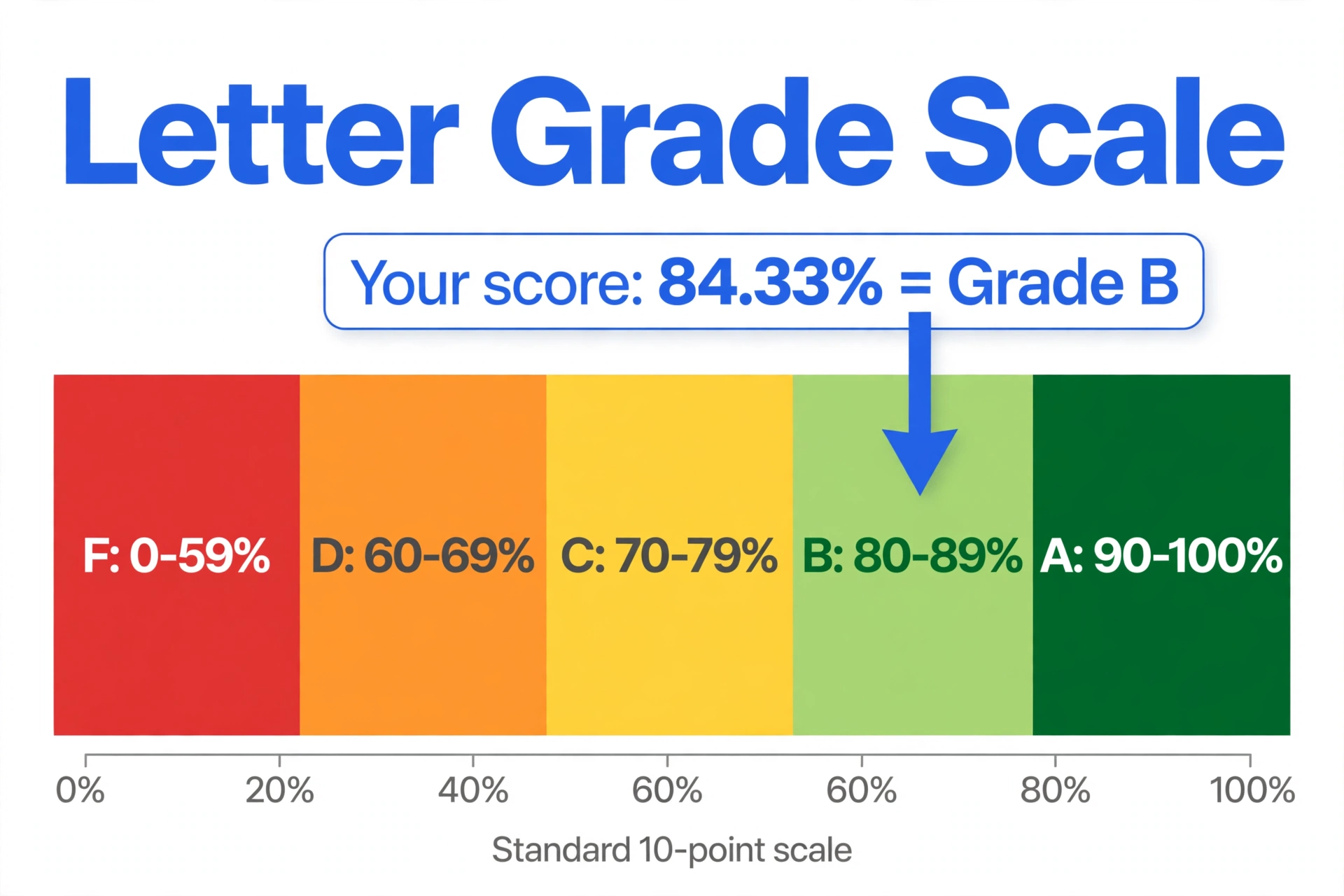
With more than one test, the calculator adds first and divides once: overall percentage = (total points earned ÷ total points possible) × 100. The letter grade then comes from the scale you selected — 84.33% is a B on the standard scale, a B on the plus/minus scale, and a pass on the pass/fail scale.
Worked example
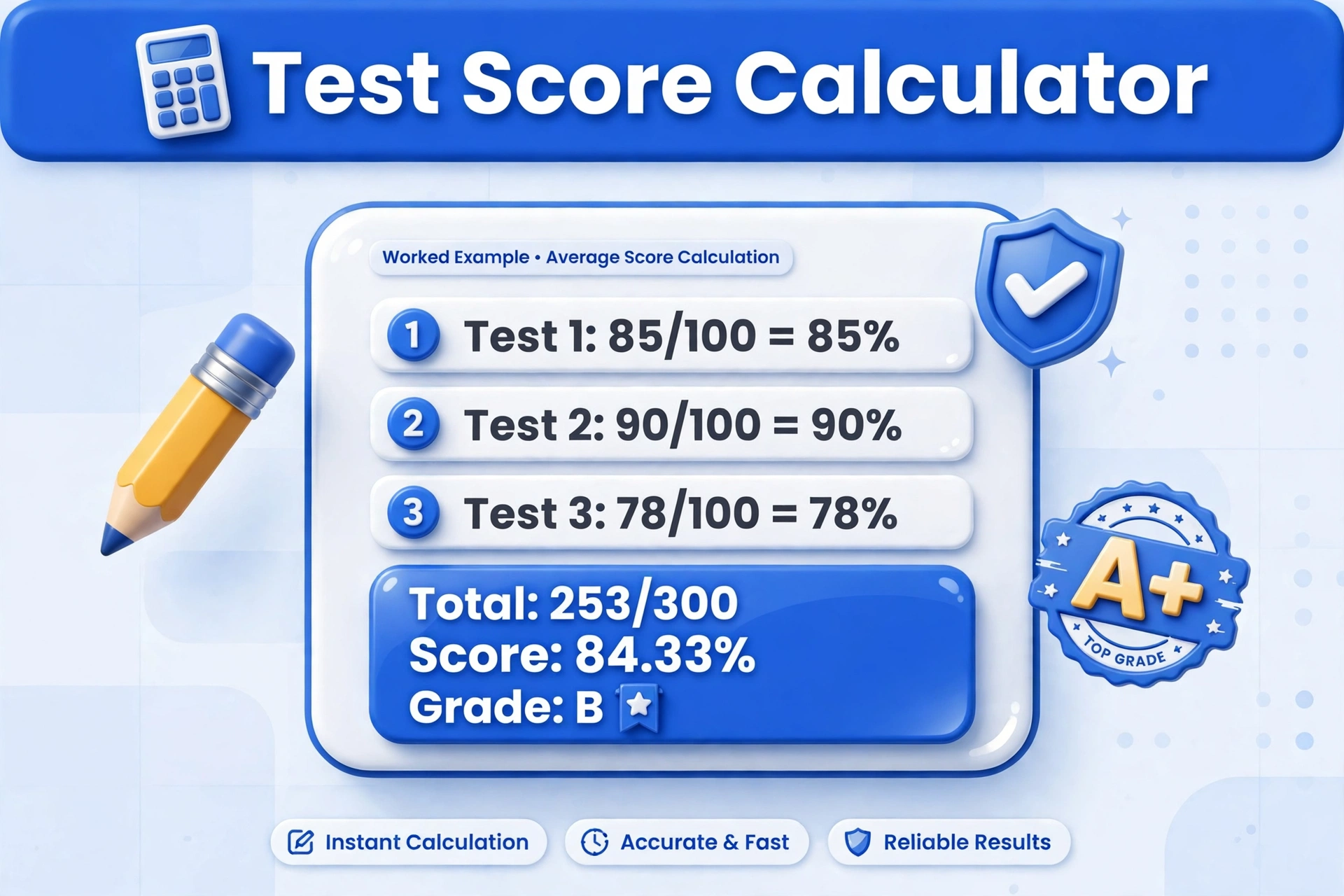
Three tests: 85/100, 90/100 and 78/100.
- Total points earned: 85 + 90 + 78 = 253
- Total points possible: 100 + 100 + 100 = 300
- Overall percentage: 253 ÷ 300 × 100 = 84.33%
- Letter grade on the standard scale: B
Each test also gets its own percentage: 85%, 90% and 78%.
How to use the test score calculator
Enter the points you earned and the max points for each test, quiz or assignment. The calculator totals everything and returns one percentage, one letter grade, and a per-test breakdown so you can see exactly where the points came from.
Step by step
- Enter your scores. Each row takes points earned and max points. You start with three rows — use "Add another test" for more, or Remove to drop a row.
- Pick a grading scale: Standard, Plus/Minus or Pass/Fail.
- Click Calculate. Your totals, percentage, letter grade and a per-test table appear below the form.
What you get
- Total points earned and total points possible
- Overall percentage, to two decimals
- Letter grade from your chosen scale
- Per-test breakdown: each test's own percentage and grade
Completely empty rows are skipped, so spare rows never break the math. Extra credit works too — if you earned more than the max points, the percentage can rise above 100%.
Letter-grade scales: standard, plus/minus and pass/fail
The standard 10-point scale is the most common in US schools: 90 and up is an A, the 80s a B, the 70s a C, the 60s a D, and anything below 60 an F. The plus/minus scale splits each band into three finer grades. Pass/fail skips letters entirely and only checks whether you cleared the bar.
| Percentage | Standard | Plus/Minus |
|---|---|---|
| 97–100% | A | A+ |
| 93–96% | A | A |
| 90–92% | A | A− |
| 87–89% | B | B+ |
| 83–86% | B | B |
| 80–82% | B | B− |
| 77–79% | C | C+ |
| 73–76% | C | C |
| 70–72% | C | C− |
| 67–69% | D | D+ |
| 63–66% | D | D |
| 60–62% | D | D− |
| 0–59% | F | F |
On the pass/fail scale the cut is simple: Pass at 60% or above, Fail below 60%.
These bands follow the widely used US convention, but schools set their own cutoffs — some drop the pluses and minuses, some move the pass line. The College Board publishes one commonly used conversion (A at 90–100, B at 80–89) and notes that grading scales differ between schools, so check your syllabus for the exact bands your teacher uses.
Why you should not average the percentages
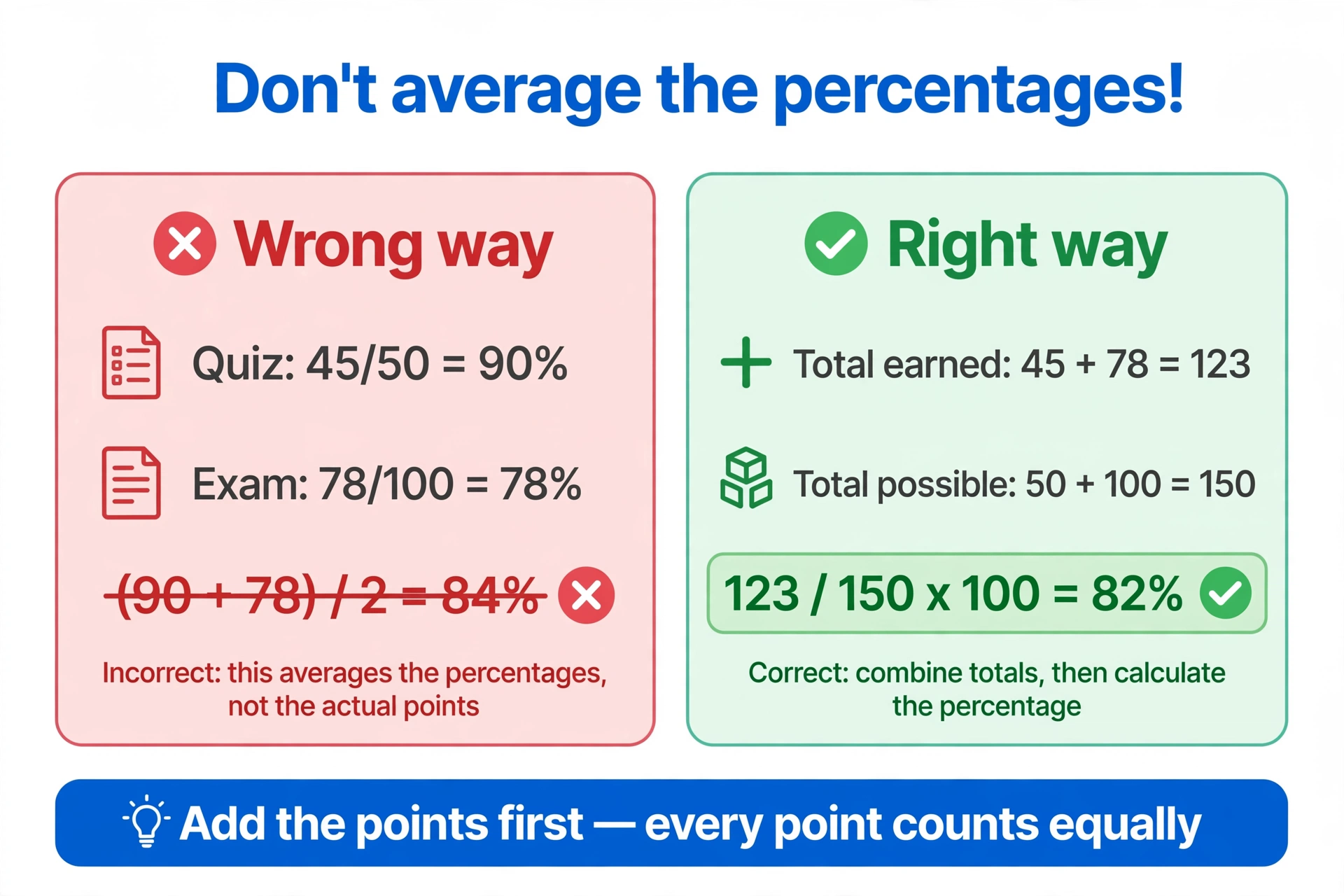
The most common test-score mistake is averaging each test's percentage. It looks right, but it gives every test the same weight even when the point totals differ. Take a 45/50 quiz (90%) and a 78/100 exam (78%):
- Wrong: (90 + 78) ÷ 2 = 84%
- Right: (45 + 78) ÷ (50 + 100) × 100 = 123 ÷ 150 × 100 = 82%
The naive average says 84%, but you only earned 123 of 150 points — 82%. The quiz counted for 50 points and the exam for 100, so the exam should pull twice as hard. Adding the raw points first gets the weighting right automatically, because every point counts equally.
Averaging percentages only works when every test is out of the same total. The test score calculator always uses the totals method, so mixed-point quizzes and exams come out correct.
If the test you are scoring has not happened yet and you want to plan backwards from a target instead, our final grade calculator tells you the score you need on the final to reach the grade you want.
Test score vs. course grade: which tool do you need?
A test score is raw scoring: points earned out of points possible on the tests you take. A course grade is what happens after the syllabus weighs those pieces — homework might count 20%, quizzes 30% and the final 50%. This calculator handles the raw part; it treats every point equally and does not apply category weights.
When your course weighs categories differently, use our grade calculator instead — it takes each category's weight and returns the weighted course grade. The two tools answer different questions: "how did I score on these tests?" versus "what is my grade in the course?"
Rule of thumb: same point totals across tests, or a single test → test score calculator. Categories with different weights → grade calculator. Grades across whole courses → GPA calculator.
Frequently asked questions
How do you calculate a test score percentage?
Divide the points you earned by the max points, then multiply by 100. For example, 85 points out of 100 is (85 ÷ 100) × 100 = 85%. The calculator does this for you, including the totals across several tests.
How does the calculator combine multiple tests?
It adds up all the points you earned and all the max points, then calculates one percentage from those totals. For 85/100, 90/100 and 78/100, that is 253 out of 300, or 84.33%. It never averages the individual percentages, which would be wrong when tests have different point totals.
What is the difference between the standard and plus/minus grading scales?
The standard scale uses five letters: A at 90%, B at 80%, C at 70%, D at 60% and F below 60%. The plus/minus scale splits each band into three finer grades, such as A+ (97–100%), A (93–96%) and A− (90–92%). The pass/fail scale only checks whether you reached 60%.
What grade is 84.33%?
On the standard scale, 84.33% is a B (the B band is 80–89%). On the plus/minus scale it is also a B (83–86%). On the pass/fail scale it is a pass.
Can a test score be over 100%?
Yes. If you earned extra credit and scored more than the max points, the percentage goes above 100%. For example, 52 points out of 50 is 104%. The calculator accepts earned points above the max.
What should I enter if I scored zero on a test?
Enter 0 for points earned and the test's max points as usual. The row still counts toward the totals, which is correct: a missed test drags the average down exactly as it should.
Is a test score the same as a course grade?
No. A test score is raw points turned into a percentage. A course grade applies the syllabus weights on top, for example homework 20%, quizzes 30% and the final 50%. For weighted courses, use a grade calculator; for raw test scoring, this calculator is the right tool.
Related calculators

GPA / CGPA Calculator
Calculate your weighted grade point average from courses, grades, and credit hours.
Use calculator
Grade Calculator
Compute your weighted course grade and the final score you need.
Use calculatorFinal Grade Calculator
See your current grade and the final score you need.
Use calculator