GPA Calculator
Add your courses with their grades and credit hours to calculate your weighted grade point average instantly. See the formula, a worked example, and how each course affects your GPA.
How the GPA calculator works
A GPA calculator turns your list of courses into a single number that summarizes your academic performance. Enter each course name, the grade you earned, and its credit hours. The calculator converts every letter grade to grade points, multiplies by the course credits, and divides by your total credits.
Because credits act as weights, a high grade in a 4-credit course moves your GPA more than the same grade in a 1-credit course. This is called a weighted GPA, and it is the standard method used by most colleges and universities. If you want to see what share of your total points each course contributes, our percentage calculator can break that down.
The GPA formula
GPA is a weighted average. Each course contributes its grade points multiplied by its credit hours, and the sum is divided by total credit hours:
GPA = Σ(grade points × credit hours) ÷ Σ(credit hours)
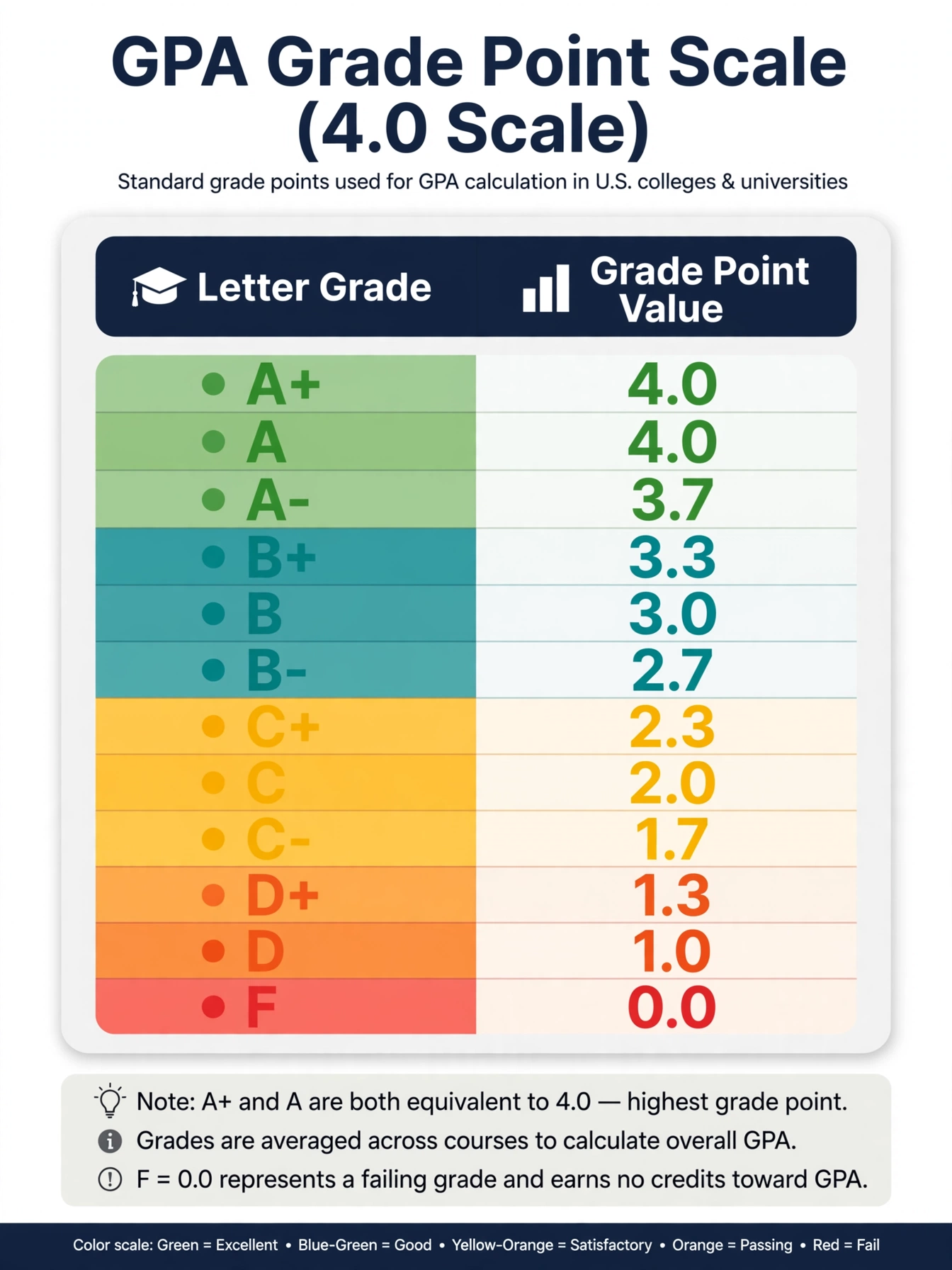
On the standard 4.0 scale, an A is worth 4.0 points, a B is 3.0, a C is 2.0, a D is 1.0, and an F is 0.0, with plus and minus grades falling in between. The table below shows the full mapping used by this calculator.
| Letter grade | Grade points | Letter grade | Grade points |
|---|---|---|---|
| A+ | 4.0 | C+ | 2.3 |
| A | 4.0 | C | 2.0 |
| A- | 3.7 | C- | 1.7 |
| B+ | 3.3 | D+ | 1.3 |
| B | 3.0 | D | 1.0 |
| B- | 2.7 | F | 0.0 |
Worked example
Say you took three courses this semester:
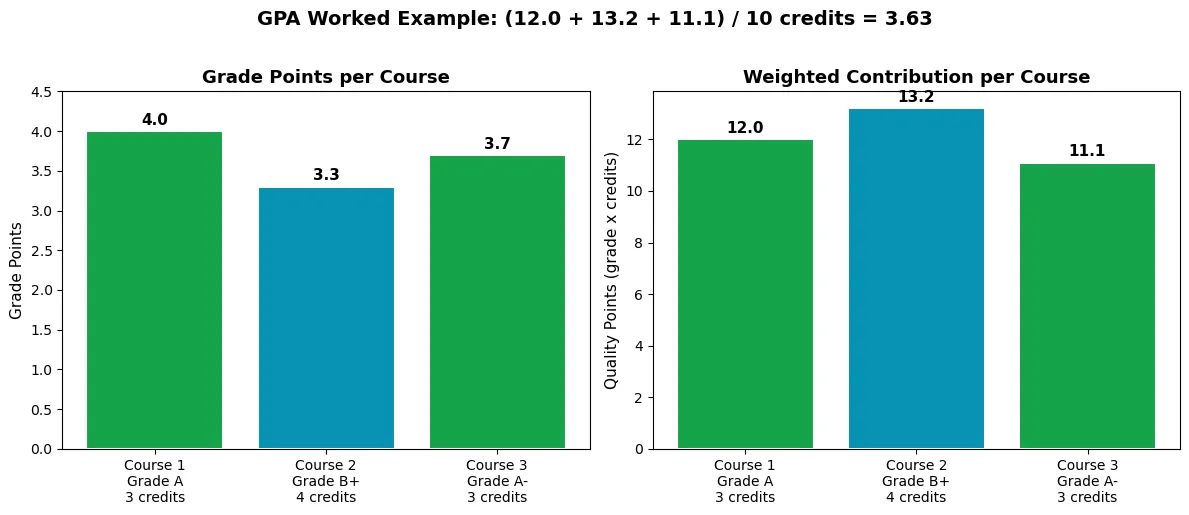
| Course | Grade | Credits | Grade points × credits |
|---|---|---|---|
| Calculus | A (4.0) | 3 | 12.0 |
| History | B+ (3.3) | 4 | 13.2 |
| Chemistry | A- (3.7) | 3 | 11.1 |
Total quality points = 12.0 + 13.2 + 11.1 = 36.3. Total credits = 10. GPA = 36.3 ÷ 10 = 3.63. Notice how the B+ in the 4-credit History course contributes the most points (13.2) despite not being the highest grade.
Weighted vs unweighted GPA
An unweighted GPA treats every course equally: it averages grade points without considering credit hours. A weighted GPA — the method this calculator uses — gives more influence to courses with more credits, which matches how most universities compute it.
Some high schools also add bonus points for honors or AP courses (for example, an A in an AP class counts as 5.0 instead of 4.0), producing weighted GPAs above 4.0. This calculator uses the standard unweighted 4.0 scale. If your school uses a different scale, convert your grades first or check whether your registrar publishes a conversion table. For quick arithmetic on converted values, the scientific calculator can help.
5 tips to improve your GPA
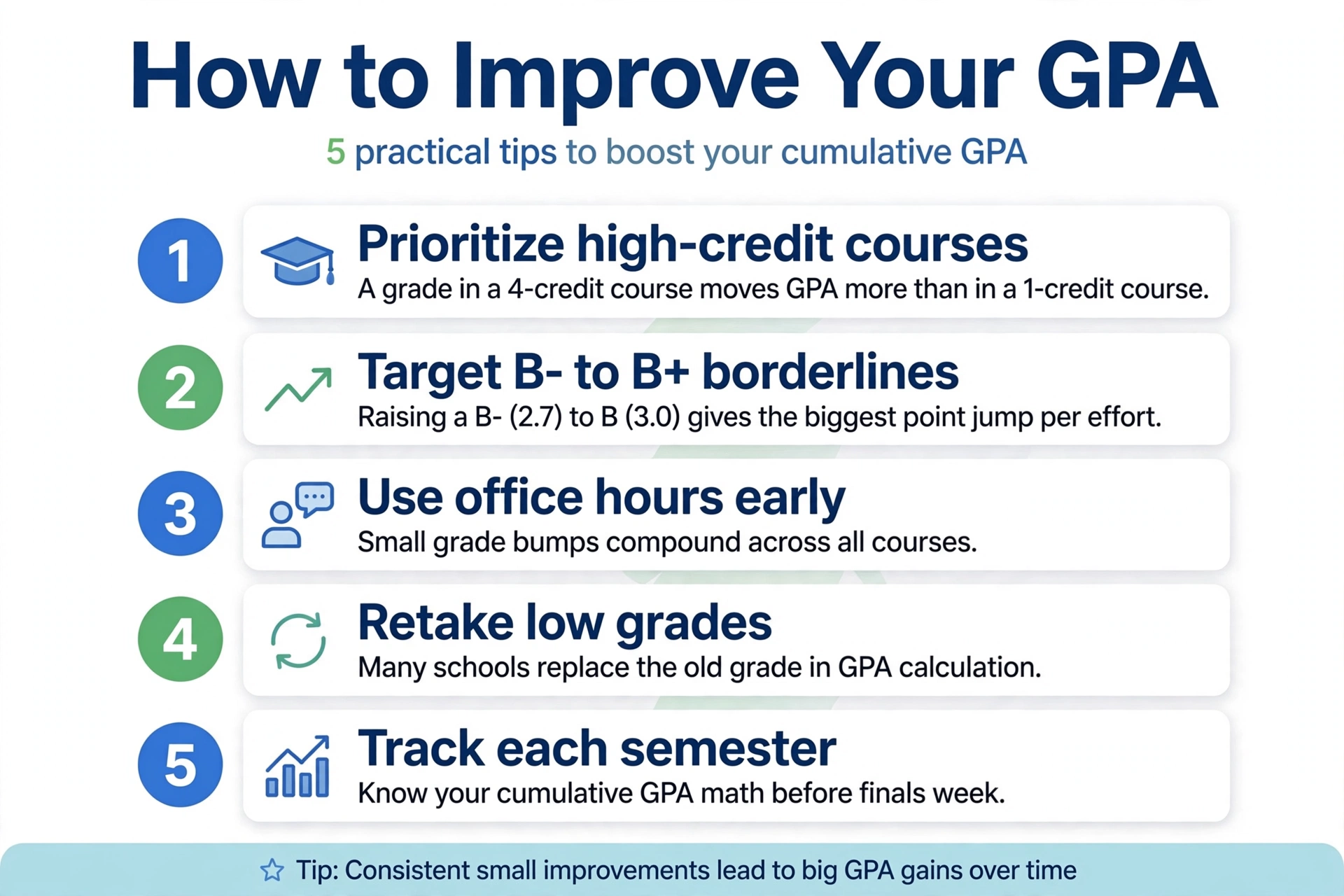
- Prioritize high-credit courses. An A in a 4-credit course adds 16 quality points; the same A in a 1-credit course adds only 4.
- Target borderline grades. Moving a B- (2.7) to a B (3.0) gains 0.3 points per credit — often the best return on study time.
- Use office hours early. Small bumps across several courses compound into a meaningful GPA lift.
- Ask about retake policies. Many schools replace the old grade when you retake a course, which can repair past damage.
- Track your GPA each semester. Knowing the math before finals lets you set realistic grade targets per course.
Frequently asked questions
How is GPA calculated?
GPA is a weighted average: multiply each course's grade points by its credit hours, add those products together, then divide by total credit hours. On the 4.0 scale, A = 4.0, B = 3.0, C = 2.0, D = 1.0, and F = 0.0, with plus/minus grades in between.
What is a good GPA?
It depends on your goals. A 3.0 (B average) meets most graduation requirements. A 3.5 or higher is generally competitive for graduate programs and many scholarships, while highly selective programs often look for 3.7 and above. Context matters: your major, school, and trend over time all count.
What is the difference between weighted and unweighted GPA?
Unweighted GPA averages grade points without considering credit hours, capped at 4.0. Weighted GPA accounts for credit hours (and sometimes adds bonus points for honors/AP courses), so it can exceed 4.0. This calculator computes the standard credit-weighted GPA on the 4.0 scale.
Do all schools use the same GPA scale?
No. While the 4.0 scale is the most common in the US, some schools use 4.3 or 5.0 scales, omit plus/minus grades, or weight honors courses differently. Always check your school's grading policy — this calculator uses the standard 4.0 scale shown in the grade table above.
How can I raise my GPA quickly?
Focus on high-credit courses where a grade bump earns the most quality points, and target borderline grades (like B- to B) for the biggest point gain per effort. Retaking a course you failed can also help if your school replaces the old grade. Consistent work across all courses beats cramming for one.
Does an F grade hurt my GPA a lot?
Yes. An F earns 0.0 grade points but its credit hours still count in the denominator, dragging the average down significantly. For example, an F in a 3-credit course contributes 0 quality points while adding 3 to total credits. Retaking the course is often the fastest way to recover if your school allows grade replacement.
Is GPA cumulative or per semester?
Both exist. Semester GPA covers one term; cumulative GPA covers all terms combined. To get your cumulative GPA, enter every course you have ever taken, or combine your prior cumulative GPA with new courses by treating the prior GPA as weighted by prior credits. Colleges and employers usually look at the cumulative figure.