Grade Calculator: Weighted Grades Made Simple
Wondering where you stand — or what you need on the final? Enter your graded items with their weights, and this free grade calculator will compute your current weighted grade and the exact final-exam score needed for any target.
Formulas verified against standard references. Calculator logic tested with verified worked examples. Last reviewed: October 2026. Our methodology
How weighted grades work
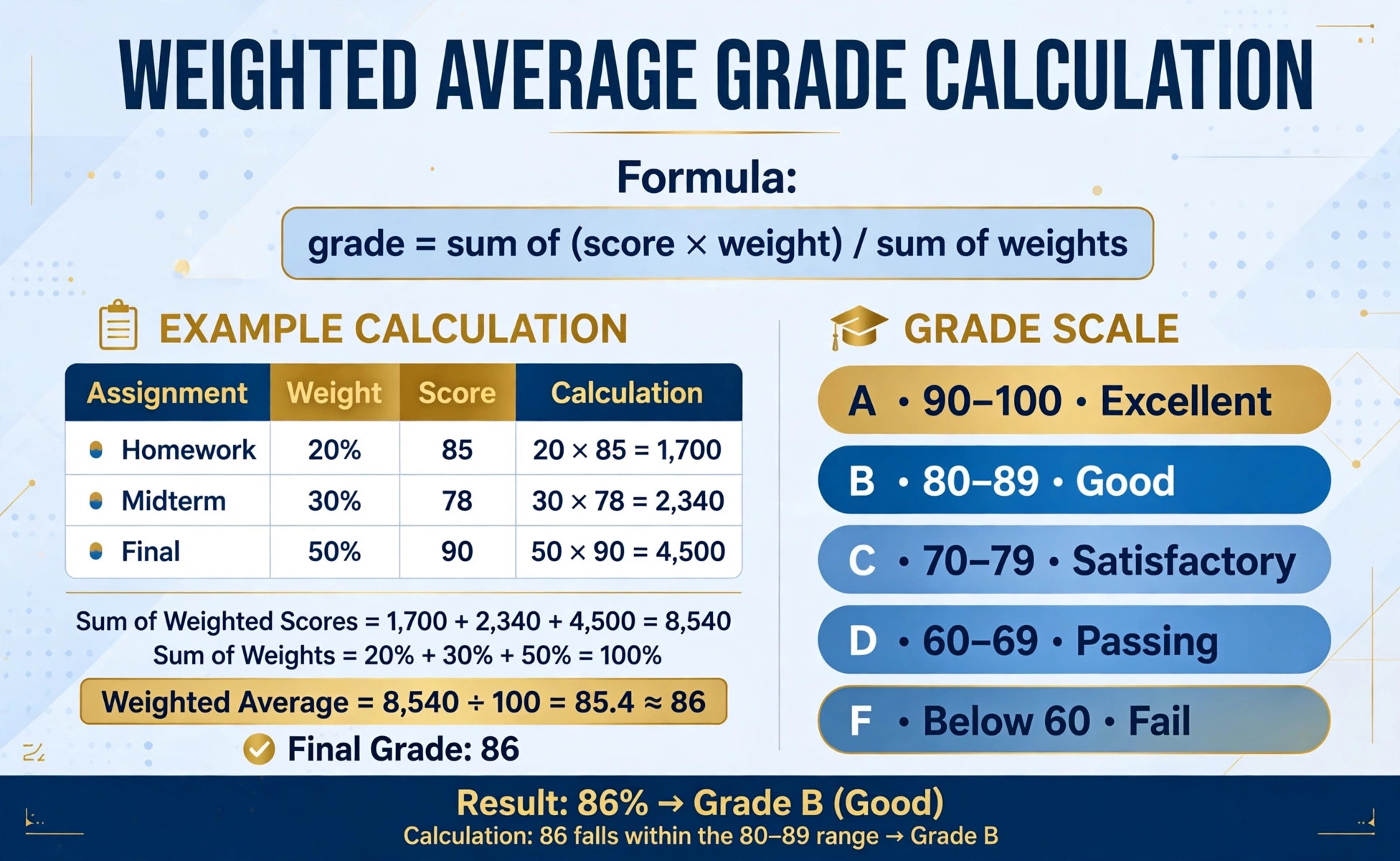
Not all assignments count equally. A weighted grade multiplies each score by its importance, then divides by total weight:
- Current grade = Σ(score × weight) ÷ Σ(weights) — add up every score-times-weight, divide by the weights’ total.
- Needed on final = (target × total weight − earned points) ÷ final weight — rearranges the same equation to solve for the unknown exam score.
- Weights don’t have to sum to 100 — the division handles any scale, though most syllabi use 100.
| Item | Score | Weight | Points |
|---|---|---|---|
| Homework | 85% | 20 | 17.0 |
| Midterm | 78% | 30 | 23.4 |
| Final | ? | 50 | ? |
| Total | 100 | 40.4 + 0.5 × final |
Current grade: 40.4 ÷ 50 = 80.8%. For a 90% target: (90 − 40.4) ÷ 0.5 = 99.2% needed on the final — steep but possible.
Worked example
Your syllabus: homework 20% (you scored 85), midterm 30% (you scored 78), final 50%. Target: 90%.
Earned points: 85 × 20 + 78 × 30 = 1,700 + 2,340 = 4,040. Completed weight: 50. Current grade: 4,040 ÷ 50 = 80.8%.
Needed on final: (90 × 100 − 4,040) ÷ 50 = (9,000 − 4,040) ÷ 50 = 4,960 ÷ 50 = 99.2%. You need near-perfection — time to negotiate extra credit or recalibrate the target.
How to use the grade calculator
Leave unused rows blank — only filled rows count. Weights can be percentages or points; just be consistent.
Step by step
- Enter each graded item’s score and weight. Use up to four rows: homework, quizzes, midterm, project — whatever your syllabus lists.
- Enter the final exam’s weight. The big one, often 30–50%.
- Enter your target course grade. The letter-grade cutoff you are aiming for.
- Press Calculate. Your current weighted grade appears, plus the exact final score you need.
- Read the verdict: over 100% means the target is out of reach; below 0% means you have already secured it.
Reading your syllabus like a strategist
Grade weights reveal where effort pays. Compare two syllabi:
| Syllabus A | Weight | Syllabus B | Weight |
|---|---|---|---|
| Homework | 30% | Homework | 10% |
| Midterm | 30% | Midterm | 25% |
| Final | 40% | Final | 65% |
In A, steady homework effort protects you; in B, almost everything rides on exams, so practice tests beat problem sets. Plug both scenarios into the calculator with your real scores — the "needed on final" number tells you instantly which course needs the rescue effort.
What to do when the final looks impossible
The calculator says you need 104%. Do not panic — you have options:
- Ask about extra credit before the final, not after. Many instructors would rather reward effort early.
- Check for dropped scores. If the lowest quiz is dropped, remove it from the calculator and watch the target fall.
- Recalibrate the target. The gap between an A and a B is rarely worth a breakdown; a realistic goal beats a fantasy one.
- Weight your study time by the final’s weight — a 50%-weighted final deserves half your course effort in the last weeks.
And remember the math cuts both ways: if you need only 40% on the final to keep your A, you can study calmly instead of cramming. A GPA calculator then rolls every course grade into your semester average.
Letter grades, GPA and the bigger picture
Course grades feed your GPA on a 4.0 scale:
| Letter | Range | Grade points |
|---|---|---|
| A | 90–100% | 4.0 |
| B | 80–89% | 3.0 |
| C | 70–79% | 2.0 |
| D | 60–69% | 1.0 |
| F | Below 60% | 0.0 |
Ranges vary by school and professor (some use plus/minus granularity), so confirm your syllabus’s cutoffs before targeting a letter. One course rarely decides a GPA — consistent B+ work across semesters beats one heroic A surrounded by C’s.

Frequently asked questions
How do you calculate a weighted grade?
Multiply each score by its weight, add the results, and divide by the total weight: Σ(score × weight) ÷ Σ(weights). Scores of 85 (weight 20) and 78 (weight 30) give (1,700+2,340) ÷ 50 = 80.8%.
How do I calculate what I need on my final?
Needed = (target × total weight − earned points) ÷ final weight. With 4,040 points earned of 50 completed weight, a 50%-weighted final and a 90% target: (9,000 − 4,040) ÷ 50 = 99.2% needed.
What if I need over 100% on the final?
The target is mathematically out of reach without extra credit or dropped scores. Recalculate with the lowest score dropped, ask about extra credit, or set a realistic target.
Do weights have to add up to 100?
No — the formula divides by the actual total, so points-based systems (e.g. 200/300 pts) work too. Just keep every weight in the same units.
How is GPA different from a grade?
A grade is one course’s result (often a percentage or letter); GPA averages all courses’ grade points (A=4.0, B=3.0…) weighted by credit hours. Use this calculator per course, then a GPA calculator for the semester.
Should I drop a low score before calculating?
Only if your syllabus actually drops it. Model both versions in the calculator — the difference shows exactly what the dropped-score policy is worth to you.
What is a good target grade?
One you can reach with focused effort. The calculator’s 'needed on final' is the reality check: 70–85% needed means study hard; 95%+ means also line up extra credit or adjust.