CGPA to Percentage Converter
Enter your CGPA and pick the conversion rule your board or university uses: CBSE x9.5, direct x10, VTU/Anna University, or a custom multiplier. Get the percentage, grade band, and a reverse verification.

Formulas verified against standard references. Calculator logic tested with verified worked examples. Last reviewed: November 2026. Our methodology
Why 9.5? The Story Behind the Multiplier
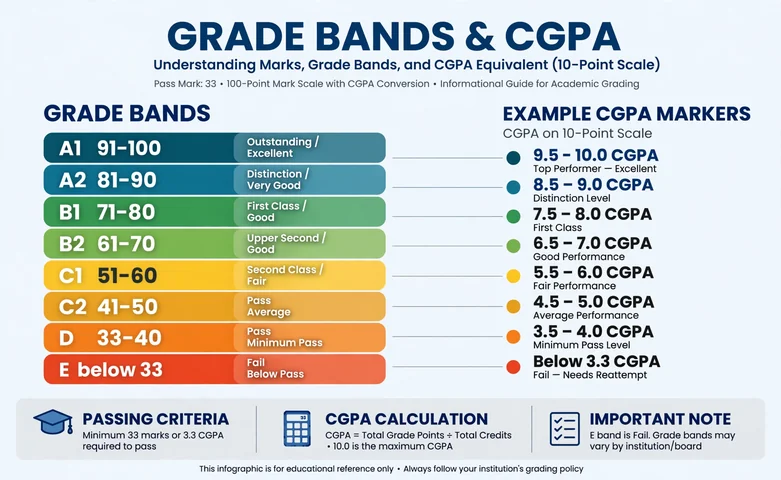
CBSE derived 9.5 empirically. Analyzing years of board results, it found that students earning the top A1 grade (91-100 marks) averaged about 95 marks. Dividing that 95 by the A1 grade point of 10 gives exactly 9.5, the anchor for the whole scale.
The point was fairness, not generosity: a 10 CGPA maps to 95%, a realistic ceiling, rather than 100%, which almost nobody actually scores. That is why percentage = CGPA x 9.5 remains the CBSE and AICTE standard.
Formulas Compared
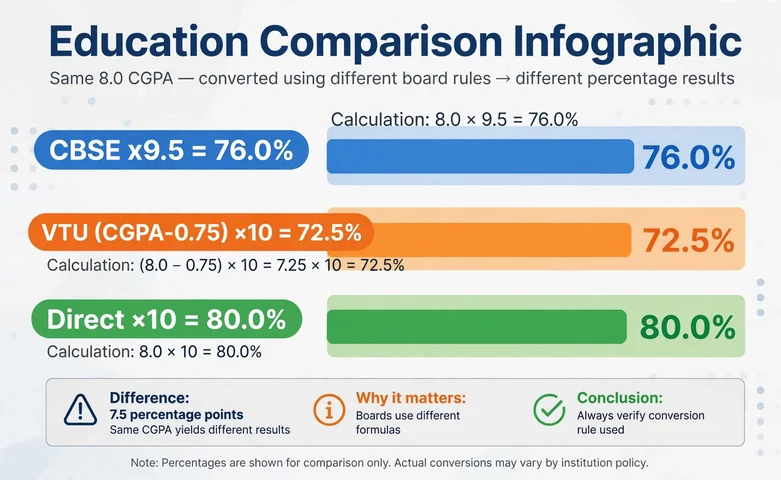
There is no single universal formula. CBSE uses x9.5, some universities use a straight x10, and VTU/Anna University use (CGPA - 0.75) x 10, which always lands below the CBSE figure. The same CGPA gives genuinely different percentages under different rules.
| Formula | Used by | 8.0 CGPA becomes |
|---|---|---|
| CGPA x 9.5 | CBSE, AICTE, Delhi University | 76.0% |
| CGPA x 10 | Some state universities | 80.0% |
| (CGPA - 0.75) x 10 | VTU, Anna University | 72.5% |
| (SGPA x 10) - 7.5 | Mumbai University | 72.5% |
Worked Examples
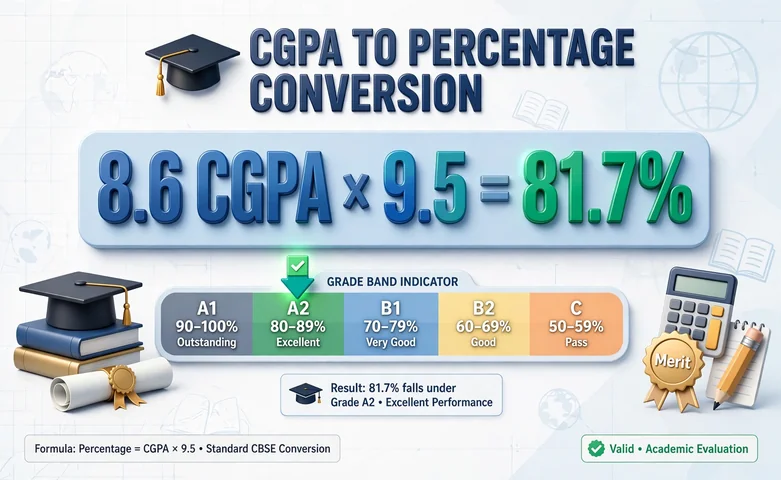
CBSE rule: a CGPA of 8.6 gives 8.6 x 9.5 = 81.7%, an A2 grade band. VTU rule: the same 8.6 gives (8.6 - 0.75) x 10 = 78.5%. Direct scale: 8.6 x 10 = 86.0%.
Reverse check: a percentage converts back by dividing by 9.5 under CBSE, so 81.7% / 9.5 = 8.6 CGPA. The calculator shows this reverse figure so you can verify the round trip.
Quick Conversion Table (CBSE x9.5)
Reference values under the CBSE rule, each exactly CGPA x 9.5. Bookmark this table for forms that ask for a percentage but only your CGPA is handy.
| CGPA | Percentage | CGPA | Percentage |
|---|---|---|---|
| 10.0 | 95.00% | 7.5 | 71.25% |
| 9.5 | 90.25% | 7.0 | 66.50% |
| 9.0 | 85.50% | 6.5 | 61.75% |
| 8.5 | 80.75% | 6.0 | 57.00% |
| 8.0 | 76.00% | 5.5 | 52.25% |
When to Use Which Formula
Use the formula your institution publishes, full stop. If your marksheet or university regulations print a conversion rule, that rule overrides every generic table on the internet, including this page. Admissions offices check against their own formula.
If no formula is published, CBSE's x9.5 is the safest default in India, and a straight x10 is the common fallback elsewhere. When in doubt, ask the exam section for a conversion certificate rather than guessing.
CGPA vs SGPA vs Percentage
SGPA is one semester's average; CGPA is the cumulative average across semesters. Percentage is the marks-based figure that some forms still demand. The three describe the same performance in different units, and converting between them is arithmetic, not judgment.
To build a CGPA from semester grades in the first place, the CGPA calculator averages your SGPAs, and the percentage calculator handles raw marks directly.
Frequently asked questions
How do you convert CGPA to percentage?
Multiply by your institution's factor. CBSE and AICTE use percentage = CGPA x 9.5, so 8.6 CGPA = 81.7%.
Why is CGPA multiplied by 9.5?
CBSE found that A1-grade students averaged about 95 marks; 95 divided by the grade point 10 gives 9.5. It maps a perfect 10 CGPA to 95%, a realistic ceiling.
What is the VTU formula for CGPA to percentage?
Percentage = (CGPA - 0.75) x 10. An 8.0 CGPA becomes 72.5%, lower than CBSE's 76.0% for the same CGPA.
How do you convert percentage back to CGPA?
Divide by the same factor: under CBSE, CGPA = percentage / 9.5, so 76% = 8.0 CGPA.
Is CGPA x 10 correct?
Only where your university says so. It overstates compared with CBSE's x9.5, so never use it for CBSE/AICTE forms.
What is the difference between CGPA and SGPA?
SGPA covers one semester; CGPA is the cumulative average across all semesters of the degree.
Which formula should I use on official forms?
The one printed on your marksheet or in your university's regulations. If none is printed, ask the exam section for a conversion certificate.