CGPA Calculator
Calculate your CGPA the way registrars do: each course weighted by its credit hours. Enter up to five courses with credits and letter grades on the standard 4.0 scale, optionally add your prior cumulative GPA and credits, and get your semester GPA, total quality points, per-course breakdown, and updated cumulative GPA.

Formulas verified against standard references. Calculator logic tested with verified worked examples. Last reviewed: October 2026. Our methodology
The Weighted Formula
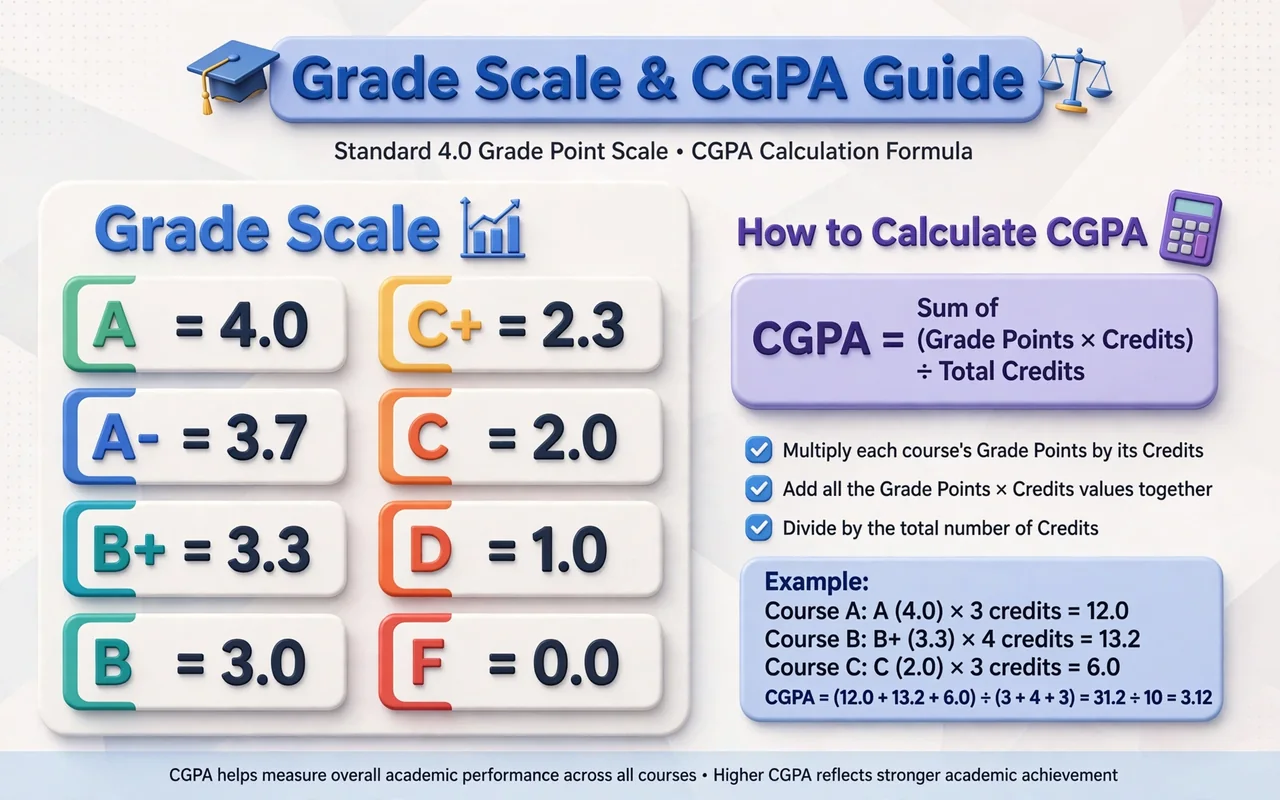
A CGPA is not an average of letter grades; it is a credit-weighted average. Each course contributes grade points × credit hours (its quality points), and the CGPA is total quality points ÷ total credits. A 4-credit A (16 quality points) pulls four times harder than a 1-credit A.
Example: A in a 4-credit course, B+ in a 3-credit course, C in a 3-credit course. Quality points: 16 + 9.9 + 6 = 31.9; credits: 10; CGPA = 3.190. A plain average of the three grades would have given a different, wrong number, because it ignores the credit weights.
| Course | Credits | Grade | Quality points |
|---|---|---|---|
| Biology | 4 | A (4.0) | 16.00 |
| Calculus | 3 | B+ (3.3) | 9.90 |
| History | 3 | C (2.0) | 6.00 |
| Total | 10 | 31.90 = CGPA 3.190 |
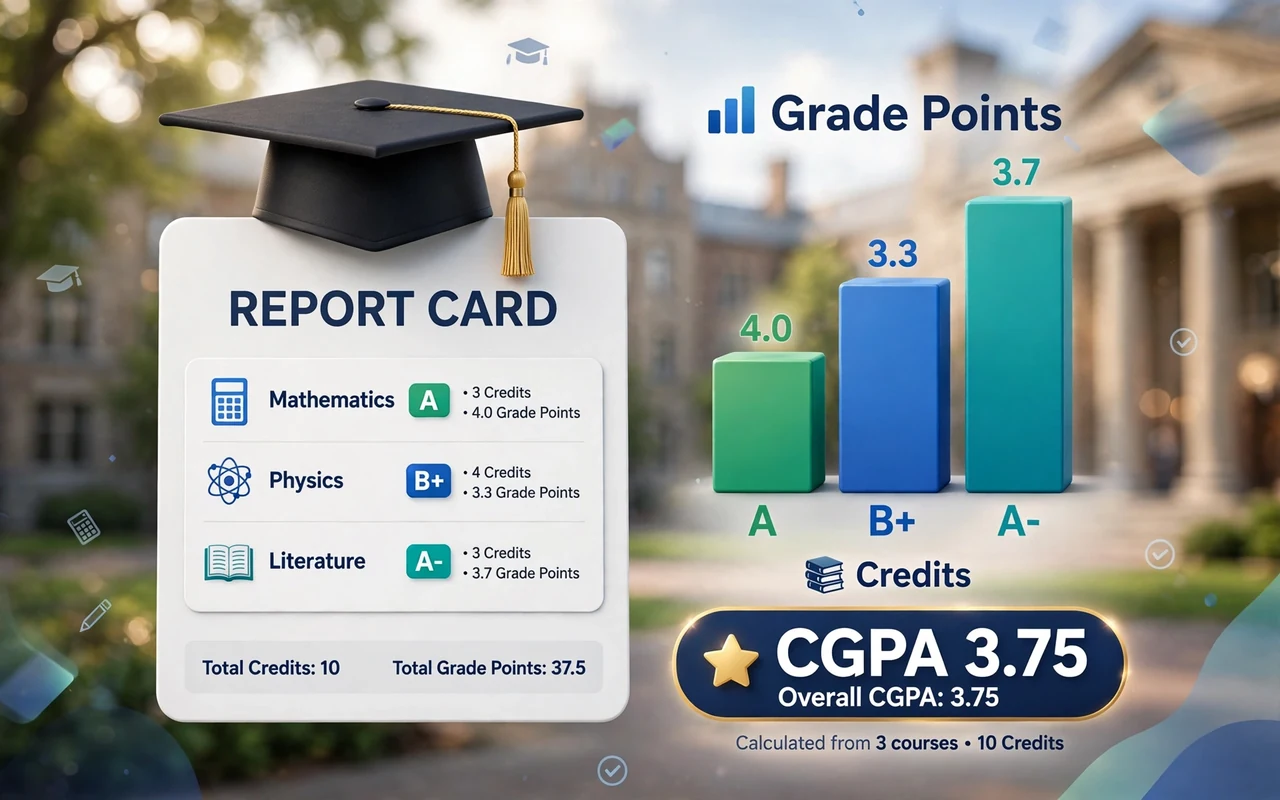
The 4.0 Grade Scale
The calculator uses the standard US 4.0 scale: A and A+ are 4.0, A- is 3.7, B+ is 3.3, B is 3.0, stepping down through C and D to F at 0.0. Plus and minus grades matter: swapping a B+ for a B in a 3-credit course moves quality points by 0.9.
Scales vary by institution, and some schools use 4.3 (A+ = 4.3) or percentage conversions, so confirm your school's table before treating the result as official. What never changes is the weighting logic: credits are the weights, whatever the scale.
| Letter | Points | Letter | Points |
|---|---|---|---|
| A / A+ | 4.0 | C+ | 2.3 |
| A- | 3.7 | C | 2.0 |
| B+ | 3.3 | C- | 1.7 |
| B | 3.0 | D | 1.0 |
| B- | 2.7 | F | 0.0 |
Semester vs Cumulative GPA
A semester GPA covers one term's courses; a cumulative GPA covers everything, weighted across terms. To fold a new term into your cumulative record, the calculator needs your prior GPA and prior credits: new cumulative = (prior GPA × prior credits + new quality points) ÷ (prior credits + new credits).
That is why early terms cast a long shadow: 60 prior credits at 3.0 absorb a 15-credit 4.0 term into a cumulative of only 3.2. Conversely, a rough first semester gets diluted as credits accumulate. Enter prior GPA and credits whenever you want the full picture, not just the term.
CGPA vs GPA: Clearing the Confusion
In US usage, GPA and CGPA are often the same number: the credit-weighted average. Some schools distinguish semester GPA (one term) from cumulative GPA (all terms). In several other countries, CGPA specifically means the cumulative figure across semesters, with SGPA for a single semester.
Whatever the local label, the math here is identical. If your school reports on a 10-point scale or as a percentage, convert first: the percentage calculator helps with the percentage side of grade math, and the GPA calculator covers the same 4.0-scale ground for quick checks.
Planning: What You Need Next Term
The formula runs backwards for planning. Suppose you have 30 credits at 3.0 and want a 3.5 cumulative after 15 more credits: you need (3.5 × 45 − 3.0 × 30) ÷ 15 = 4.5 average quality points per credit, which is impossible on a 4.0 scale, so the target needs more terms or a lower goal.
Do that reality check before the term starts, not after. It also shows why protecting high-credit courses matters most: one 4-credit A offsets a 3-credit C almost exactly.
Common Mistakes
Averaging the grade points without weighting by credits is the classic error; it overstates the impact of 1-credit labs and understates 4-credit cores. Second, mixing scales: entering percentage grades into a 4.0 table, or vice versa.
Third, forgetting that F still counts its credits in the denominator: a failed 3-credit course adds 0 quality points but 3 credits, dragging the average down twice over. Fourth, leaving the prior-credits field blank while entering a prior GPA, which silently computes a semester GPA labeled as cumulative. The calculator requires both or neither.

Frequently asked questions
How is CGPA calculated?
Multiply each course's grade points by its credit hours, add those quality points, and divide by total credits: CGPA = sum(grade points x credits) / sum(credits).
What is the difference between GPA and CGPA?
Often nothing: both are credit-weighted averages. Some schools use GPA for one term and CGPA (cumulative) for all terms combined.
Do credits really matter that much?
Yes. A 4-credit course affects your CGPA four times more than a 1-credit course with the same grade, because credits are the weights.
What grade scale does this use?
The standard US 4.0 scale: A/A+ = 4.0, A- = 3.7, B+ = 3.3, B = 3.0, down to F = 0.0. Confirm your school's scale for official use.
How do I include past semesters?
Enter your prior cumulative GPA and prior credits earned; the calculator folds the new term in with proper weighting.
Does an F hurt more than a low grade?
An F adds zero quality points but its credits still count in the denominator, so yes, it drags the average down harder than a D.
Can I plan what grades I need?
Yes, run the formula backwards: required average = (target x total credits - current points) / new credits. If it exceeds 4.0, the target needs more terms.