Reading Speed Test: Find Your Words Per Minute
Read the passage at your natural pace, timing yourself with the start and stop buttons. Your reading speed in words per minute appears instantly.

Formulas verified against standard references. Calculator logic tested with verified worked examples. Last reviewed: October 2026. Our methodology
How the Test Works
Press Start and read the 236-word passage at the pace you would use for a novel you enjoy. Do not skim or skip ahead. The moment you finish the last word, press Stop. Your speed is the word count divided by your minutes, shown instantly with a level from slow reader to speed reader.
Read for comprehension, not for the clock. A fast time with no memory of the passage is not really reading, so try summarizing it in a sentence before checking your score. The test rejects times under 3 seconds as accidental taps.
Reading Speed Benchmarks
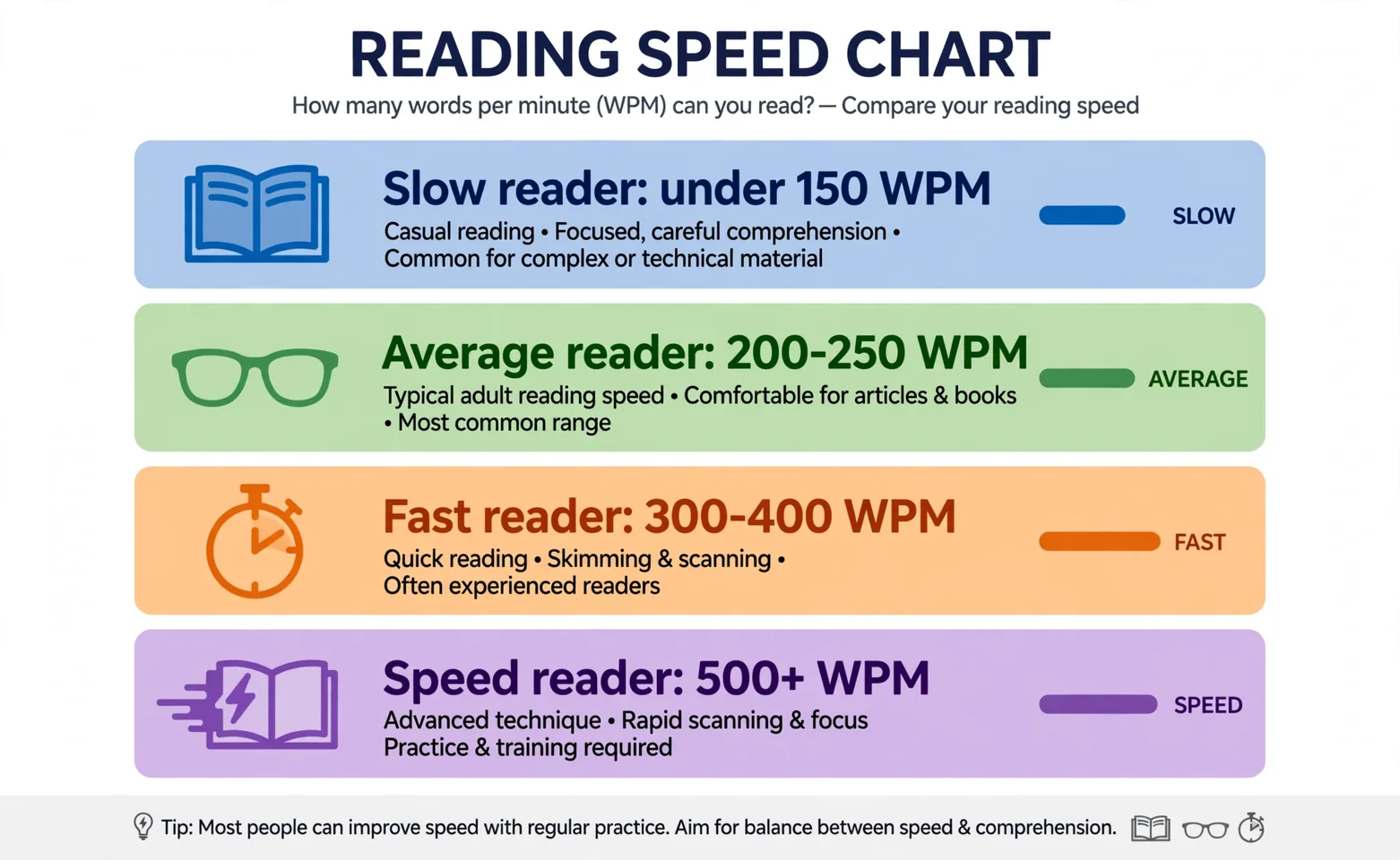
Most adults read 200 to 250 words per minute with good comprehension, which puts a typical paperback page at about two minutes. College students often land between 250 and 350 on familiar material. Self-described speed readers exceed 500, though studies consistently show comprehension falling as pace climbs past about 400.
Children's benchmarks run lower: 150 WPM is strong for a middle-schooler. Technical material also reads slower than fiction for everyone, so compare your score against the same kind of text, not against a single universal number.
| Level | WPM range | Typical reader |
|---|---|---|
| Slow reader | Under 150 | Young students |
| Average reader | 200-250 | Most adults |
| Fast reader | 300-400 | Practiced readers |
| Speed reader | 500+ | Trained, lower comprehension |
Worked Example
Suppose you finish the 236-word passage in 63 seconds. Convert to minutes: 63 / 60 = 1.05 minutes. Divide words by minutes: 236 / 1.05 = 225 WPM, a solid average adult pace. Finish in 40 seconds and the same passage gives 236 / 0.667 = 354 WPM, firmly in fast-reader territory.
To estimate book time from your pace, divide the book's word count by your WPM. An 80,000-word novel at 225 WPM takes about 356 minutes, just under 6 hours of reading. The reading time calculator does that book math for any word count.
| Time for 236 words | WPM | Level |
|---|---|---|
| 90 seconds | 157 | Slow reader |
| 63 seconds | 225 | Average reader |
| 40 seconds | 354 | Fast reader |
What Slows Readers Down
Subvocalization, sounding out every word in your head, caps most readers near 250 WPM because inner speech cannot go much faster. Regression, the eyes jumping back to reread lines, quietly doubles the work on difficult passages. A narrow eye span that takes in one word at a time multiplies the fixations each line needs.
Fix the cheapest problems first: use a finger or cursor to guide your eyes and cut regressions, then practice taking in two or three words per fixation on easy material. Only then worry about subvocalization, which fades naturally as phrase reading improves.
Improving Without Losing Comprehension
Preview before you read: scan headings and first sentences so your brain knows what is coming, which makes the full pass faster. Read in phrases rather than words, and push your eyes slightly ahead of your inner voice instead of sounding out each syllable.
Track one number weekly, your WPM on similar material, and watch the trend rather than any single run. Ten seconds saved per page compounds into hours over a book. And protect comprehension deliberately: pause every few pages and recall the main point before continuing.
Common Mistakes
The most common mistake is skimming during a test and counting it as reading. If you cannot summarize the passage afterward, the WPM number is meaningless. The second is testing on much harder or easier material than usual and comparing the scores directly.
A third mistake is chasing WPM alone. Reading you enjoy at 220 WPM beats joyless sprinting at 400 WPM that you abandon after a week. Balance pace with pleasure, because the best reading speed is the one you will actually keep using.

Frequently asked questions
What is a good reading speed?
200 to 250 words per minute with good comprehension is the adult average. 300-plus is fast, and 500-plus is speed-reader territory, usually with lower comprehension.
How is reading speed calculated?
Words read divided by minutes taken. A 236-word passage finished in 63 seconds (1.05 minutes) gives 225 WPM.
Does speed reading hurt comprehension?
Past about 400 WPM, comprehension typically drops in studies. Techniques that preserve understanding, like phrase reading and previewing, beat raw sprinting.
How can I read faster?
Reduce rereading with an eye guide, take in phrases instead of single words, preview headings first, and practice weekly on similar material.
Why is my speed different on hard material?
Technical or dense text demands more processing per word, so everyone reads it slower. Compare scores only across similar difficulty.
How long will a book take me?
Divide its word count by your WPM. An 80,000-word novel at 225 WPM takes about 6 hours of reading.
Should children take this test?
Yes, with expectations adjusted: around 150 WPM is strong for a middle-schooler, and the passage suits teens and adults best.