Reading Time Calculator: How Long to Read Any Text
Enter a word count and your reading speed to get the reading time, the speaking time for reading aloud, and how many 30-minute sessions the text needs.
Formulas verified against standard references. Calculator logic tested with verified worked examples. Last reviewed: October 2026. Our methodology
The One Formula Behind Reading Time
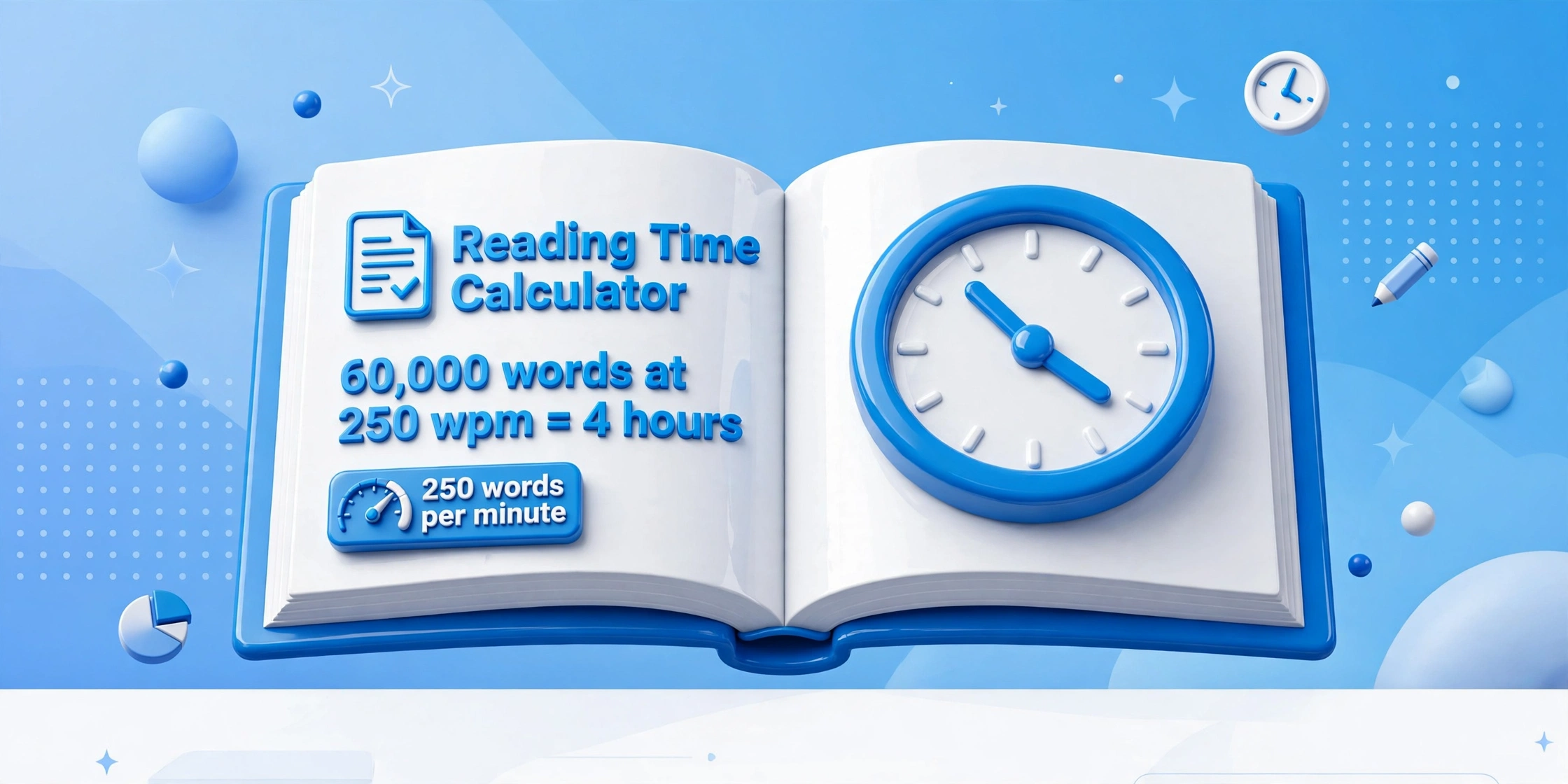
Reading time is word count divided by reading speed. A 60,000-word book at 250 words per minute takes 240 minutes, which is 4 hours. A 1000-word article at the same speed takes 4 minutes. The formula is that simple, and the only hard part is choosing an honest speed.
Average adult reading speeds cluster around 200 to 300 words per minute for ordinary prose, with careful reading near 150 and fast reading near 400 or more. Technical material, dense arguments, and unfamiliar vocabulary all slow the real rate below the preset, which is why this calculator is a planning estimate, not a promise.
For converting a word count into pages, a words to pages converter handles single and double spacing.
Reading Speeds to Use
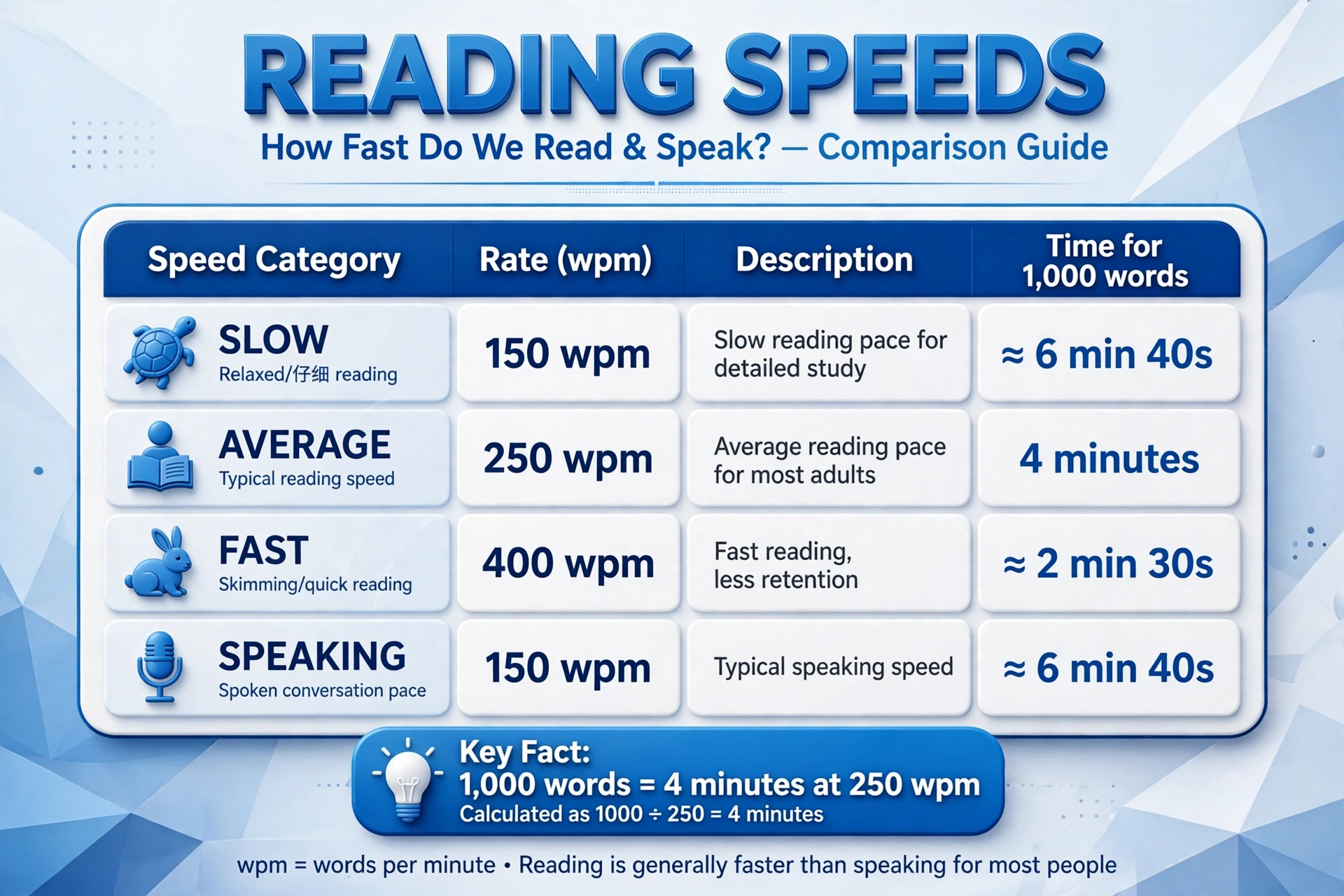
Slow reading, around 150 words per minute, fits study material, legal text, and anything you plan to annotate. Average reading, around 250 words per minute, fits novels, news, and general nonfiction. Fast reading, around 400 words per minute, fits light material you already partly know. Speed reading above 600 words per minute is possible for skimming, but comprehension usually falls as speed rises.
Speaking is slower than silent reading: a prepared speech runs about 130 to 150 words per minute, which is why a 2000-word talk takes about 13 to 15 minutes to deliver, even though it takes only 8 minutes to read silently. This calculator shows speaking time at 150 words per minute alongside reading time, so talks and presentations can be timed from the same word count.
| Pace | Words per minute | 1000 words | 60,000 words |
|---|---|---|---|
| Slow / study | 150 | 6 min 40 s | 6h 40m |
| Average | 250 | 4 min | 4h |
| Fast | 400 | 2 min 30 s | 2h 30m |
| Speaking | 150 | 6 min 40 s | 6h 40m |
Worked Examples
Example 1: a 60,000-word novel at 250 words per minute. Reading time is 240 minutes, which is 4 hours, speaking time is 400 minutes, which is 6 hours 40 minutes, and at 30 minutes a day it takes 8 sessions. Example 2: a 3000-word article at 250 words per minute. Reading time is 12 minutes, which fits a coffee break.
Example 3: a 100,000-word textbook at a careful 150 words per minute. Reading time is about 667 minutes, which is 11 hours 7 minutes, and at 30 minutes a day it takes 23 sessions. Example 4: a 500-word email at 250 words per minute. Reading time is 2 minutes, which is why short messages rarely need a calculator, but the same formula still applies.
| Text | Words | Speed | Reading time | Sessions (30 min) |
|---|---|---|---|---|
| Novel | 60,000 | 250 wpm | 4h | 8 |
| Article | 3000 | 250 wpm | 12 min | 1 |
| Textbook | 100,000 | 150 wpm | 11h 7m | 23 |
| 500 | 250 wpm | 2 min | 1 |
Counting Words and Pages
If you only know pages, convert first: a typical paperback page holds about 250 to 300 words, so a 300-page novel holds roughly 75,000 to 90,000 words. A double-spaced manuscript page holds about 250 words, while a single-spaced page holds about 500. Word processors count words exactly, so paste the text or check the word count in the document rather than guessing from pages when accuracy matters.
Images, charts, and tables add time that a word count misses. A common planning allowance is about 12 seconds per visual for scanning, plus extra time for any figure that must be studied rather than glanced at. For textbooks, add a density buffer for rereading, note-taking, and worked examples, which can easily add 10 to 25 percent to the plain reading time.
| Format | Words per page | 300 pages |
|---|---|---|
| Paperback novel | About 250-300 | 75,000-90,000 |
| Double-spaced manuscript | About 250 | 75,000 |
| Single-spaced document | About 500 | 150,000 |
Common Mistakes
The most common mistake is using a speed from a test on easy material for a hard book: a reader who manages 400 words per minute on news may read a textbook at 150. Another mistake is forgetting speaking speed when timing a talk: a speech that reads in 8 minutes takes about 13 minutes to deliver, and running over time is the usual result.
A third mistake is treating the estimate as exact. Fatigue, interruptions, and unfamiliar terms all add time, so pad a plan by 10 to 20 percent for anything that must finish by a deadline. A fourth mistake is counting only words and ignoring visuals, exercises, and references, which can dominate a textbook chapter.
Planning Reading Sessions
Turn the total into sessions by dividing by the minutes you actually have each day. A 4-hour book at 30 minutes a day is 8 sessions, which is just over a week of daily reading. A 12-minute article is one session, and a textbook at 30 minutes a day across a term is a schedule you can hold.
For study planning, a time card calculator totals hours across days, though it is built for work shifts. The session count here is simpler: total minutes divided by 30, rounded up, so the last session is never a fraction of a minute.

Frequently asked questions
How long does it take to read 60,000 words?
4 hours at 250 words per minute, which is the average adult speed. At a slow 150 words per minute it takes 6 hours 40 minutes, and at a fast 400 it takes 2 hours 30 minutes.
What is a good average reading speed?
About 200 to 300 words per minute for ordinary prose. This calculator defaults to 250, with slow at 150 and fast at 400.
How do I calculate reading time?
Divide the word count by words per minute. A 3000-word article at 250 words per minute takes 12 minutes.
How long does it take to read 1000 words?
4 minutes at 250 words per minute, or 6 minutes 40 seconds at 150 words per minute.
How is speaking time different?
Speaking runs about 130 to 150 words per minute, slower than silent reading. This calculator shows speaking time at 150 words per minute.
How many words are on a book page?
About 250 to 300 words on a typical paperback page, about 250 on a double-spaced manuscript page, and about 500 on a single-spaced page.
Why does my actual reading time differ?
Difficulty, unfamiliar vocabulary, note-taking, visuals, fatigue, and distractions all change the real rate. Treat the result as a planning estimate and pad it by 10 to 20 percent for deadlines.