Time Card Calculator: Hours Worked and Gross Pay
Calculate hours worked and gross pay from clock-in times, unpaid breaks and your hourly rate — for one shift and for a 5-day week.
Formulas verified against standard references. Calculator logic tested with verified worked examples. Last reviewed: October 2026.Our methodology
How a time card works
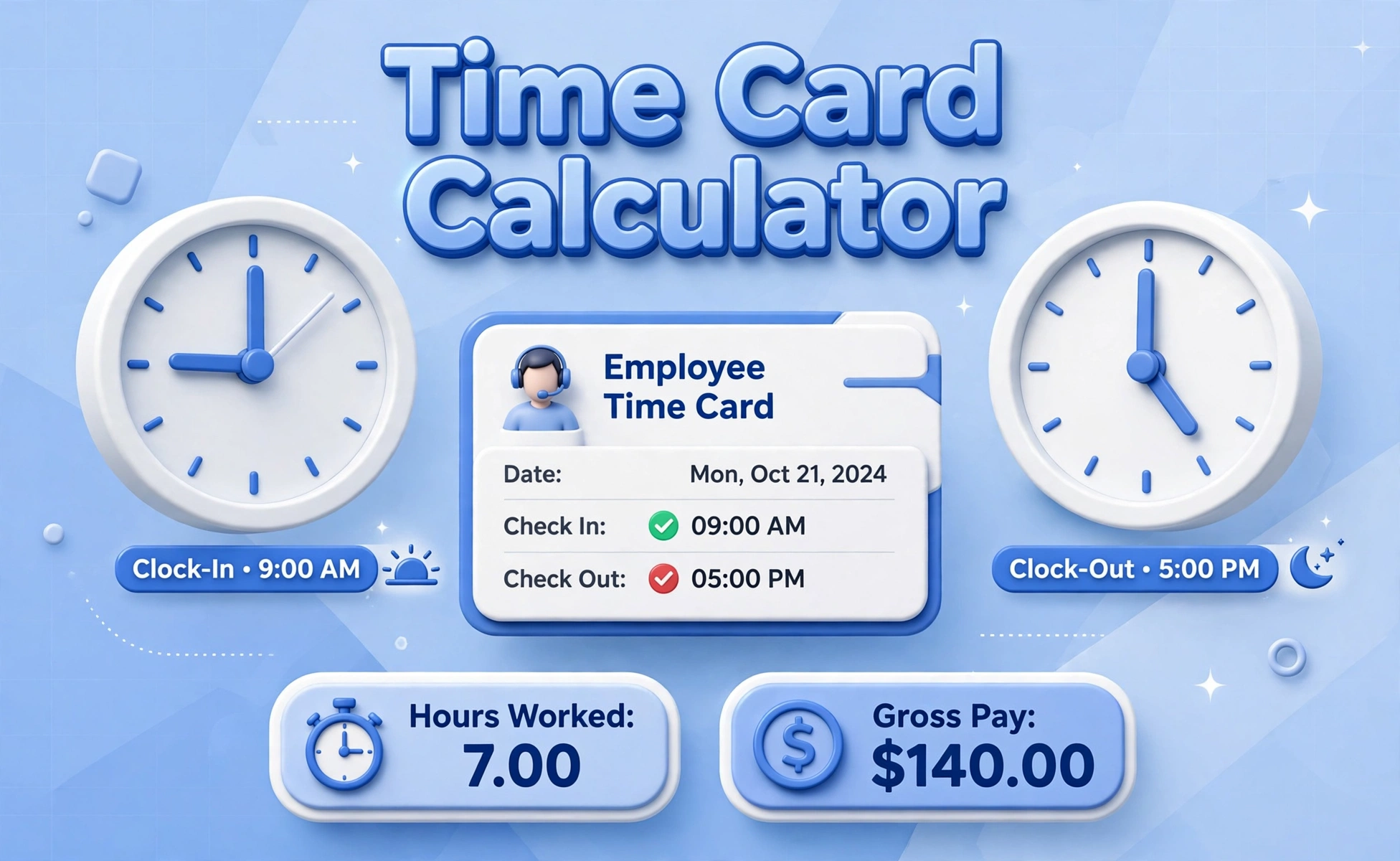
A time card records when a shift starts and ends. Paid time is the time between clock-in and clock-out minus any unpaid break, and gross pay is paid time multiplied by the hourly rate.
For example, a shift from 09:00 to 17:00 is 8 hours on the clock. After a 60-minute unpaid break, paid time is 7 hours, so at $20 per hour the shift pays $140.
Time card formula
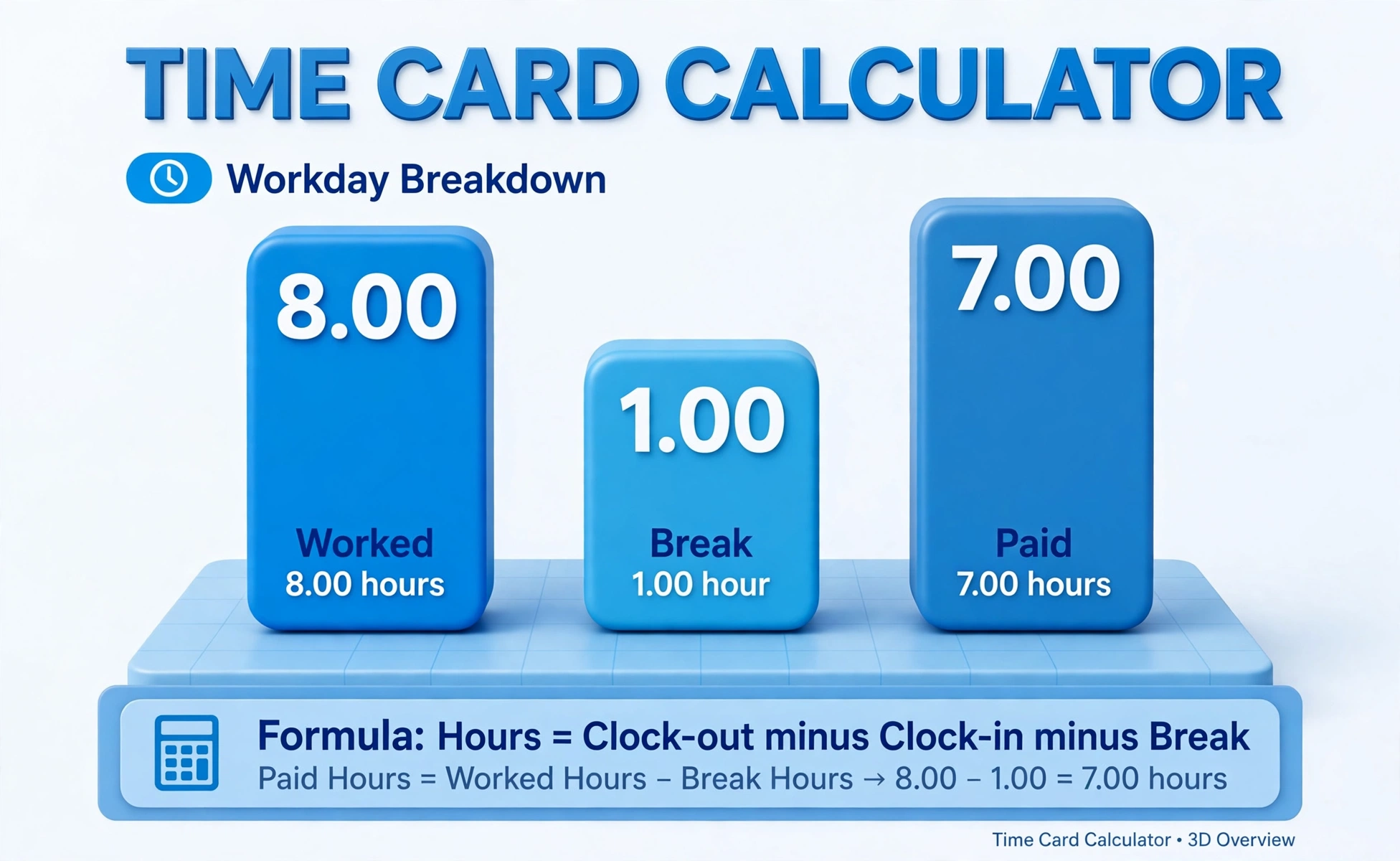
Hours worked = (clock-out time − clock-in time) − unpaid break time. Convert minutes to hours by dividing by 60.
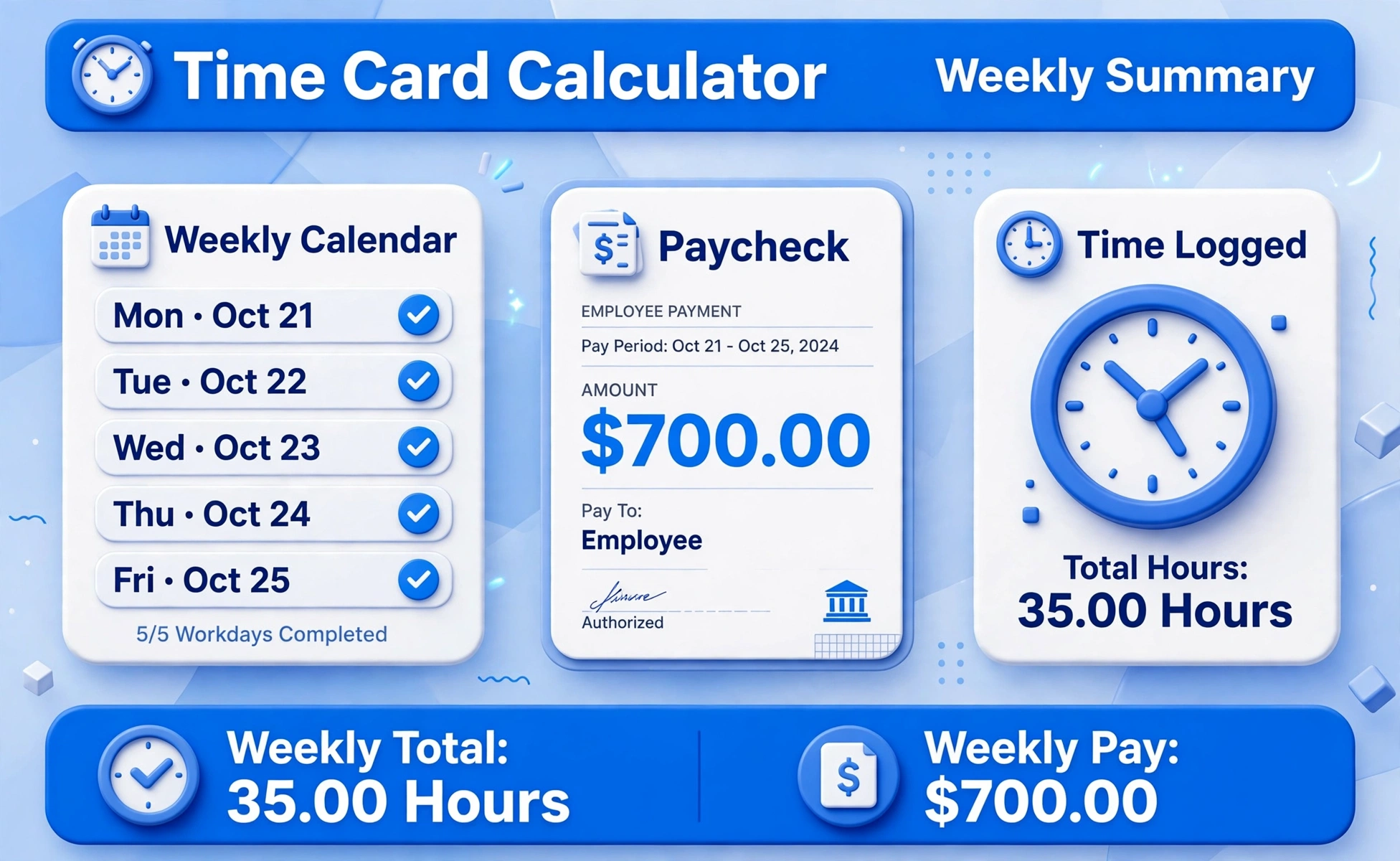
Gross pay for the shift = hours worked × hourly rate. The weekly projection repeats the same shift for 5 days: weekly hours = hours worked × 5 and weekly pay = gross pay × 5.
To check your pay against a yearly figure, use the salary calculator to convert between annual, monthly and hourly pay.
Worked example: 09:00 to 17:00 at $20 per hour
- Time on the clock: 17:00 − 09:00 = 8.00 hours.
- Subtract the unpaid break: 8.00 − 1.00 = 7.00 hours worked.
- Shift pay: 7.00 × $20 = $140.00.
- Weekly projection (5 days): 7.00 × 5 = 35.00 hours and $140.00 × 5 = $700.00.
Shift and weekly examples
The table below applies the same formula to a few common shifts. All figures use paid hours after the unpaid break.
| Shift | Break | Paid hours | Pay at $20/hour |
|---|---|---|---|
| 09:00–17:00 | 60 min | 7.00 | $140.00 |
| 08:00–16:30 | 30 min | 8.00 | $160.00 |
| 10:00–18:00 | 0 min | 8.00 | $160.00 |
Paid time, breaks and take-home pay
Only unpaid breaks are subtracted here. A paid break stays inside paid time, so check your contract or payslip before entering a break as unpaid.
| Item | How it is treated |
|---|---|
| Unpaid break | Subtracted from paid hours |
| Paid break | Left inside paid hours (enter 0 unpaid minutes) |
| Overnight shift | Clock-out earlier than clock-in is treated as the next day |
| Tax and deductions | Not deducted here; this is gross pay |
Gross pay is before tax and other deductions. To see what a regular paycheck looks like after the usual payroll items, use the paycheck calculator.
Frequently asked questions
How do I calculate hours worked from clock-in and clock-out times?
Subtract clock-in from clock-out, then subtract unpaid break time. For 09:00 to 17:00 with a 60-minute break, that is 8.00 minus 1.00, which equals 7.00 hours.
What is gross pay on a time card?
Gross pay is paid hours multiplied by the hourly rate, before tax and deductions. At 7.00 hours and $20 per hour, gross pay is $140.00.
Are breaks paid or unpaid?
It depends on your employer. This calculator subtracts only the unpaid break minutes you enter; enter 0 if your break is paid.
What if my shift crosses midnight?
If clock-out is earlier than clock-in, the calculator treats clock-out as the next day, so a 22:00 to 06:00 shift counts as 8 hours before breaks.
How is the 5-day weekly projection calculated?
It repeats the same shift for 5 days: weekly hours equal shift hours times 5, and weekly pay equals shift pay times 5.
What if I work different hours each day?
Run the calculator once for each different shift and add the results, because the weekly projection assumes five identical shifts.
Does this calculator include overtime?
No. It calculates straight gross pay at the rate you enter, with no overtime rate or overtime threshold applied.