Attendance Calculator: Your Attendance Percentage
Enter the total classes held and how many you attended, pick your required attendance threshold, and see your percentage plus your margin above or below it.
Formulas verified against standard references. Calculator logic tested with verified worked examples. Last reviewed: October 2026. Our methodology
How Attendance Percentage Works
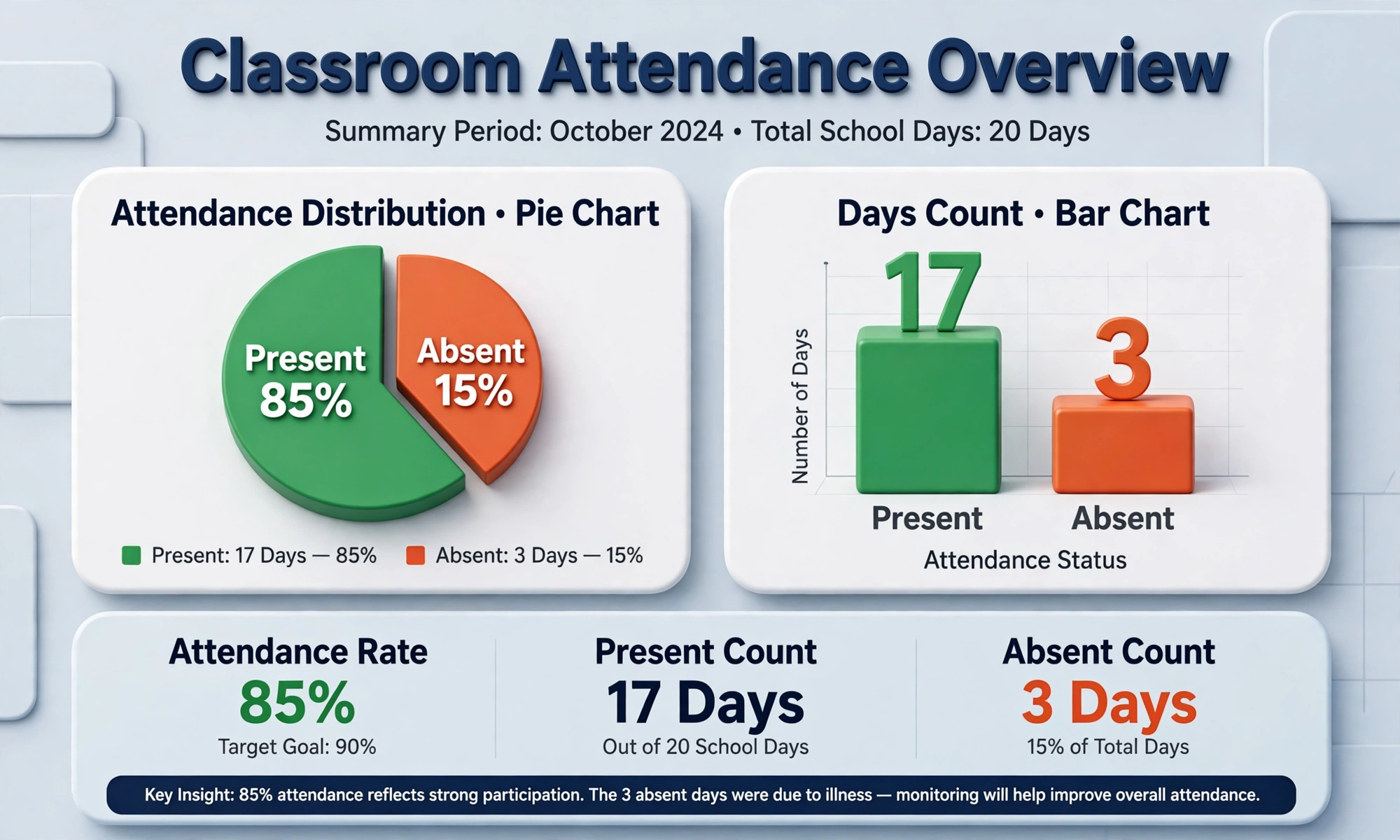
Attendance percentage is attended classes divided by total classes held, times 100. If 40 classes were held and you attended 36, your attendance is 36 divided by 40, which is 0.9, or 90 percent. Missed classes are simply total minus attended, so 40 minus 36 is 4 missed.
Schools and colleges usually set a minimum, often 75 percent, below which students may lose exam eligibility or marks. That threshold is what makes the margin matter: 90 percent is comfortable, but 76 percent against a 75 percent rule leaves room for only one more miss in many schedules.
For grades rather than attendance, a GPA calculator and a test score calculator cover the marks side of the same term.

How Many More Can You Miss
The margin question is: how many more classes can you miss in a row and stay at or above the threshold? Each miss adds to the total without adding to attended, so the percentage falls a little each time. The calculator counts forward until the percentage would drop below the threshold, and reports how many misses fit before that happens.
Example: 36 of 40 attended is 90 percent, threshold 75 percent. One more miss gives 36 of 41, or 87.8 percent, still above 75. Counting on, you can miss 8 in a row, reaching 36 of 48, or 75 percent exactly, and the 9th miss drops below. So the margin is 8.
| Attended | Total | Percentage | Misses allowed at 75% |
|---|---|---|---|
| 36 | 40 | 90% | 8 |
| 30 | 40 | 75% | 0 |
| 38 | 40 | 95% | 10 |
| 20 | 30 | 66.67% | Below threshold |
How Many Must You Attend to Recover
If you are below the threshold, the recovery question is the mirror image: how many classes in a row must you attend to climb back to it? Each attended class adds to both attended and total, so the percentage rises toward 100 but never jumps straight there.
Example: 20 of 30 attended is 66.67 percent, threshold 75 percent. Attending 1 more gives 21 of 31, or 67.74 percent. Counting on, 10 in a row gives 30 of 40, exactly 75 percent, so 10 straight attendances recover the threshold. Missing even one along the way pushes the target further out.
| Attended | Total | Now | Attend in a row to reach 75% |
|---|---|---|---|
| 20 | 30 | 66.67% | 10 |
| 25 | 40 | 62.5% | 20 |
| 28 | 40 | 70% | 8 |
| 14 | 20 | 70% | 4 |
Worked Examples
Example 1: 36 of 40 attended, threshold 75 percent. Attendance is 90 percent, missed classes are 4, and the margin is 8 more misses: 36 of 48 is exactly 75 percent, while the 9th miss gives 36 of 49, or 73.47 percent, below the threshold.
Example 2: 45 of 50 attended, threshold 80 percent. Attendance is 90 percent, and the margin is 6 more misses: 45 of 56 is 80.36 percent, still above 80, while the 7th miss gives 45 of 57, or 78.95 percent, below it. The margin shrinks fast as the total grows, which is why counting beats guessing.
| Attended | Total | Threshold | Margin |
|---|---|---|---|
| 36 | 40 | 75% | 8 misses |
| 45 | 50 | 80% | 6 misses |
| 30 | 40 | 75% | 0 misses |
| 20 | 30 | 75% | Need 10 attends |
Common Mistakes
The most common mistake is counting misses against attended instead of total: missing 4 of 40 is 10 percent missed, but missing 4 of the 36 attended is a different, wrong fraction. Always divide by total classes held.
A second mistake is rounding too early: 1 of 3 missed is 66.67 percent attendance, not 67 percent rounded then reused, since small rounding errors change the margin by a class. A third mistake is treating excused absences as attended: unless your institution counts them that way, an excused absence still counts as not attended in the percentage.
Practical Uses
Use this calculator at mid-term to see whether a planned trip or a busy week is affordable, or whether every remaining class is now required. Students near a threshold should check before booking travel, and students above it can relax without guessing.
Teachers and parents use the same math for the whole class: average attendance across students, or the share of students above the threshold, both come from the same attended divided by total formula applied per student or across the class.

Frequently asked questions
How do I calculate attendance percentage?
Divide classes attended by total classes held, then multiply by 100. Attending 36 of 40 classes is 90 percent.
How many classes can I miss and stay above 75%?
It depends on your numbers. With 36 of 40 attended, you can miss 8 more in a row and stay at exactly 75 percent. Enter your numbers to get your margin.
I am below 75%. How many classes must I attend to recover?
Attend in a row until the percentage climbs back: with 20 of 30 attended, 10 straight attendances reach 75 percent. Missing one along the way pushes the target further.
Do excused absences count?
Usually they still count as not attended for the percentage, unless your institution's rules say otherwise. Check your handbook before relying on an excused absence.
What is a good attendance percentage?
Most institutions require 75 percent or more for exam eligibility, and 90 percent or more is generally considered strong. The threshold that matters is your institution's own rule.
Does attendance affect grades?
Often, yes: some courses tie marks or eligibility to attendance, and missed classes also mean missed content. Check your course outline for the exact rule.
Can attendance exceed 100%?
No. Attended can never exceed total classes held, so 100 percent, attending every class, is the maximum.