Probability Calculator: Two Events, Step by Step
When two events are independent — like two coin flips — their probabilities combine with simple rules. Enter P(A) and P(B) as decimals between 0 and 1, and this probability calculator returns the chance of both happening, either happening, only one happening and neither happening, with the working shown.
Formulas verified against standard mathematics references. Calculator logic tested with verified worked examples. Last reviewed: October 2026. Our methodology
The probability formulas
All the outputs below assume independent events. Probabilities are written as decimals between 0 and 1; multiply by 100 for a percentage.
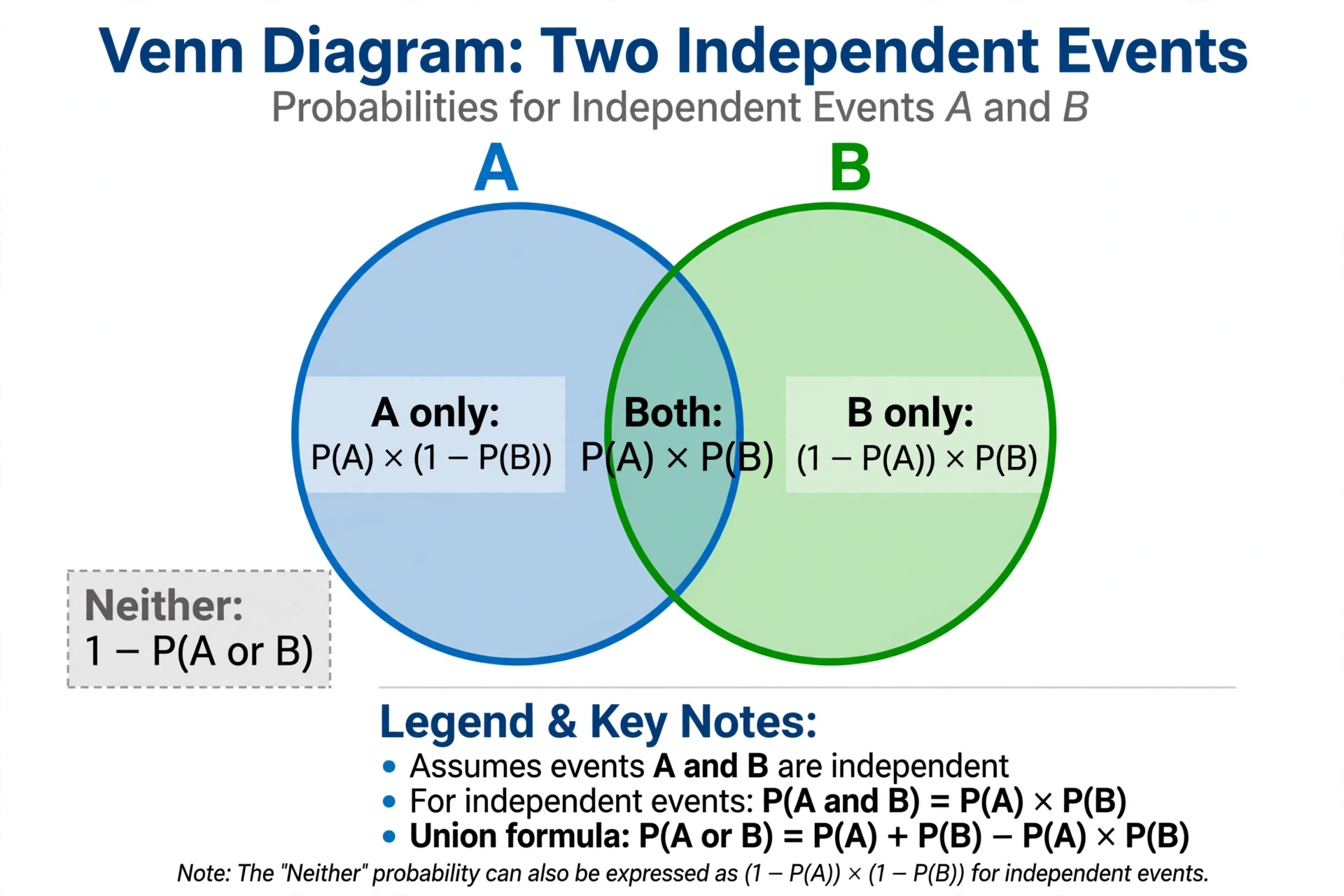
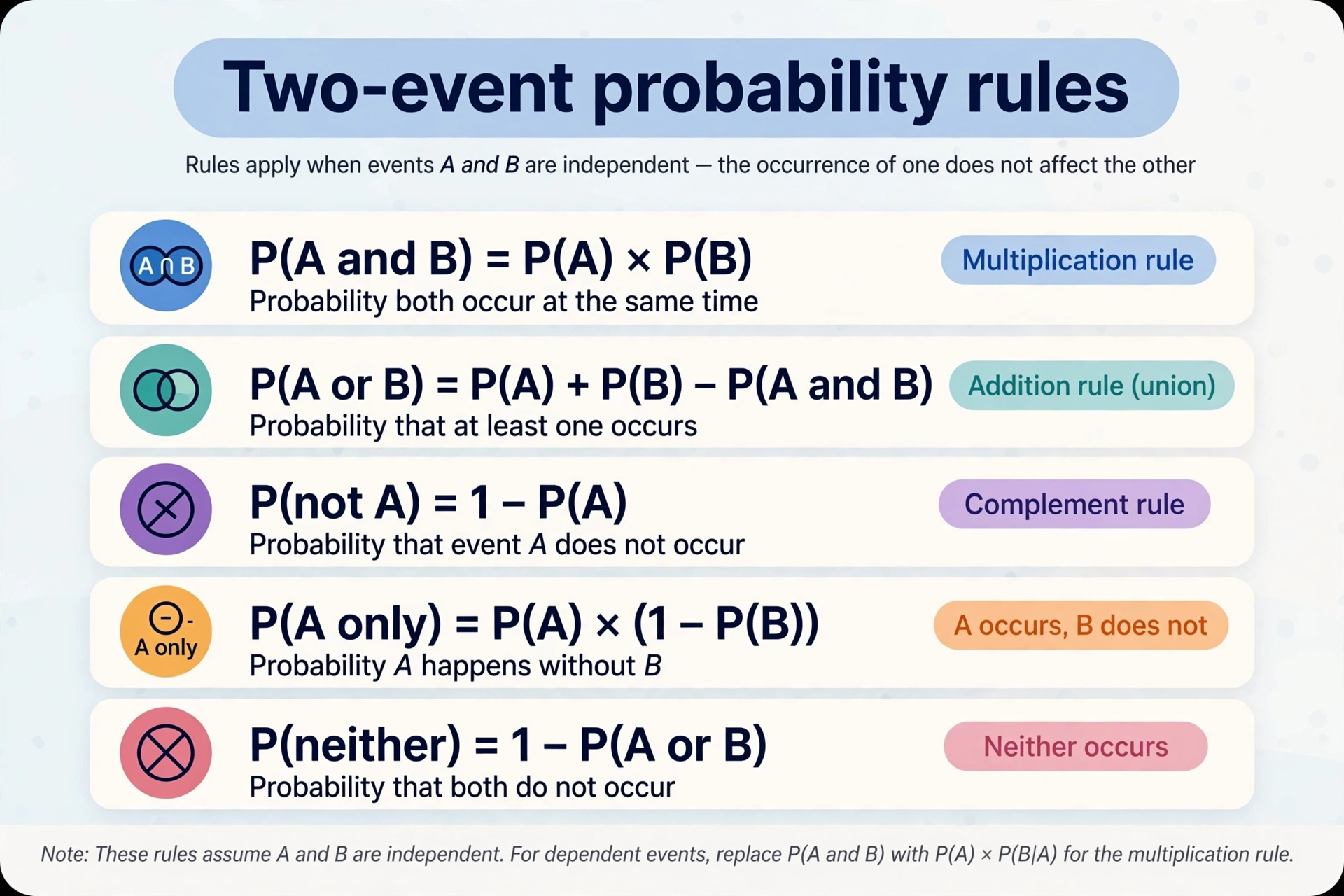
- P(A and B) — both occur: P(A) × P(B)
- P(A or B) — at least one occurs: P(A) + P(B) − P(A and B)
- P(A only): P(A) × (1 − P(B))
- P(B only): (1 − P(A)) × P(B)
- P(exactly one): P(A only) + P(B only), or equivalently P(A or B) − P(A and B)
- P(neither): 1 − P(A or B)
- Complements: P(not A) = 1 − P(A); P(not B) = 1 − P(B)
- P(A given B): for independent events, P(A given B) = P(A) — knowing B happened changes nothing
Worked example
Flip a fair coin twice. Let A = heads on the first flip, B = heads on the second flip: P(A) = 0.5, P(B) = 0.5.
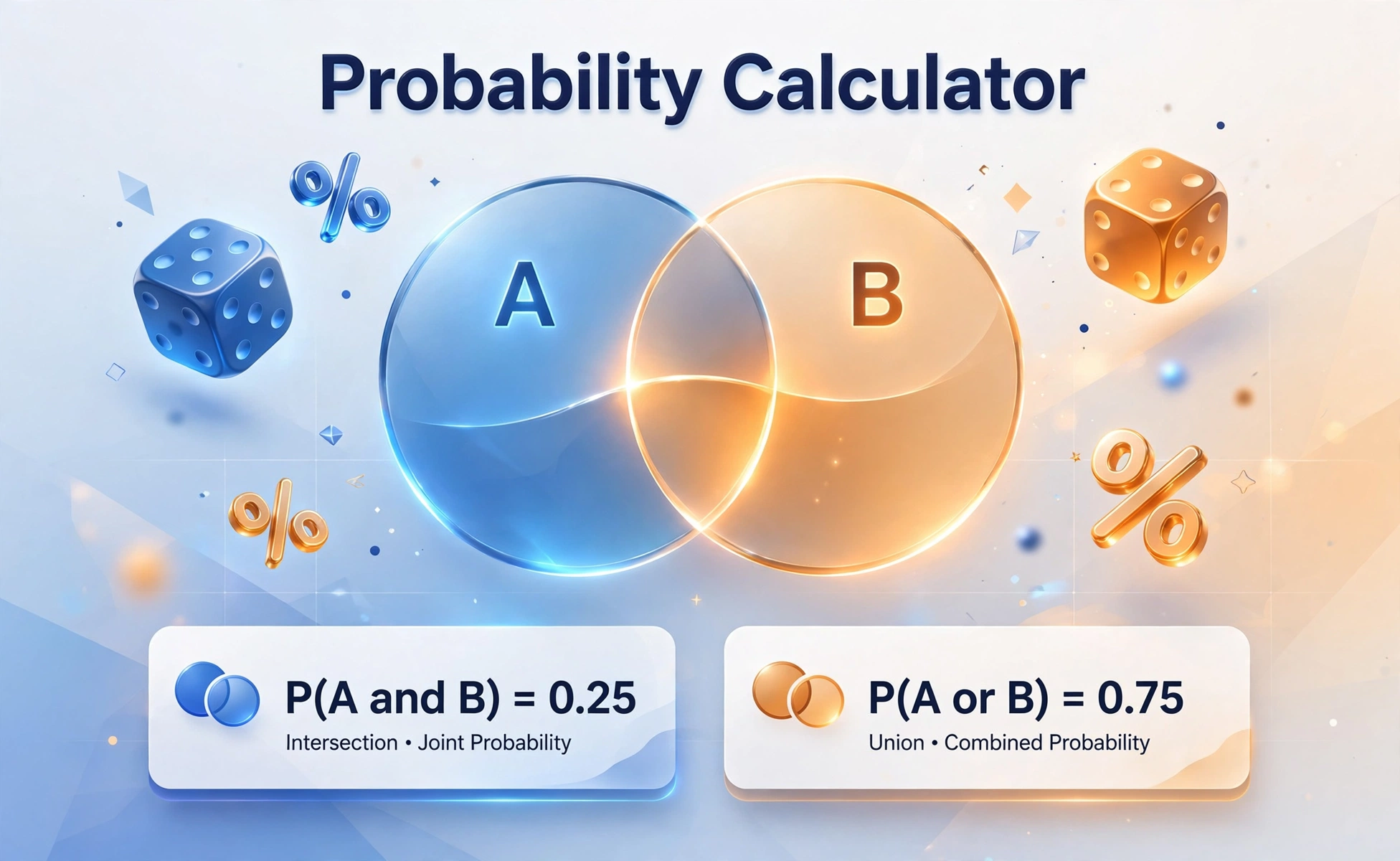
- P(A and B) = 0.5 × 0.5 = 0.25 — two heads in a row, 25%
- P(A or B) = 0.5 + 0.5 − 0.25 = 0.75 — at least one heads, 75%
- P(A only) = 0.5 × 0.5 = 0.25 — heads then tails
- P(neither) = 1 − 0.75 = 0.25 — two tails
The four outcomes — heads-heads, heads-tails, tails-heads, tails-tails — are equally likely at 0.25 each, and the four numbers above just group them.
How to use the probability calculator
Two inputs, eight answers. Decimals only — 0.5 means a 50% chance, 0.05 means 5%.
Step by step
- Enter P(A). The probability of the first event, as a decimal between 0 and 1. For example, a 30% chance is 0.3.
- Enter P(B). The probability of the second event, same format.
- Press Calculate. Read P(A and B), P(A or B), the only-one/either-neither combinations, and the step-by-step working underneath.
Percentages and probabilities convert freely: just multiply a decimal by 100. A percentage calculator can handle the conversions if you think in percent.
Independent, dependent and mutually exclusive events
The formulas change completely with the relationship between the events. This calculator handles the independent case, where one event does not affect the other.
| Relationship | Meaning | Example |
|---|---|---|
| Independent | One event does not change the other's probability | Two separate coin flips |
| Dependent | The first event changes the second's probability | Drawing two cards from a deck without replacing the first |
| Mutually exclusive | Both cannot happen at once; P(A and B) = 0 | Rolling a 2 and rolling a 5 on one die throw |
For mutually exclusive events, P(A or B) is simply P(A) + P(B) — the subtraction term vanishes because both cannot happen. For dependent events you need conditional probability, P(A given B), which this calculator does not attempt.
Where two-event probability shows up
These rules are not just textbook exercises:
- Games and lotteries. The chance of winning twice in a row, or of at least one win across several plays, follows exactly these formulas.
- Risk and insurance. The probability that at least one of two independent failures hits — two machines, two suppliers — drives redundancy planning.
- Medicine and testing. The chance that at least one of two independent tests catches a condition is P(A or B), which is why retesting helps.
- Everyday planning. If two independent events each have a 90% chance of going right, the chance both go right is 0.9 × 0.9 = 0.81 — only 81%, a useful reality check for optimistic plans.
Averages and rates feed into many of the same analyses; an average calculator covers the mean, median and mode side. For the mathematical foundations, Wikipedia's overview of probability is a solid, well-referenced starting point.
Common probability mistakes
- Adding probabilities for overlapping events. P(A or B) = P(A) + P(B) only works when both cannot happen at once. Otherwise you double-count the overlap — that is what the − P(A and B) term fixes.
- The gambler's fallacy. After five tails, the next flip is still 0.5 heads. Independent events have no memory.
- Confusing P(A and B) with P(A given B). Both happening is P(A) × P(B); A given that B already happened is a conditional probability and needs different information.
- Percentages above 100. No probability exceeds 1 (or 100%). If your inputs combine to more than 1 somewhere unexpected, re-check whether the events are really independent.
- Assuming independence without checking. Real events are often subtly linked — weather and traffic, for example. The formulas are only as good as the assumption.
Frequently asked questions
What is probability?
Probability is a number between 0 and 1 measuring how likely an event is: 0 means impossible, 1 means certain, and 0.5 means a fifty-fifty chance. Multiply by 100 to express it as a percentage.
How do you calculate P(A and B)?
For independent events, multiply: P(A and B) = P(A) × P(B). For example, two coin flips at 0.5 each give 0.5 × 0.5 = 0.25, a 25% chance of two heads. For dependent events you need P(A given B) instead of plain multiplication.
How do you calculate P(A or B)?
Use P(A or B) = P(A) + P(B) − P(A and B). The subtraction removes the double-counted overlap where both occur. With P(A) = P(B) = 0.5, that is 0.5 + 0.5 − 0.25 = 0.75.
What does it mean for events to be independent?
One event happening does not change the probability of the other. Two separate coin flips are independent; drawing two cards from a deck without replacing the first is not, because the first draw changes what remains.
What is the difference between P(A and B) and P(A given B)?
P(A and B) is the chance both happen — 0.25 for two heads. P(A given B) is the chance A happens knowing B already happened — for independent events it is just P(A), 0.5, because B tells you nothing about A.
Can a probability be greater than 1?
No. Probabilities run from 0 to 1, and percentages from 0% to 100%. If a calculation gives more than 1, either the inputs are wrong or the events are not independent.
Why does P(A or B) subtract P(A and B)?
Because adding P(A) + P(B) counts the overlap — the cases where both happen — twice. Subtracting P(A and B) once leaves every outcome counted exactly once. When the events are mutually exclusive the overlap is zero and the subtraction vanishes.