Mobile Car Paint Correction Cost Calculator

Work out what paint correction will cost for your car. Enter the number of panels by size, the correction stage and any ceramic coating, then see the total cost, the stage uplift and the average cost per panel.

The size sets the typical panel counts for that vehicle. You can change any count after choosing.

Mirrors, pillars, door sills and bumper trim sections. Single-stage correction runs $25 to $50 each.

Doors on a mid-size vehicle, bumper faces and the hood of a compact car. Single-stage correction runs $60 to $90 each.

The hood and roof of a full-size truck or SUV and full-length doors. Single-stage correction runs $100 to $150 each.

One step removes light swirls. Two steps add a heavy cut before the finishing polish. Three steps are for deep defects and neglected paint.

Enter 0 for no coating. A ceramic coating typically adds about $800 on top of the correction.

Formula: base correction cost = (small panels x $37.50) + (standard panels x $75) + (large panels x $125), then total cost = base correction cost x stage multiplier + ceramic coating cost.

How to Use the Mobile Car Paint Correction Cost Calculator

Detailers quote paint correction per panel, so this calculator prices it the same way. Count your panels, pick the stage and the tool adds the total.

  1. Choose the vehicle size. It sets the typical panel counts for a coupe, sedan, SUV or truck.
  2. Count the small panels, meaning mirrors, pillars, door sills and bumper trim sections.
  3. Count the standard panels, meaning doors, bumper faces and the hood of a compact car.
  4. Count the large panels, meaning the hood and roof of a full-size truck or SUV and full-length doors.
  5. Choose the correction stage. One step removes light swirls, two steps add a heavy cut before the finishing polish, and three steps are for deep defects and neglected paint.
  6. Enter the ceramic coating cost, or 0 for no coating. A ceramic coating typically adds about $800. Press Calculate, or press Enter. The total appears first and large, with the base cost, the stage uplift and the average cost per panel below.
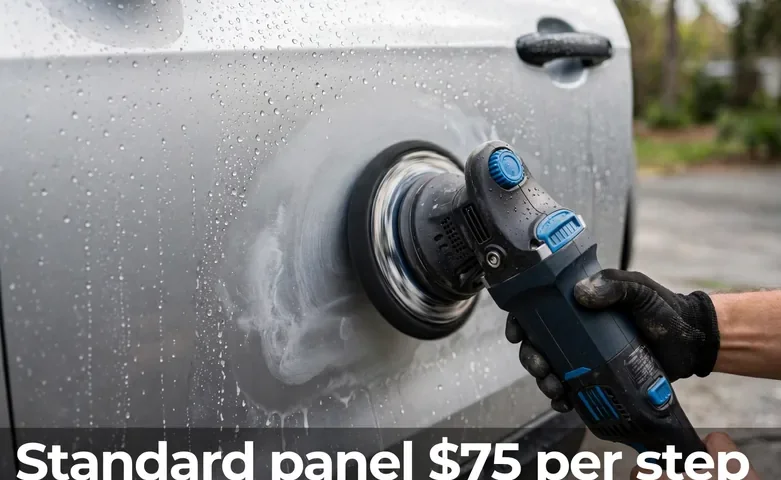
A photo of a mobile detailer machine polishing a car door panel outdoors
A standard panel costs about $75 for a single-stage correction.

The Paint Correction Cost Formula

Base correction cost = (small panels x $37.50) + (standard panels x $75) + (large panels x $125). Total cost = base correction cost x stage multiplier + ceramic coating cost. Stage uplift = base correction cost x (stage multiplier minus 1). Average cost per panel = correction cost without coating / total panels. The per-panel rates are midpoints of published single-stage ranges. Small panels run $25 to $50, standard panels $60 to $90 and large panels $100 to $150. The stage multipliers are midpoints of published ranges. Two-stage correction adds 40 to 70% to the single-stage price, so the multiplier is 1.55, and three-stage correction adds 100 to 150%, so the multiplier is 2.25.
Worked Example: Two-Step Correction on a Sedan

A mid-size sedan has 2 small panels, 6 standard panels and 2 large panels, and the paint needs a two-step correction with no ceramic coating.

  1. Small panels: 2 x $37.50 = $75.
  2. Standard panels: 6 x $75 = $450.
  3. Large panels: 2 x $125 = $250.
  4. Base correction cost: $75 + $450 + $250 = $775.
  5. Two-step total: $775 x 1.55 = $1,201.25.
  6. Stage uplift: $1,201.25 - $775 = $426.25.
  7. Average cost per panel: $1,201.25 / 10 panels = $120.13.

As a second check, take the same sedan at one step with an $800 ceramic coating. The base is $775, the multiplier is 1.00, so the correction is $775 and the total with coating is $1,575. The same steps work for any car, so try your own panel counts in the tool above.

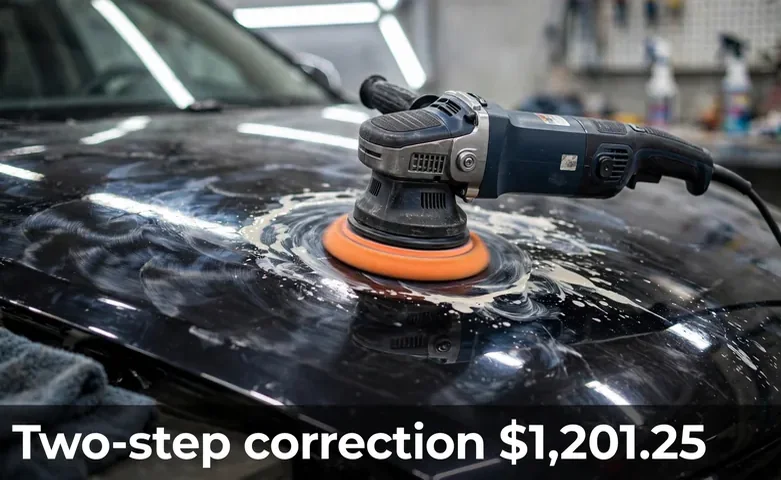
A photo of a dual action polisher correcting swirl marks on a dark car hood
The worked example costs $1,201.25 for a two-step correction on a sedan.

One Step, Two Steps or Three Steps

The stage is decided by the paint, not by the budget. A one-step correction is a single polishing pass that removes light swirls and haze and restores gloss. It suits a car that is washed carefully and kept garaged. A two-step correction adds a heavy cutting pass before the finishing polish, which removes most swirls and light scratches. It is the common choice for a daily driver. A three-step correction adds a second cutting pass for deep defects, heavy oxidation and neglected paint, and it is the show-car level. Published 2026 ranges put a one-step sedan at $250 to $450, a two-step at $500 to $800 and a three-step at $900 to $1,500, with SUVs and trucks higher. One mobile detailer lists a one-step correction at $500 and a two-step at $700 for a full car. Ask the detailer for a test spot under a strong light before you agree a stage, because the test spot shows what one step can and cannot remove.

What Changes the Price

Panel size is the first driver, because a large hood takes longer to polish than a mirror. Paint hardness is the second. Hard German paint needs more passes than soft Japanese paint, so the same stage takes longer. Colour is the third. Dark paint shows every swirl, so it needs more careful work to look right, while light paint hides defects. Condition is the fourth. A car that has never been corrected needs more stages than a car that is corrected every year. Location is the fifth, because labour rates vary by city. Our car detailing price calculator prices a full detail the same way, from hours, vehicle size and drive time, and our mobile car wash subscription calculator prices the wash plan that keeps corrected paint looking right afterwards.

Paint Correction and Ceramic Coating

Paint correction and ceramic coating are two different jobs. Correction removes defects from the clear coat. Coating adds a hard layer on top that protects the corrected paint and makes washing easier. Correction always comes first, because coating over swirls locks them in. A coating typically adds about $800 to the job, and it lasts two to five years depending on the product and how the car is washed. It does not make the paint scratch-proof, and it does not replace correction. If the budget only covers one job, correct the paint first and add the coating later, because the coating can be applied at any time after correction. Our paint calculator works out how much paint a different kind of job needs, from area to gallons, with the same kind of step-by-step math.

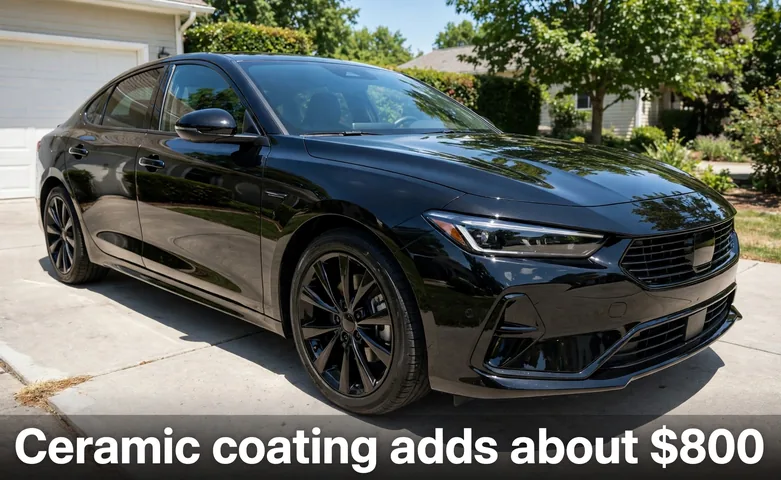
A photo of a freshly corrected glossy black car parked in bright daylight
A ceramic coating typically adds about $800 on top of the correction.

Frequently asked questions

How much does paint correction cost?

A full-vehicle correction on a mid-size sedan runs $400 to $2,500, depending on stage and condition. Published 2026 ranges put a one-step sedan at $250 to $450, a two-step at $500 to $800 and a three-step at $900 to $1,500. In the worked example, a two-step correction on a sedan with 10 panels costs $1,201.25.

How much does paint correction cost per panel?

Single-stage correction runs $25 to $50 for a small panel, $60 to $90 for a standard panel and $100 to $150 for a large panel. Two-stage correction adds 40 to 70% to those prices, and three-stage adds 100 to 150%. The calculator shows the average cost per panel for your own car.

How long does paint correction take?

A one-step correction on a sedan takes about 4 to 8 hours, a two-step takes 1 to 2 days, and a three-step can take 2 to 4 days. Larger vehicles, harder paint and worse condition all add time. A mobile detailer works at your home, so ask how many days the car will be with them.

Does paint correction remove all scratches?

No. Machine polishing removes swirls and scratches that sit in the clear coat. A scratch you can feel with a fingernail has gone through the clear coat and needs paint repair, not polishing. A test spot under a strong light shows what correction can and cannot remove before you pay.

Will paint correction damage my clear coat?

A skilled detailer removes only a tiny amount of clear coat, and a well-kept car can be corrected several times in its life. The risk comes from an inexperienced operator or from correcting the same panel too often. Ask the detailer to measure the paint thickness before they start.

This is an estimate for planning. Actual paint correction prices come from your detailer after a test spot on your own paint, and they vary by vehicle size, paint hardness and condition.

Start Calculating Now!

Discover the power of smart tools at KitQuarter.

Explore All Tools