Graduation Date Calculator
Enter your program start date and its length to find your expected graduation month and year, with a countdown in days from today.
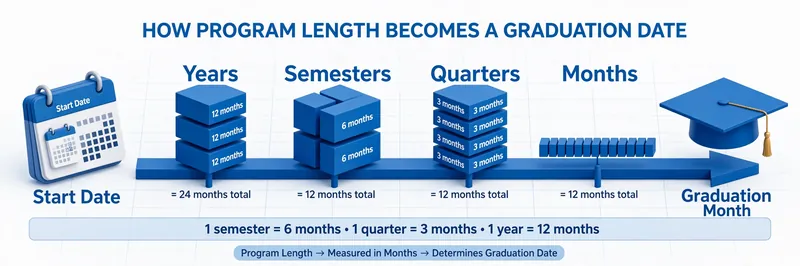
Formula. Graduation date = program start date + program length in months, counting 1 semester as 6 months, 1 quarter as 3 months, and 1 year as 12 months on the Gregorian calendar.

Formulas verified against standard references. Calculator logic tested with verified worked examples. Published: November 3, 2026 | Last updated: November 3, 2026. Our methodology
What Is a Graduation Date Calculator?
A graduation date calculator tells you when you will finish a study program. You enter the day you start and how long the program lasts, and it returns your expected graduation month and year plus a countdown in days from today.
It works for college degrees, diplomas, coding bootcamps, and professional certificates. Knowing the finish date early helps you plan tuition payments, housing, and job applications around one fixed target.

How the Date Math Works
The calculator turns your program length into months, then adds those months to your start date on the real calendar.
graduation date = program start date + program length in months
Program start date is the first day of your program. Program length in months is your length value times the unit rule, so 8 semesters become 48 months. Graduation date is the resulting date, and its month and year are the main answer. The math adds calendar months, not fixed 30-day blocks, so leap years and short months are handled exactly. When the start day does not exist in the target month, the date lands on that month's last day.
Worked Example
A student starts a program on August 18, 2025, and the program runs 8 semesters.
Step 1. Convert the length to months. 8 semesters x 6 months = 48 months.
Step 2. Add 48 months to August 18, 2025. That is 4 full calendar years forward, which lands on August 18, 2029.
Step 3. Read the month and year. The expected graduation month is August 2029.
Step 4. Count down. From November 3, 2026 to August 18, 2029 is 1,019 days, so the countdown reads 1,019 days from today.
How to Use the Calculator
- Pick your program start date in the first field.
- Enter the program length and choose years, semesters, quarters, or months.
- Press Calculate to see your graduation month and year, the full graduation date, and the day-by-day countdown.
- Press Reset to clear the form and test another scenario.
Semesters, Quarters, and Years
Schools describe program length in different units, and the calculator treats them as interchangeable calendar months. A common bachelor's degree runs 4 years, which schools also describe as 8 semesters. Under the unit rule, 4 years = 48 months and 8 semesters = 48 months, so either input gives the same graduation date.
The mapping is fixed. One year is 12 months, one semester is 6 months, and one quarter is 3 months. It is a planning convention, not a count of class days, so it works the same for full-time, part-time, and self-paced programs.
One caution. Some schools define a semester as about 4 months of instruction with breaks between terms. If your school's terms do not match the convention, enter your program length in months for the most exact result.
Planning Backwards from a Target Date
Flip the math when you already have a target in mind. If you want to graduate in May 2028 and the program needs 2 years, May 2028 minus 24 months gives May 2026 as your latest start date.
You can do this with the calculator itself. Guess a start date, press Calculate, then move the date earlier or later until the result lands on your target month. Three or four tries usually pin it down.
Once the date is set, keep your attendance on track and watch your GPA each term, because failed or repeated courses are the most common reason the real date slips past the estimate.

Frequently asked questions
How do I calculate my graduation date?
Enter your program start date and its length, pick the unit, and press Calculate. The tool converts the length to months, adds them to your start date, and reports the graduation month and year plus a countdown in days.
How many months are in a semester or quarter?
This calculator counts one semester as 6 months and one quarter as 3 months. Some schools define terms differently, so if yours does not match, enter the length in months for the most exact result.
Does the calculator account for leap years?
Yes. The date math follows the Gregorian calendar, so January 31, 2024 plus one month gives February 29, 2024, while the same addition in 2023 gives February 28.
What if my program includes breaks or summer terms?
The result assumes continuous study. Add extra months for breaks, gap terms, or part-time pacing, then re-run the calculator to see the adjusted date.
How accurate is the graduation month?
It is an estimate based on calendar months. Your school's official calendar, ceremony schedule, and degree conferral rules decide the real date, so confirm it with your advisor.
Related calculators

Tuition Calculator
Estimate total college tuition and see how costs add up by year.
Use calculatorGPA Calculator
Compute your semester GPA from course grades and credit hours.
Use calculatorFinal Grade Calculator
Find the grade you need on the final to reach your target.
Use calculatorGrade Calculator
Turn raw scores into letter grades and percentages fast.
Use calculatorAttendance Calculator
Track class attendance and see how absences affect your record.
Use calculatorCGPA Calculator
Calculate your cumulative GPA across all semesters.
Use calculatorTest Score Calculator
Convert correct answers into a test score percentage.
Use calculatorQuiz Grade Calculator
Grade quizzes quickly from points earned and points possible.
Use calculatorReading Time Calculator
Estimate how long any article, book, or assignment takes to read.
Use calculatorCountdown Calculator
Count down the days, hours, and minutes to your graduation day.
Use calculator