Fuel Economy Calculator: MPG, L/100km & Costs
Find out how fuel-efficient your vehicle really is. Enter the distance you drove and the fuel you used, and this fuel economy calculator returns your miles per gallon, liters per 100 km, kilometers per liter, cost per mile and an estimated monthly fuel bill.
Formulas verified against standard finance references. Calculator logic tested with verified worked examples. Calculator logic tested with verified worked examples. Last reviewed: October 2026. Our methodology
The fuel economy formulas
Fuel economy is distance divided by fuel — the same idea in two unit systems. The US version (miles per gallon) rewards bigger numbers; the metric version (liters per 100 km) rewards smaller ones.
- Miles per gallon: MPG = miles ÷ gallons
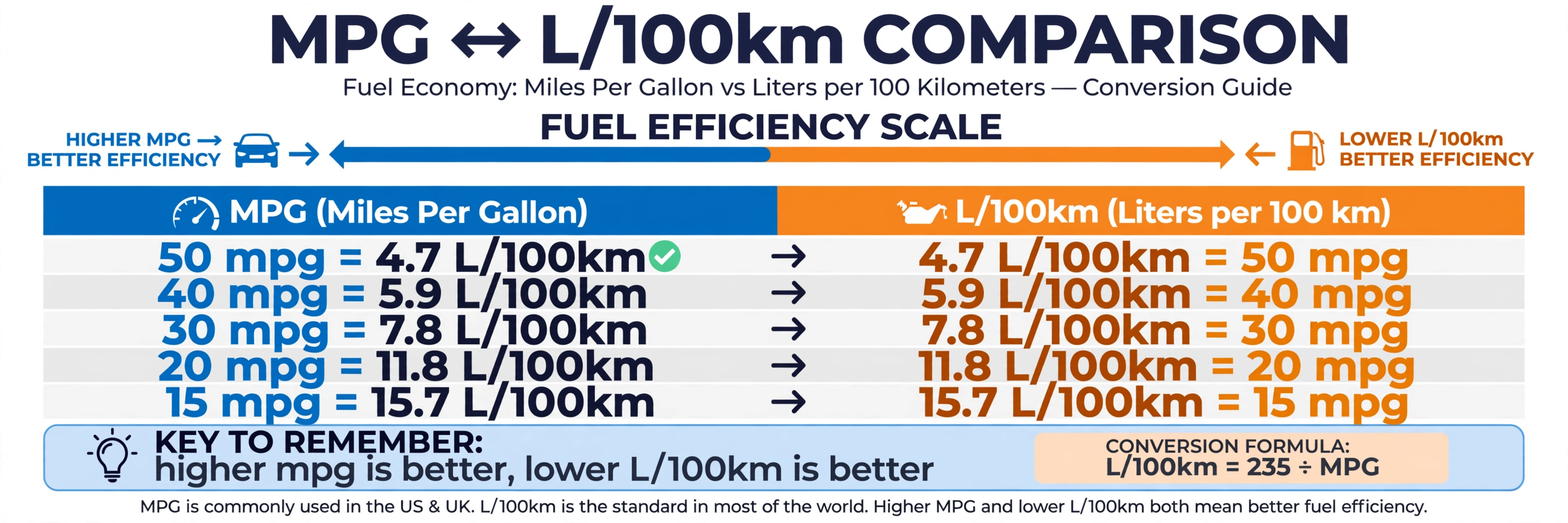
- Liters per 100 km: L/100km = 235.214583 ÷ MPG
- Kilometers per liter: km/L = MPG × 0.425144
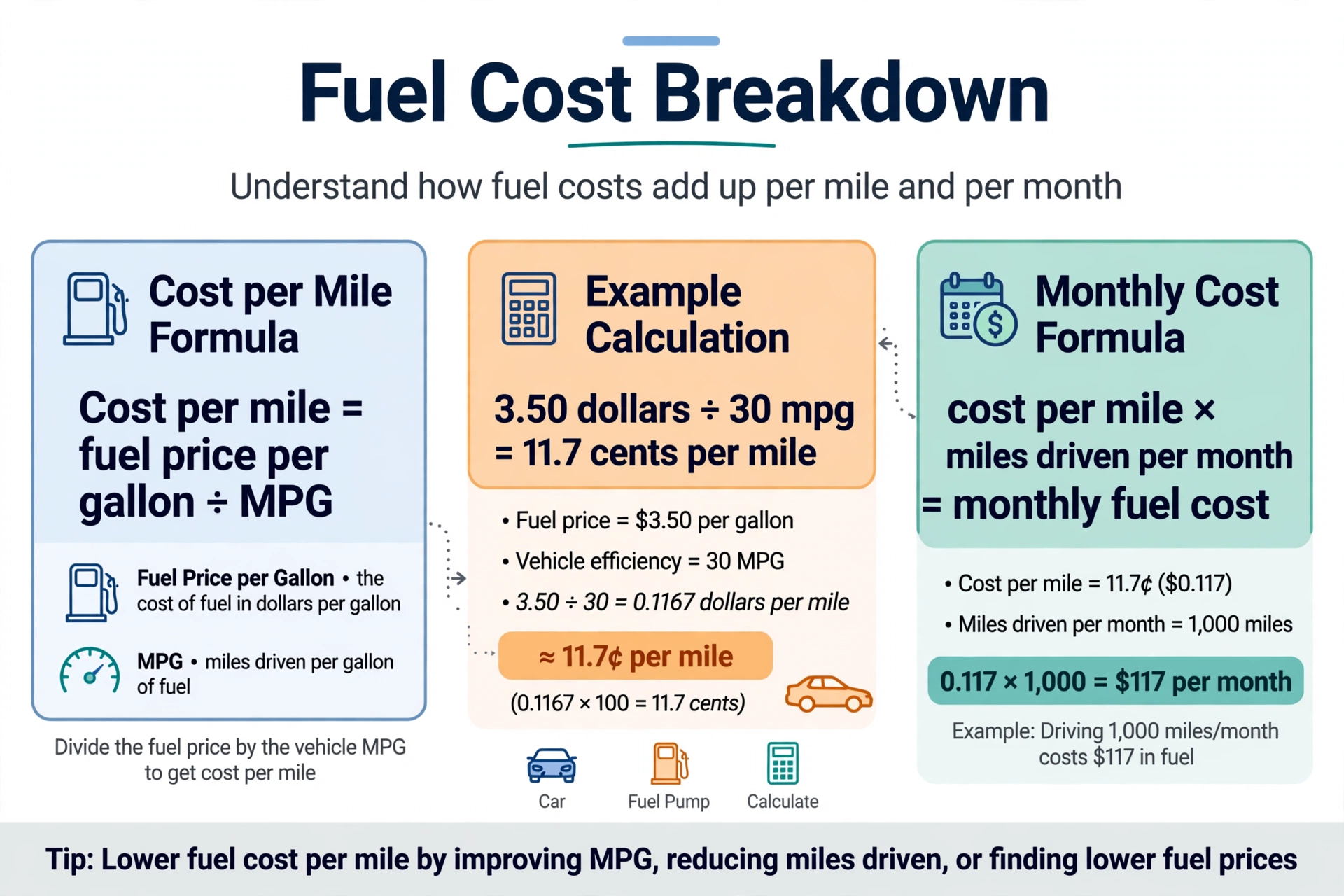
- Cost per mile: fuel price ÷ MPG
- Monthly fuel cost: cost per mile × miles driven per month
Sources: fueleconomy.gov — how fuel economy is tested and rated by the EPA.
Worked example
You drive 300 miles and use 10 gallons between fill-ups. MPG is 300 ÷ 10 = 30 mpg. In metric terms, 235.215 ÷ 30 = 7.84 L/100km, and 30 × 0.425144 = 12.75 km/L. If fuel costs $3.50 per gallon, each mile costs 3.50 ÷ 30 = $0.1167 (about 11.7 cents). Driving 1,000 miles a month at that rate costs 0.1167 × 1,000 = $116.67 per month, or about $1,400 a year.
How to use the fuel economy calculator
Two required inputs and two optional ones. The required pair gives you efficiency; adding a fuel price unlocks the cost figures.
Step by step
- Choose the unit system. US (miles and gallons) or metric (kilometers and liters).
- Enter the distance driven and the fuel used over that distance — ideally measured fill-up to fill-up.
- Optionally enter the fuel price per gallon or liter to get cost per mile and cost per km.
- Optionally enter your monthly distance to estimate the monthly and annual fuel bill.
- Press Calculate. Read your MPG, L/100km, km/L, cost figures and the step-by-step working underneath.
How to measure your real fuel economy
Dashboard trip computers estimate; the fill-to-fill method measures. It is the method the EPA’s own guidance implies and the one hypermilers trust.
The fill-to-fill method
- Fill the tank completely and reset the trip odometer (or note the odometer reading).
- Drive normally for at least half a tank — longer is better, since it averages out variation.
- Fill up again at the same pump if possible and note the gallons or liters added.
- Divide miles driven by fuel added. That is your true MPG for that driving.
Repeat over several tanks and average the results — a single tank can be skewed by one long highway trip or one week of idling in traffic. Fuel is only one part of car ownership: the car loan calculator covers the monthly payment side of the same budget.
What affects your fuel economy
Two identical cars can return very different numbers depending on how and where they are driven. These are the factors with the biggest real-world effect.
| Factor | What happens |
|---|---|
| Speed | Economy typically peaks around 50 mph and falls quickly above it — drag grows with the square of speed |
| Tire pressure | Under-inflated tires raise rolling resistance and waste fuel on every mile |
| Air conditioning | Adds engine load; hurts most in slow city driving |
| Short trips | A cold engine is inefficient, so many short trips use more fuel per mile |
| Roof cargo | Roof boxes and racks add drag even when empty |
| Maintenance | Clogged air filters and worn spark plugs reduce efficiency |
The pattern is simple: anything that makes the engine work harder for the same distance lowers your MPG. Smooth acceleration, steady speeds and light loads are free efficiency.
Is your MPG good? Reading your results
There is no single “good” MPG — a pickup and a hybrid play different games. The honest benchmark is your own car’s EPA combined rating on its window sticker, measured under the same laboratory cycles for every vehicle. Use this table to translate between the two rating systems.
| MPG | L/100km | km/L |
|---|---|---|
| 15 | 15.68 | 6.38 |
| 20 | 11.76 | 8.50 |
| 25 | 9.41 | 10.63 |
| 30 | 7.84 | 12.75 |
| 35 | 6.72 | 14.88 |
| 40 | 5.88 | 17.01 |
| 50 | 4.70 | 21.26 |
If your measured economy is far below the sticker, check tire pressure and driving style before suspecting the car — and remember that winter fuel blends and cold starts cost a few MPG everywhere. Financing the car efficiently matters too: a simple interest calculator shows what straightforward loan interest adds to the purchase price.
Frequently asked questions
How do I calculate my car's MPG?
Fill the tank completely and reset the trip odometer. Drive normally, then fill up again. Divide the miles driven by the gallons added on the second fill-up — 300 miles on 10 gallons is 30 MPG. This fill-to-fill method is the most accurate way to measure real fuel economy.
What does L/100km mean?
Liters per 100 kilometers is the metric way to express fuel consumption: how many liters the car uses to travel 100 km. Unlike MPG, lower is better — 5 L/100km beats 8 L/100km. Convert with L/100km = 235.215 / MPG.
What is a good MPG?
Compare against your own vehicle's EPA combined rating on its window sticker rather than a single number, because good economy depends on vehicle size and type. The EPA tests every new light-duty vehicle in a laboratory and publishes city, highway and combined ratings at fueleconomy.gov.
Why is my real MPG different from the sticker rating?
The EPA ratings come from standardized laboratory driving cycles, while real driving adds cold starts, traffic, hills, cargo, air conditioning and higher speeds. The EPA notes that individual results vary with driving conditions, vehicle condition and accessory use — your mileage will vary.
Does air conditioning really affect fuel economy?
Yes. Running the air conditioning puts an extra load on the engine and measurably reduces fuel economy, especially in stop-and-go city driving. At highway speeds the effect is smaller, and open windows create drag that can cost nearly as much.
How can I improve my fuel economy?
Drive smoothly and keep to moderate speeds, keep tires inflated to the recommended pressure, remove unused roof cargo, avoid long idling and keep up with maintenance like air filters and spark plugs. Aggressive acceleration and braking are among the biggest fuel wasters.
How is fuel economy measured for electric vehicles?
Electric vehicles do not use gallons, so the EPA rates them in kilowatt-hours per 100 miles — and also in MPGe (miles per gallon equivalent), which converts electrical energy into the energy content of a gallon of gasoline so electrics can be compared with gasoline cars.