Complex Number Calculator
Add, subtract, multiply, and divide complex numbers. Enter the real and imaginary parts of two numbers, choose an operation, and press Calculate for the answer in standard a+bi form with the full steps, the modulus, and the argument.

Formulas verified against standard references. Calculator logic tested with verified worked examples. Published: November 3, 2026 | Last updated: November 3, 2026. Our methodology
What Does the Complex Number Calculator Do?
The complex number calculator adds, subtracts, multiplies, and divides complex numbers. Enter the real and imaginary parts of two numbers, choose an operation, and press Calculate. The answer appears in standard a+bi form, with the modulus, the argument, and a full step-by-step breakdown.
A complex number looks like 3 + 4i, where 3 is the real part and 4 is the imaginary part, the coefficient of i. The imaginary unit i is defined by i² = -1, which lets equations like x² + 1 = 0 have solutions, namely i and -i. Complex numbers take over where real numbers run out of answers, and the quadratic equation solver shows them in action on equations with no real roots.
The Four Formulas the Calculator Uses
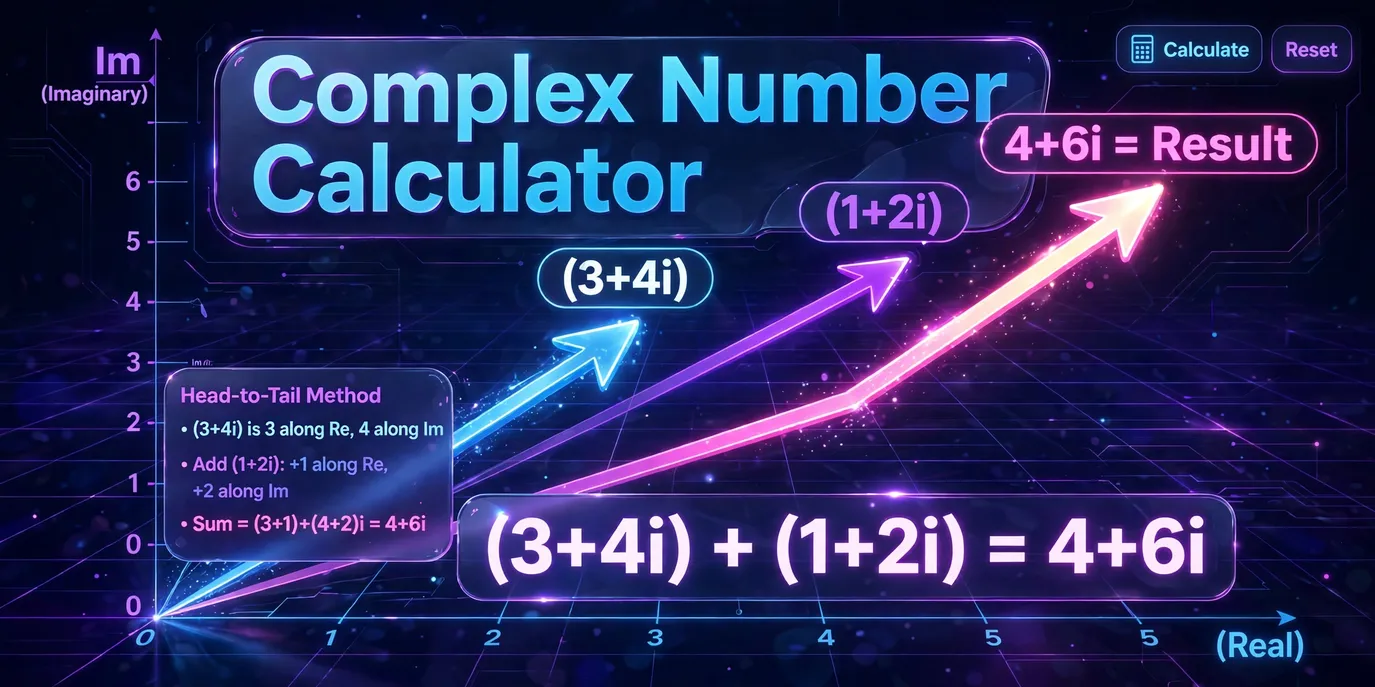
Write the two numbers as z1 = a + bi and z2 = c + di. Addition and subtraction combine real and imaginary parts separately. Multiplication expands the product and replaces i² with -1. Division multiplies the top and bottom by the conjugate of the denominator, turning the bottom into the real number c² + d².
| Operation | Formula |
|---|---|
| Addition | (a + bi) + (c + di) = (a + c) + (b + d)i |
| Subtraction | (a + bi) - (c + di) = (a - c) + (b - d)i |
| Multiplication | (a + bi)(c + di) = (ac - bd) + (ad + bc)i |
| Division | (a + bi) / (c + di) = ((ac + bd) + (bc - ad)i) / (c² + d²) |
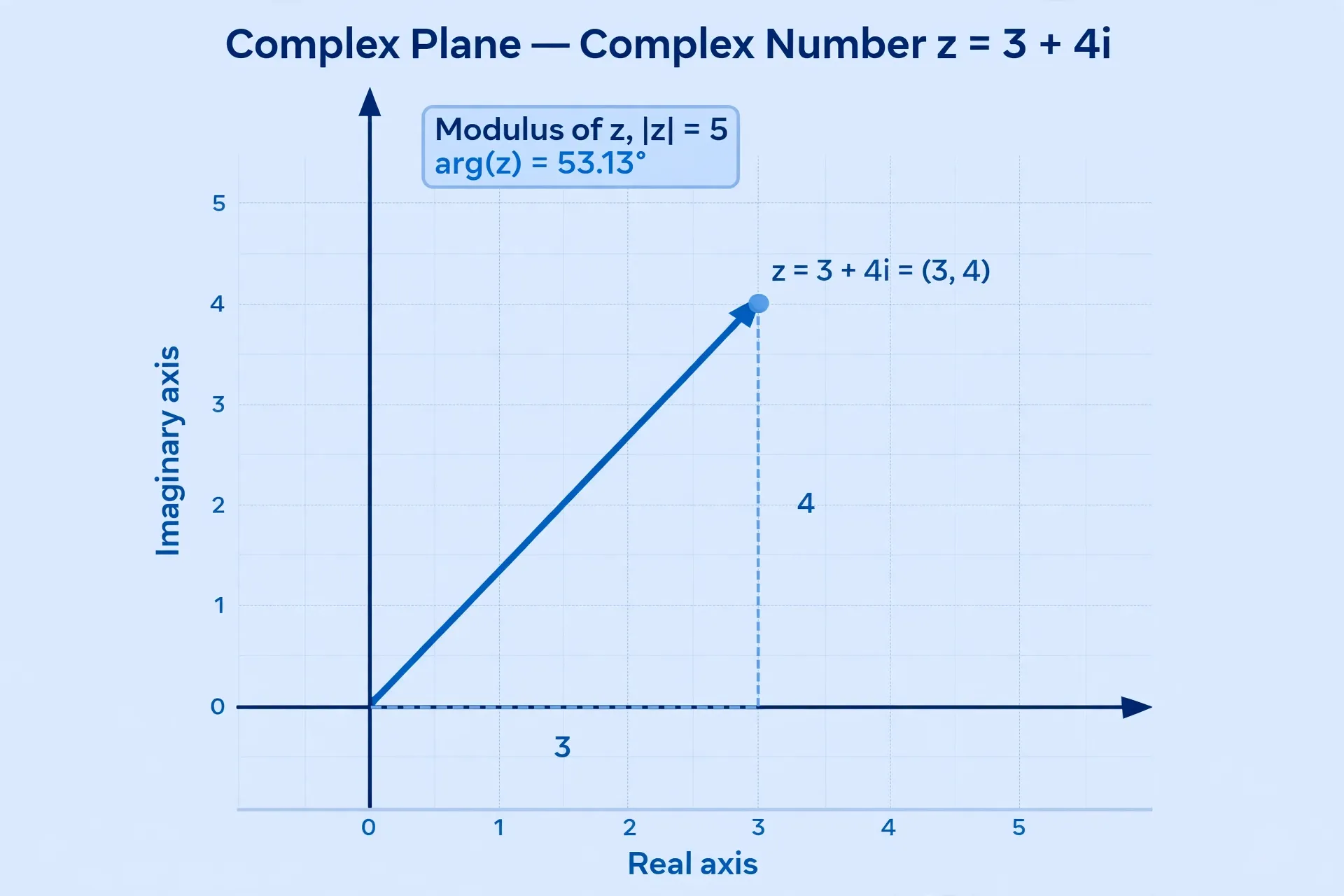
The modulus |z| = √(a² + b²) is the distance of the point from the origin. The argument arg(z) = atan2(b, a) is the angle the arrow makes with the positive real axis, shown in degrees. Together they give the polar form r ∠ θ, and the scientific calculator is handy for checking the trig behind those angles.
Worked Example: (2+3i) × (1+4i)
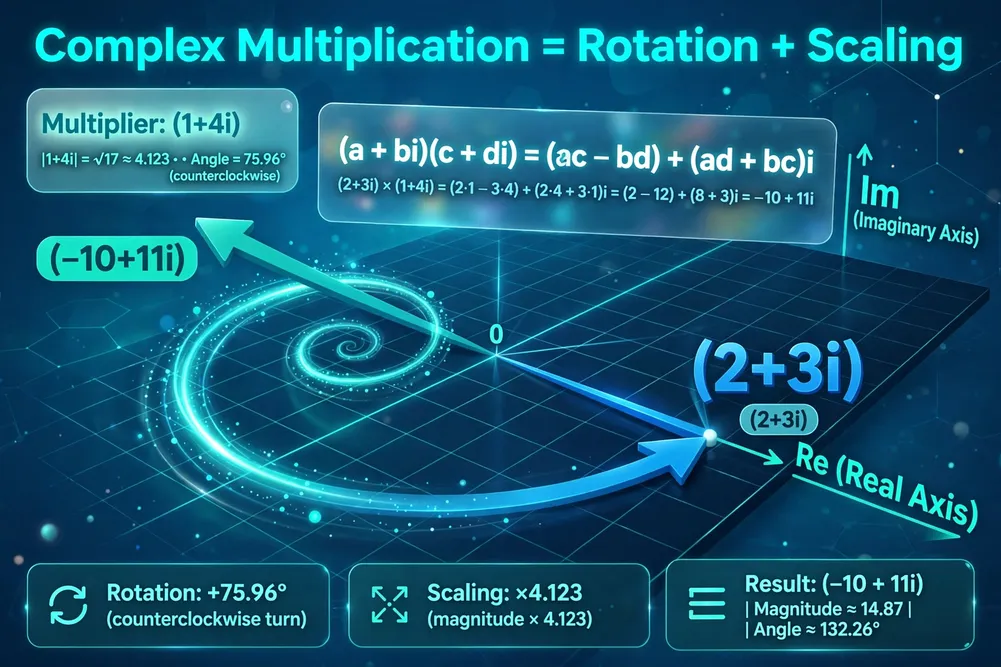
Multiply (2+3i) by (1+4i). Here a = 2, b = 3, c = 1, and d = 4. Expand the brackets. 2·1 gives 2, 2·4i gives 8i, 3i·1 gives 3i, and 3i·4i gives 12i². Replace i² with -1, so 12i² becomes -12. Collect the parts. The real parts 2 and -12 combine to -10, and the imaginary parts 8i and 3i combine to 11i. The final answer is -10 + 11i.
The modulus of the answer is √((-10)² + 11²) = √(100 + 121) = √221 ≈ 14.87. The argument is atan2(11, -10) ≈ 132.27°, so the polar form is 14.87 ∠ 132.27°. You can sanity-check the division case the same way. (1+2i)/(3+4i) becomes (11+2i)/25, which is 0.44 + 0.08i.
How to Use the Complex Number Calculator
- Type the real part and the imaginary part of the first number, for example 3 and 4 for 3+4i. The preview under the fields shows the number in standard form as you type.
- Type the real part and the imaginary part of the second number the same way.
- Pick addition, subtraction, multiplication, or division from the operation menu.
- Press Calculate. The results show the answer in a+bi form, its modulus and argument, the polar form, and every step of the working.
Why Multiplication Rotates and Scales
Addition and subtraction treat a complex number like an arrow and add arrows head to tail. Multiplication does something richer. It scales the length by the multiplier's modulus and rotates the arrow by the multiplier's angle. That is why the polar form is the natural home for multiplication. (2+3i) times (1+4i) stretches the (2+3i) arrow by |1+4i| = √17 ≈ 4.12 and turns it counterclockwise by atan2(4, 1) ≈ 75.96°, landing on -10+11i.
Multiplication by i alone is a quarter turn. i times 1 is i, i times i is -1, i times -1 is -i, and i times -i is 1. When a hand result disagrees with the steps shown here, check the i² = -1 substitution first.
Common Mistakes with Complex Numbers
The most frequent error is adding a real part to an imaginary part. 3 + 4i is neither 7 nor 7i. The two parts stay separate because i is not a real number.
Two more traps appear often. First, the division denominator c² + d² uses a plus sign, not a minus, because (c + di)(c - di) = c² + d². A minus there breaks the conjugate trick and gives a wrong quotient. Second, division by 0 + 0i is undefined. Some online tools return 0 or garbage for it. This calculator shows a plain message instead, because a quiet wrong answer is worse than no answer.
Where Complex Numbers Show Up in Real Life
Complex numbers are not classroom-only objects. Electrical engineers write voltage and current as complex numbers and solve AC circuits with them. Signal processing uses complex exponentials for the Fourier transforms behind audio compression and image formats. Quantum mechanics writes its wave functions in complex numbers, and control engineers place poles and zeros on the complex plane to judge whether a system stays stable. Students of abstract algebra meet the same rotations and scalings again in the matrix calculator.
Frequently asked questions
What is a complex number in simple terms?
A complex number has the form a + bi, where a and b are real numbers and i is the imaginary unit with i² = -1. Think of it as the point (a, b) on a plane, with the horizontal axis for the real part and the vertical axis for the imaginary part.
How do I multiply two complex numbers?
Multiply the brackets like binomials and replace i² with -1: (a+bi)(c+di) = (ac-bd) + (ad+bc)i. For (2+3i)(1+4i) that gives (2-12) + (8+3)i = -10+11i.
What happens when I divide by 0 + 0i?
Division is undefined, just as for real numbers. The calculator shows a plain message instead of a number, so you never get a misleading answer.
What is the modulus of a complex number?
The modulus |a+bi| = √(a² + b²) is the straight-line distance from the origin to the point on the complex plane. For example, |3+4i| = √25 = 5.
What is the argument of a complex number?
The argument is the angle the number's arrow makes with the positive real axis, measured in degrees. arg(3+4i) = atan2(4, 3) ≈ 53.13°, which the calculator also shows as the polar form r ∠ θ.
Related calculators

Scientific Calculator
Advanced functions, logs, and trig in one tool.
Use calculatorMatrix Calculator
Add, multiply, and solve matrices step by step.
Use calculatorQuadratic Equation Solver
Solve any quadratic equation step by step.
Use calculatorExponent Calculator
Raise numbers to any power, with steps.
Use calculatorLogarithm Calculator
Logs in any base, with worked steps.
Use calculatorSquare Root Calculator
Simplify roots and see the working.
Use calculatorAbsolute Value Calculator
The distance of any number from zero.
Use calculatorFraction Calculator
Add, subtract, multiply, and divide fractions.
Use calculatorPythagorean Theorem Calculator
Find any side of a right triangle.
Use calculatorSlope Calculator
Slope of a line between two points, with steps.
Use calculator