Matrix Calculator: Add, Subtract and Multiply 2x2 Matrices
Add, subtract and multiply 2x2 matrices with steps.
Formulas verified against standard references. Calculator logic tested with verified worked examples. Last reviewed: October 2026. Our methodology
How 2x2 Matrix Operations Work
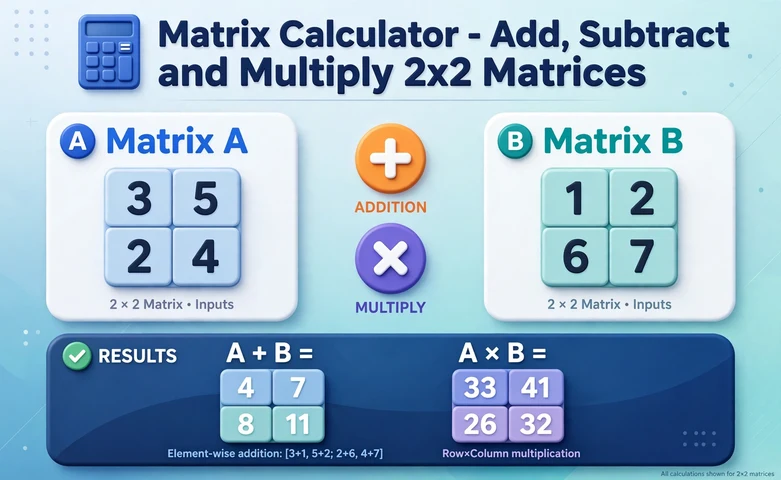
A 2x2 matrix is a grid of four numbers arranged in two rows and two columns. This calculator takes two such matrices, A and B, and adds, subtracts or multiplies them, showing every step and both determinants.
Addition and subtraction work entry by entry: add or subtract the numbers in matching positions. Multiplication is different — each result entry combines a whole row of A with a whole column of B, which is why the order of multiplication matters.
If you work with whole numbers and their common factors, the LCM and GCD calculator is a useful companion tool.
For counting problems where order matters, see the permutation and combination calculator.
Formulas
Addition: A + B adds matching entries: the top-left result is a11 + b11, and so on for all four positions.
Subtraction: A − B subtracts matching entries: the top-left result is a11 − b11, and so on.
Multiplication: For C = A x B, each entry is a row-times-column sum: c11 = a11 x b11 + a12 x b21, c12 = a11 x b12 + a12 x b22, c21 = a21 x b11 + a22 x b21, c22 = a21 x b12 + a22 x b22.
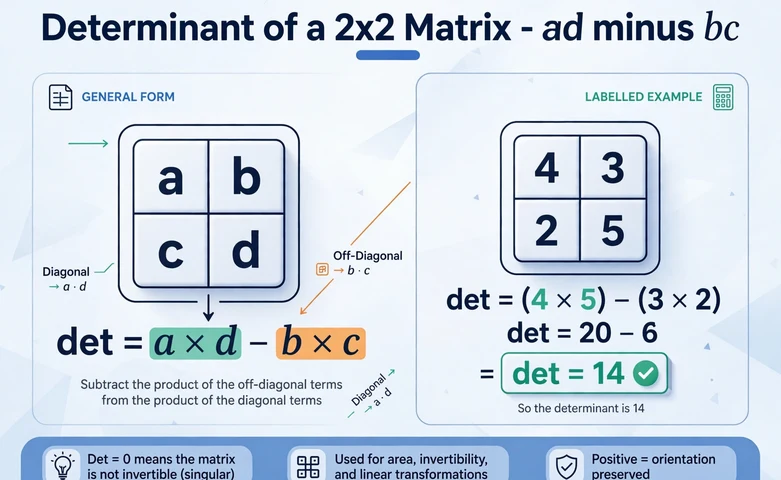
Determinant of a 2x2 matrix: det = a11 x a22 − a12 x a21. A determinant of zero means the matrix has no inverse.
Worked Example
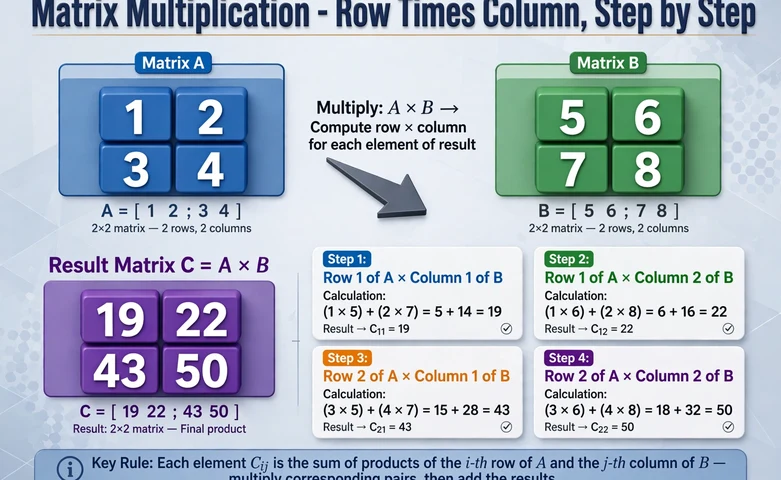
Take A = [[1, 2], [3, 4]] and B = [[5, 6], [7, 8]].
Addition: [[1+5, 2+6], [3+7, 4+8]] = [[6, 8], [10, 12]].
Multiplication: c11 = 1x5 + 2x7 = 19, c12 = 1x6 + 2x8 = 22, c21 = 3x5 + 4x7 = 43, c22 = 3x6 + 4x8 = 50, so A x B = [[19, 22], [43, 50]].
Determinants: det A = 1x4 − 2x3 = −2 and det B = 5x8 − 6x7 = −2.
| Operation | Result | Working |
|---|---|---|
| Add (A + B) | [[6, 8], [10, 12]] | 1+5=6, 2+6=8, 3+7=10, 4+8=12 |
| Multiply (A x B) | [[19, 22], [43, 50]] | 1x5+2x7=19, 1x6+2x8=22, 3x5+4x7=43, 3x6+4x8=50 |
| Subtract (A - B) | [[−4, −4], [−4, −4]] | 1−5=−4, 2−6=−4, 3−7=−4, 4−8=−4 |
Determinants in the Worked Example
The determinant is a single number that summarises a 2x2 matrix. It is computed the same way for any 2x2 matrix, whatever the operation selected.
| Matrix | Determinant working | Determinant |
|---|---|---|
| A = [[1, 2], [3, 4]] | 1 x 4 − 2 x 3 = 4 − 6 | −2 |
| B = [[5, 6], [7, 8]] | 5 x 8 − 6 x 7 = 40 − 42 | −2 |
Tips and Limits
Matrix multiplication is not commutative in general: A x B is usually different from B x A, so check which matrix you entered first. Addition and subtraction, by contrast, are entry-by-entry and much simpler to check by hand.
This calculator handles 2x2 matrices only, with whole or decimal entries. For larger matrices, break the problem into 2x2 blocks or use a general matrix tool, and always check the result against at least one entry computed by hand.
Frequently asked questions
How do you add two 2x2 matrices?
Add the numbers in matching positions: for A + B, the top-left entry is a11 + b11, and the same rule applies to the other three entries.
How do you multiply two 2x2 matrices?
Use row times column: c11 = a11 x b11 + a12 x b21, c12 = a11 x b12 + a12 x b22, c21 = a21 x b11 + a22 x b21, c22 = a21 x b12 + a22 x b22.
What is A x B for A = [[1, 2], [3, 4]] and B = [[5, 6], [7, 8]]?
[[19, 22], [43, 50]]. For example, the top-left entry is 1x5 + 2x7 = 19.
What is A + B for the same matrices?
[[6, 8], [10, 12]]. Each entry is the sum of the matching entries: 1+5=6, 2+6=8, 3+7=10, 4+8=12.
What is the determinant of [[1, 2], [3, 4]]?
−2. The determinant is 1x4 − 2x3 = 4 − 6 = −2.
Is matrix multiplication commutative?
In general, no. A x B is usually different from B x A, so the order of the two matrices matters.
Can I enter decimal numbers?
Yes. All eight entries accept whole or decimal numbers; enter them as plain numbers, for example 1.5.
Related calculators

LCM & GCD Calculator
Find the least common multiple and greatest common divisor of two numbers.
Use calculatorPermutation & Combination Calculator
Calculate permutations and combinations with worked steps.
Use calculatorQuadratic Equation Solver
Solve quadratic equations step by step and find real roots.
Use calculator