Quadratic Equation Solver: Roots, Steps and Graph Facts
Stuck on ax² + bx + c = 0? Enter the three coefficients and this free quadratic equation solver will find both roots with step-by-step working — plus the discriminant, the vertex, and what the graph looks like.
Formulas verified against standard references. Calculator logic tested with verified worked examples. Last reviewed: October 2026. Our methodology
The quadratic formula
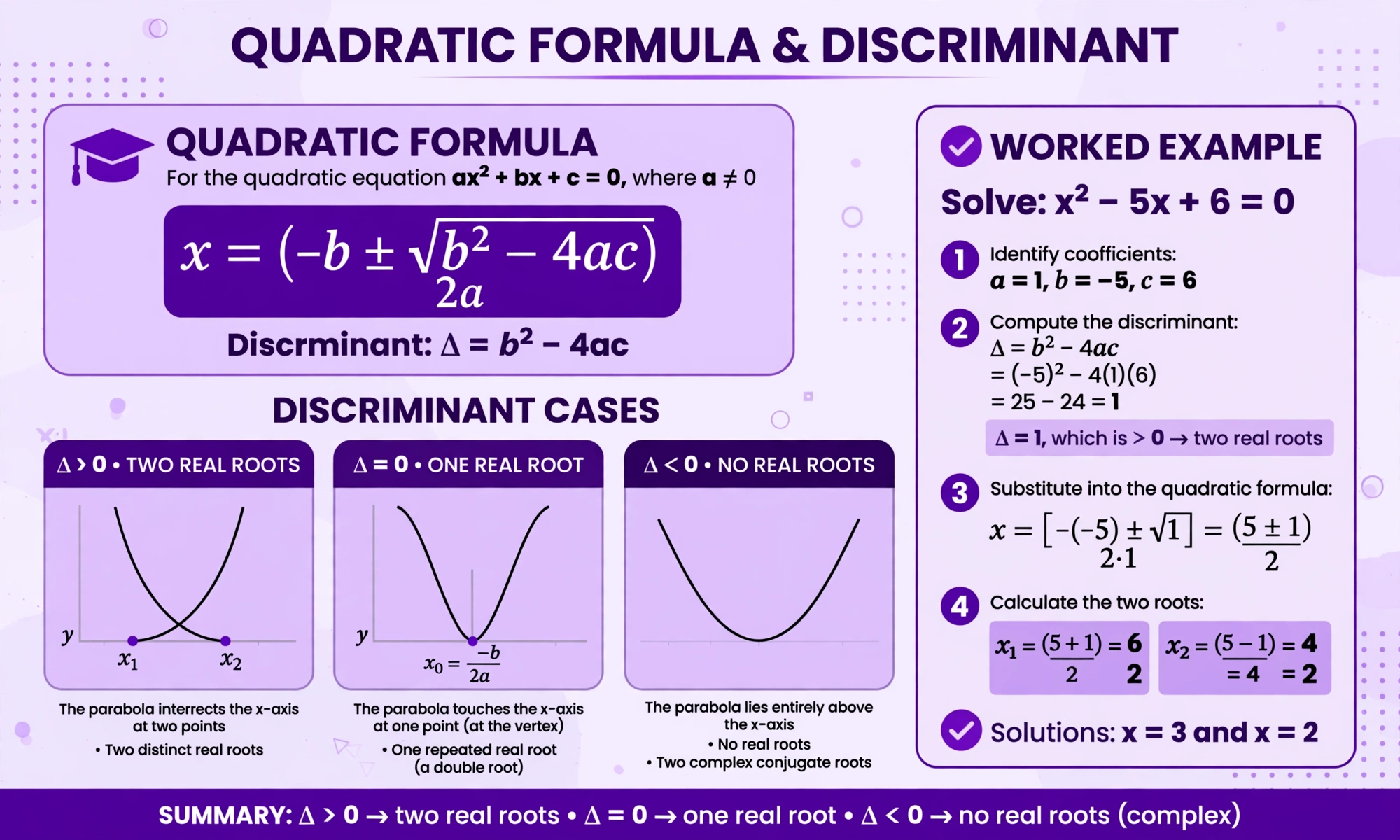
Every quadratic equation ax2 + bx + c = 0 (with a ≠ 0) is solved by one formula:
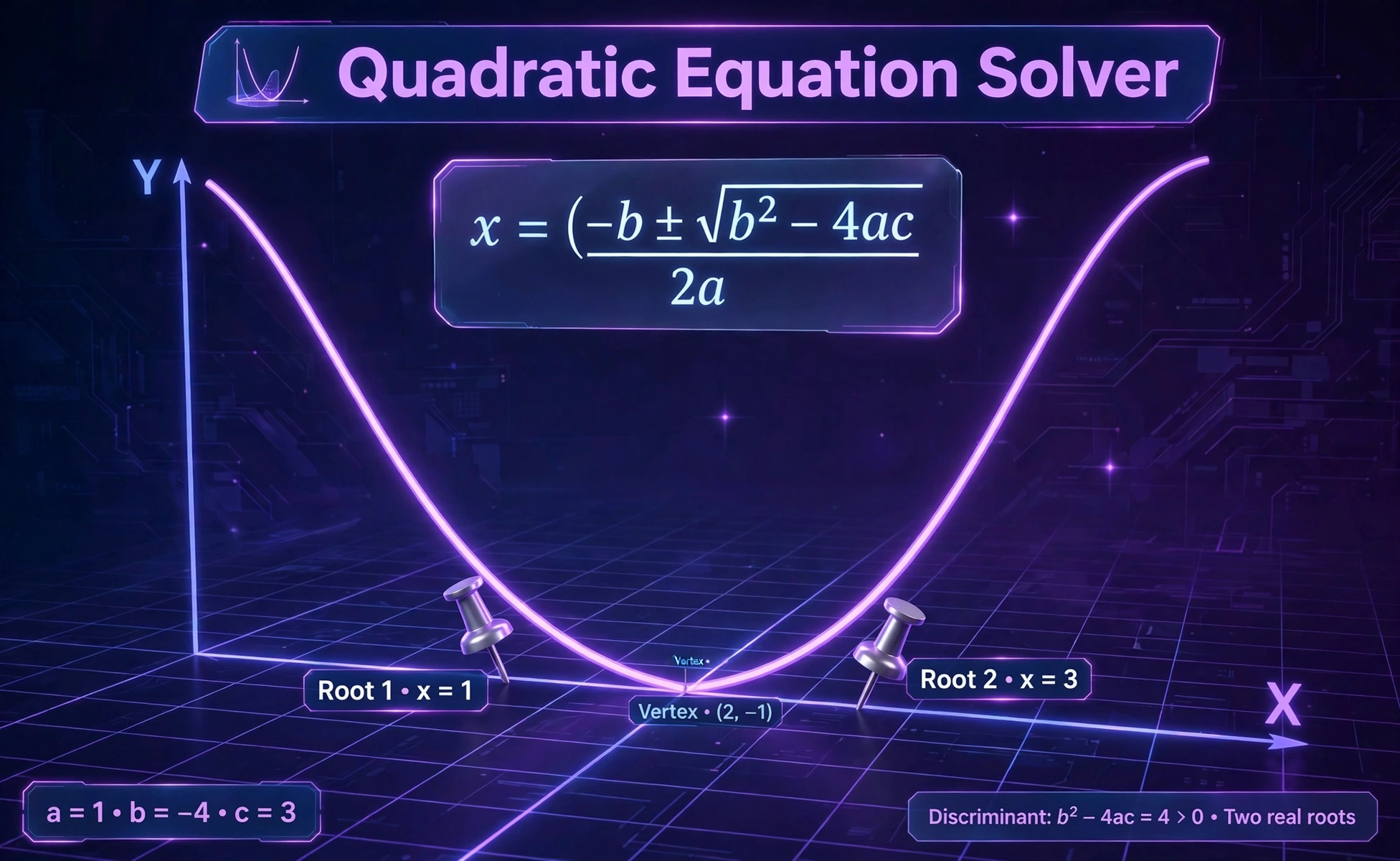
- x = (−b ± √(b² − 4ac)) ÷ 2a — plug in the three coefficients and out come the roots.
- Discriminant Δ = b² − 4ac tells you the nature of the roots before you finish: positive → two real roots, zero → one repeated root, negative → two complex roots.
- Vertex at (−b ÷ 2a, −Δ ÷ 4a) — the parabola’s turning point, useful for optimization problems.
| Discriminant | Roots | Graph |
|---|---|---|
| Δ > 0 | Two distinct real roots | Parabola crosses the x-axis twice |
| Δ = 0 | One repeated real root | Parabola just touches the x-axis |
| Δ < 0 | Two complex conjugate roots | Parabola never touches the x-axis |
The ± is doing the real work: one formula, two answers. Forgetting the second root is the classic exam mistake.
Worked example
Solve x² − 5x + 6 = 0. Coefficients: a = 1, b = −5, c = 6.
Discriminant: Δ = (−5)² − 4(1)(6) = 25 − 24 = 1. Positive, so two real roots.
x = (−(−5) ± √1) ÷ (2 × 1) = (5 ± 1) ÷ 2. So x₁ = 6 ÷ 2 = 3 and x₂ = 4 ÷ 2 = 2. Check: 3² − 15 + 6 = 0 and 2² − 10 + 6 = 0 — both check out.
How to use the quadratic equation solver
Get the equation into the form ax² + bx + c = 0 first — move everything to one side.
Step by step
- Enter a, the number multiplying x². It cannot be zero (that would make it linear).
- Enter b, the number multiplying x. Include the sign — in x² − 5x + 6, b is −5.
- Enter c, the constant term with no x attached.
- Press Calculate. Read the discriminant, both roots, the vertex and the axis of symmetry.
- Verify by substitution — plug each root back in; the equation should equal zero.
Factoring vs. formula vs. completing the square
Three roads lead to the roots. Knowing when to take each saves exam time:
| Method | Best when | Example |
|---|---|---|
| Factoring | Clean integer roots | x² − 5x + 6 = (x − 2)(x − 3) |
| Quadratic formula | Always works — the safe default | 2x² + 3x − 7 = 0 |
| Completing the square | Derivations, vertex form | x² + 6x + 5 = (x + 3)² − 4 |
Try factoring for 30 seconds; if the numbers fight back, reach for the formula. It never fails and this solver shows every step, so you can follow along and learn the pattern.
Where quadratics show up in real life
Quadratics are not just textbook exercises — they model anything that accelerates:
- Projectile motion: the height of a thrown ball over time is quadratic (gravity accelerates it downward).
- Profit optimization: revenue minus cost often forms a downward parabola; the vertex is the maximum profit.
- Area problems: fencing a rectangular pen with fixed perimeter leads to a quadratic area function.
- Physics and engineering: from lens equations to beam deflection, quadratics are everywhere second-order effects appear.
Whenever a quantity depends on the square of something — time, distance, price — expect a quadratic hiding underneath. A standard deviation calculator handles the statistics side when your data needs summarizing instead.
Complex roots: what "no real solution" really means
When Δ < 0, the parabola floats entirely above (or below) the x-axis — no real x makes the equation zero. But the story does not end there:
- Complex roots come in conjugate pairs: if 2 + 3i is a root, so is 2 − 3i.
- They are not "wrong" — in electrical engineering and quantum physics, complex roots describe real oscillating systems.
- For graphing purposes, "no real roots" plus the vertex tells you everything: the parabola’s position and direction with no x-intercepts.
This solver reports complex roots in a + bi form so nothing is hidden. If your class has not reached imaginary numbers yet, read a negative discriminant as "no real solution" and move on.
Frequently asked questions
How do you solve a quadratic equation?
Use x = (−b ± √(b²−4ac)) ÷ 2a. Compute the discriminant first: if positive you get two real roots, if zero one repeated root, if negative two complex roots. For x²−5x+6=0 the roots are x=3 and x=2.
What is the discriminant?
Δ = b² − 4ac. It is the part under the square root in the quadratic formula, and it reveals the nature of the roots before you finish: Δ>0 two real roots, Δ=0 one repeated root, Δ<0 two complex roots.
What if a = 0?
Then it is not quadratic — the x² term vanishes and you have a linear equation bx + c = 0, solved by x = −c/b. The solver flags this instead of dividing by zero.
How do you find the vertex of a parabola?
The vertex is at x = −b÷2a, with y = −Δ÷4a. For an upward parabola (a>0) it is the minimum; for downward (a<0) the maximum. Businesses use it to find maximum profit points.
Can a quadratic have no solution?
No real solution, yes — when the discriminant is negative the parabola never touches the x-axis. But it still has two complex conjugate roots (involving i = √−1), which this solver reports.
How do you factor a quadratic?
Find two numbers that multiply to a×c and add to b, then split the middle term. x²−5x+6 factors as (x−2)(x−3) because −2×−3=6 and −2+−3=−5. When the numbers are not integers, the formula is faster.
What is the difference between the quadratic formula and completing the square?
Completing the square rewrites ax²+bx+c as a(x−h)²+k, which reveals the vertex directly. The quadratic formula is actually derived by completing the square on the general equation — they are the same mathematics in different clothes.