
Small Business Data Breach Response Cost Calculator

Work out what responding to a data breach will cost your small business. Enter how many records were exposed, the type of data and your response costs, then see the total, the cost per record and the share that comes from the records themselves.

How many customer or employee records were exposed. Enter 1,000 if you are planning for a typical small breach.

IBM 2025 puts the average cost at $160 per customer record, $168 per employee record, $178 for intellectual property and $141 for anonymized data.

Forensics, incident response help and rebuilding systems. Leave your best estimate if you do not have a quote yet.

Outside counsel, regulatory filings and any fines you expect. Enter 0 if none apply.

Letters, emails, call centre time and credit monitoring for each affected person. About $5 a person is typical.

Lost customers, downtime and lost sales while the business recovers. Enter 0 if you cannot estimate it yet.

Formula: total response cost = (records exposed x cost per record) + detection and response + legal and fines + (records exposed x notification cost per person) + lost business.


How to Use the Small Business Data Breach Response Cost Calculator

A data breach bill arrives in pieces, so the first job is to put the pieces in one place. This calculator adds the five pieces that make up most of a small business breach bill and shows which piece is biggest.

  1. Enter the number of records exposed. Count every customer or employee record the attacker could have seen.
  2. Choose the type of data. Customer personal data costs $160 a record on average, employee data $168, intellectual property $178 and anonymized data $141, all from the IBM 2025 report.
  3. Enter the detection and response cost, meaning forensics, incident response help and rebuilding systems.
  4. Enter the legal and regulatory fines you expect, or 0 if none apply.
  5. Enter the notification cost per person, meaning letters, emails, call centre time and credit monitoring. About $5 a person is typical.
  6. Enter the lost business cost, meaning lost customers, downtime and lost sales. Press Calculate, or press Enter. The total appears first and large, with the records cost, the notification cost and the cost per record below.
A photo of a small business owner reviewing a security alert on a laptop in an office
1,000 records at $160 each cost $160,000 before any response work is counted.

The Data Breach Response Cost Formula

Total response cost = (records exposed x cost per record) + detection and response + legal and fines + (records exposed x notification cost per person) + lost business. Cost per record = total response cost / records exposed. Records share = records cost / total response cost x 100. The records cost grows with every person affected, while detection, legal and notification work is mostly fixed, so a small breach still carries a large fixed bill. IBM puts the global average breach at $4.44 million in 2025 and the US average at $10.22 million, but those averages come mostly from large organisations. The last IBM breakdown by company size, from 2023, put the average for organisations under 500 employees at $3.31 million.
Worked Example: 1,000 Customer Records Exposed

A small online shop exposes 1,000 customer records. It pays $25,000 for forensics and response, $15,000 in legal costs and fines, $5 a person for notification and loses $20,000 of business while it recovers.

  1. Records cost: 1,000 x $160 = $160,000.
  2. Notification cost: 1,000 x $5 = $5,000.
  3. Total: $160,000 + $25,000 + $15,000 + $5,000 + $20,000 = $225,000.
  4. Cost per record: $225,000 / 1,000 = $225.
  5. Records share: $160,000 / $225,000 x 100 = 71.1%.

As a second check, take 250 records at $160 with $8,000 of response work, $5,000 legal, $4 a person for notification and $6,000 of lost business. The records cost is $40,000, notification is $1,000, the total is $60,000 and the cost per record is $240. The same steps work for any breach, so try your own numbers in the tool above.

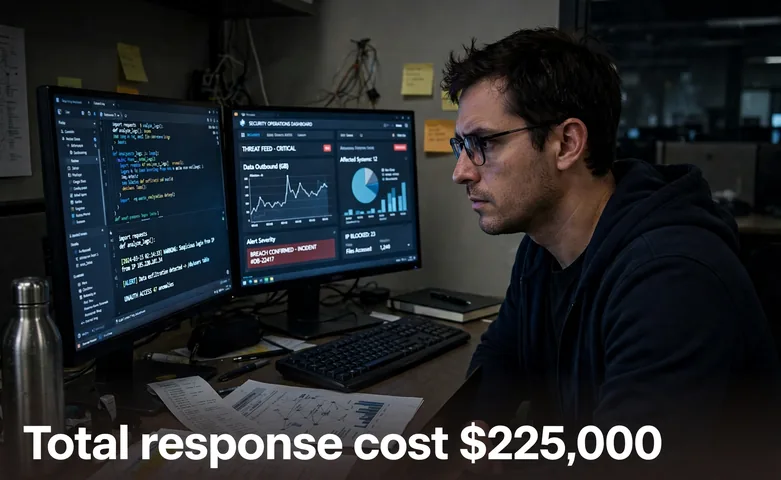
A photo of an IT specialist investigating a data breach on two monitors in a dark office
The worked example totals $225,000, or $225 per record.

What the Per-Record Number Really Means

The $160 per-record figure is an average across the 604 breaches IBM studied in 2025, not a price list for your breach. A breach of 1,000 records does not automatically cost $160,000 in record-related losses, because the average mixes tiny breaches with mega-breaches and mixes cheap notification with expensive lawsuits. Use it as a planning anchor and replace it with your own numbers whenever you have them. The more useful number on this page is the records share. When it is high, the breach is mostly about how many people were affected, so notification and credit monitoring dominate. When it is low, the breach is mostly fixed response work, so the bill stays large even if few records were exposed. That is why small businesses feel breaches so sharply. Most of the cost is fixed, and a small firm has fewer records to spread it across.

The Four Cost Buckets in a Breach Bill

Detection and response is usually the first bill and often the largest fixed one. It covers forensics to find out what happened, incident response help, overtime for your own staff and rebuilding affected systems. Legal and regulatory costs follow, and they grow when the data is regulated or when customers in several states are affected. Notification is the most predictable bucket, because it scales directly with the number of people, and credit monitoring is usually the biggest part of it. Lost business is the hardest to estimate and the easiest to understate, because it includes customers who leave quietly and sales lost while systems are down. Our payroll software cost calculator and our bookkeeping software cost calculator help you price the everyday running costs that a breach interrupts, so you can see what a week of downtime really takes from the business.

What to Do With the Number

Take the total to three places. First, take it to your insurer before you renew, because the total is the number a cyber policy has to cover, and a policy with a limit below it leaves you paying the rest yourself. Second, take it to your incident response plan, because IBM found breaches contained in under 200 days averaged $3.61 million against $5.49 million when containment ran longer, so speed is the largest lever you control. Third, use it to justify the controls that cut the bill, such as multi-factor authentication, backups that are tested and a written plan that staff have rehearsed. Our wedding venue insurance cost calculator shows the same kind of limit-versus-cost thinking for a different kind of cover, and the same question applies here. Is the limit high enough for the bill you just calculated?

A photo of a small business owner discussing an insurance policy with an adviser at a desk
Breaches contained in under 200 days averaged $3.61 million against $5.49 million when containment ran longer.

Frequently asked questions

How much does a data breach cost a small business?

The last IBM breakdown by company size, from 2023, put the average at $3.31 million for organisations under 500 employees. The global average across all sizes was $4.44 million in 2025. Your own cost depends on how many records were exposed, what kind of data they were and how fast you contain the breach.

What is the average cost per record in a data breach?

IBM 2025 puts the average at $160 per customer record, $168 per employee record, $178 for intellectual property and $141 for anonymized data. These are averages across studied breaches, not a price for your breach, so use them as a planning anchor and replace them with your own quotes when you have them.

What costs the most in a data breach?

It depends on size. In the worked example, the records cost is 71.1% of the total, so the number of people affected dominates. In a small breach, fixed detection and response work dominates instead. Lost business is often the hardest bucket to estimate and the easiest to understate.

Does cyber insurance cover the full cost of a breach?

Only up to the policy limit, and only for the costs the policy names. Compare the total from this calculator with your policy limit before you renew, and check whether it covers forensics, legal costs, notification, credit monitoring and lost business, or only some of them.

How fast should a data breach be contained?

As fast as possible. IBM 2025 found breaches contained in under 200 days averaged $3.61 million, against $5.49 million when containment ran longer. A written incident response plan that staff have rehearsed is the cheapest way to cut that time.

This is an estimate for planning. Actual breach costs come from your own quotes, your counsel and your insurer, and they vary by the data involved, the laws that apply and how fast the breach is contained.

Start Calculating Now!

Discover the power of smart tools at KitQuarter.

Explore All Tools