Property Tax Calculator
Estimate your yearly property tax bill from the numbers on your assessment notice. Enter the market value, the assessment ratio, any exemptions and your mill rate, and the calculator shows the assessed value, the annual tax, the monthly escrow figure and the effective rate. Free, no sign-up, everything runs in your browser.
Formulas: Assessed value = Market value × Assessment ratio. Taxable value = Assessed value - Exemptions. Annual tax = Taxable value × Mill rate / 1,000. Monthly tax = Annual tax / 12.

Formulas verified against standard references. Calculator logic tested with verified worked examples. Published: November 8, 2026 | Last updated: November 8, 2026. Fact-checked: November 8, 2026. Our methodology
How to Use the Property Tax Calculator
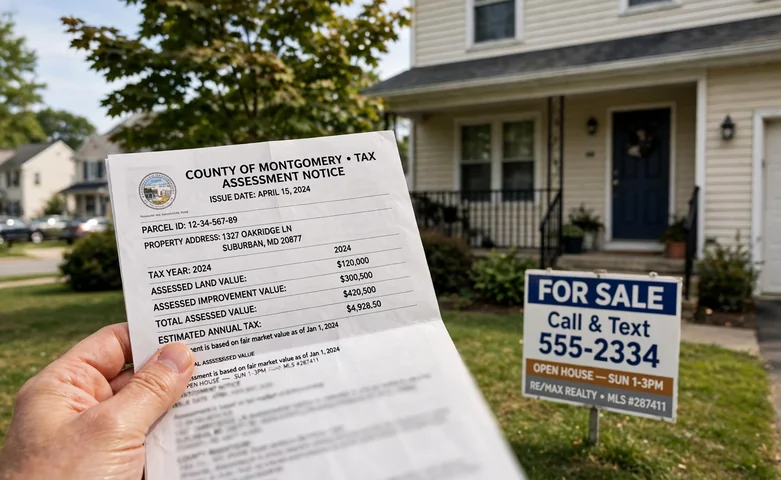
Four numbers from your assessment notice and your tax bill give you the answer. Read them off the documents if you can, instead of guessing them.
- Type the market value, which is what the property would sell for. Your assessment notice may call this the appraised value.
- Type the assessment ratio as a percent. This is the share of market value your state taxes. Enter 100 where property is assessed at full value.
- Type your exemptions in dollars, such as a homestead, senior or veteran exemption. Enter 0 if none apply.
- Type the mill rate in mills, adding every taxing body on your bill together, then press Calculate, or press Enter. The annual tax appears first and large, with the monthly figure, the assessed value and the effective rate below, plus the step-by-step math. Press Reset to clear the form and start over.

The Property Tax Formula
Three steps turn a home value into a tax bill. Each step uses a number set by a different body, which is why the bill can change even when your home does not.
Assessed value: Assessed value = Market value × Assessment ratio. A $350,000 home assessed at 100% has an assessed value of $350,000. The same home assessed at 80% has an assessed value of $280,000, and it is taxed on the lower figure.
Taxable value: Taxable value = Assessed value - Exemptions. Exemptions cut the value that gets taxed, and taxable value never goes below zero. A $25,000 homestead exemption on a $400,000 assessed value leaves $375,000 taxable.
Annual tax: Annual tax = Taxable value × Mill rate / 1,000. One mill is $1 of tax per $1,000 of value, so 22.5 mills is 2.25% of taxable value. Monthly tax = Annual tax / 12, which is the figure most lenders collect in escrow.
Effective rate: Effective rate = Annual tax / Market value × 100. This is the only figure that can be compared between towns, because it strips out the different ratios and mill rates.
Worked Example: A $350,000 Home
A home has a market value of $350,000, an assessment ratio of 100%, no exemptions and a mill rate of 22.5 mills. Here is exactly what the calculator does.
- Assessed value = $350,000.00 × 100% = $350,000.00.
- Taxable value = $350,000.00 - $0.00 = $350,000.00.
- Annual tax = $350,000.00 × 22.5 / 1,000 = $7,875.00.
- Monthly tax = $7,875.00 / 12 = $656.25.
- Effective rate = $7,875.00 / $350,000.00 × 100 = 2.25%.
This matches the 4Calculators worked example exactly, which gives the same $7,875 annual tax and $656.25 monthly figure on the same numbers. As a second check, CalcLabHub gives a $400,000 home at 100% with a $25,000 exemption and a 1.1% rate an annual tax of $4,125, or $343.75 a month, which is the same method with different numbers.
Mills, Percent Rates and Assessment Ratios
Rates come in two forms, and the mill rate is the one that confuses people. A mill is one tenth of one percent, so divide mills by 10 to get the percent rate. A 22.5-mill rate is 2.25%, and a 7.5-mill rate is 0.75%.
| Rate | Mill rate | Annual tax | Monthly tax |
|---|---|---|---|
| 0.50% | 5.0 mills | $3,500.00 | $291.67 |
| 0.75% | 7.5 mills | $5,250.00 | $437.50 |
| 1.00% | 10.0 mills | $7,000.00 | $583.33 |
| 2.25% | 22.5 mills | $15,750.00 | $1,312.50 |
The assessment ratio matters just as much as the rate. A 90-mill rate on a 25% assessment ratio is 2.25% of market value, exactly the same burden as 22.5 mills at full value. That is why mill rates cannot be compared across state lines, and why this calculator reports the effective rate on market value.
Why Your Tax Bill Changes
Your bill can rise for three reasons, and only one of them is your home gaining value. First, the assessor can raise the assessed value when the market rises, though the value is set on a fixed date and can lag the market by years.
Second, the mill rate can change when voters approve a levy or a bond issue, or when the school district, county and town each set new rates. Add every line on your bill together, because one line on its own understates the tax.
Third, exemptions can change. A homestead exemption may be capped, a senior exemption may start at a certain age, and some exemptions need a fresh application each year. If your bill jumps, check the assessed value, the ratio and the mill rate on the notice before you assume the value is wrong. Then check what the bill means for your monthly payment with our mortgage calculator and our house affordability calculator.
Common Property Tax Mistakes
The first mistake is using the market price instead of the assessed value. Assessed value is what the assessor says the property is worth for tax, and in many states it is a fraction of the market price. Using the sale price when the ratio is 80% overstates the tax by a quarter.
The second mistake is entering only one levy. Your bill usually combines municipal, school and special-district taxes, and the mill rate you enter must be the total of all of them. A school levy alone can be half the bill.
The third mistake is forgetting that rates vary hugely by place. Effective rates run from about 0.3% in Hawaii to over 2.5% in New Jersey and Illinois, with a national average near 1.1%. A rate that looks wrong may be normal for your state, so always verify it against your own bill or your assessor website.
Disclaimer
This calculator gives an estimate for planning and is for informational purposes only, not tax advice. Actual tax depends on your assessor, your exemptions and your local rates. See our disclaimer.
Frequently asked questions
How is property tax calculated?
Multiply the market value by the assessment ratio to get the assessed value, subtract any exemptions to get the taxable value, then multiply by the mill rate and divide by 1,000. A $350,000 home at 100% with no exemptions and 22.5 mills owes $7,875 a year.
What is a mill rate?
A mill rate is the dollars of tax per $1,000 of taxable value. One mill is $1 per $1,000, or 0.1%, so 22.5 mills is 2.25% and 7.5 mills is 0.75%. Divide the mill rate by 10 to get the percent rate.
What is the difference between market value and assessed value?
Market value is what the property would sell for. Assessed value is the value the assessor sets for tax, which is market value times the assessment ratio. In many states the ratio is below 100%, so the assessed value is lower than the market price.
What is a homestead exemption?
A homestead exemption cuts the assessed value of your main home before tax is applied, usually by a fixed dollar amount. A $25,000 exemption on a $400,000 assessed value leaves $375,000 taxable. Rules, amounts and applications vary by state.
What is a typical property tax rate?
Effective rates in the United States run from about 0.3% of market value in Hawaii to over 2.5% in New Jersey and Illinois, with a national average near 1.1%. The rate that applies to you is set locally, so check your own bill or assessor website.
Related calculators

Sales Tax Calculator
Work out the sales tax on a purchase.
Use calculatorMortgage Calculator
See your monthly mortgage payment with tax and insurance.
Use calculatorHouse Affordability Calculator
Find the home price your income supports.
Use calculatorRent vs Buy Calculator
Compare renting with buying, tax included.
Use calculatorIncome Tax Calculator
Estimate your income tax for the year.
Use calculatorDown Payment Calculator
Work out the down payment on a home.
Use calculator