Fibonacci Calculator
Find the nth Fibonacci number and list the whole sequence with this fibonacci calculator. Type a position n, press Calculate, and get F(n) exactly, the running sum, and the ratio to the previous term, with every step shown. It uses F(0) = 0, the standard convention, so indexes never shift. Free, no sign-up, everything runs in your browser.
Formula: F(n) = F(n-1) + F(n-2), with F(0) = 0 and F(1) = 1.

Formulas verified against standard references. Calculator logic tested with verified worked examples. Published: November 4, 2026 | Last updated: November 4, 2026. Our methodology
How to Use the Fibonacci Calculator
Getting an answer takes four quick steps. The tool needs just one input, the term position.
- Type the term position n in the "Term position (n)" field. Use 10 for the 10th term, or 50 for the 50th. The field accepts whole numbers from 0 to 10000.
- Press Calculate, or press Enter. The result appears with the sequence, the term sum, and the ratio to the previous term.
- Read the step-by-step breakdown under the answer. It shows each addition the recurrence performs.
- Press Reset to clear the form and try another position.
What Is the Fibonacci Sequence?
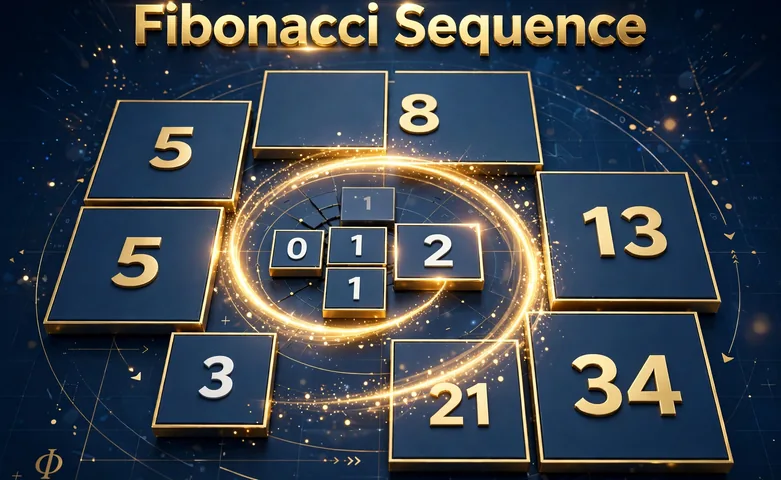
The Fibonacci sequence is a list of whole numbers where each number is the sum of the two numbers before it. It starts 0, 1, and then every new term adds its two neighbors, so the rule never changes no matter how far you go.
This page uses the standard convention F(0) = 0 and F(1) = 1. State this convention every time you compare answers across sources, because some books start at F(1) = 1 and F(2) = 1, which shifts every index by one.
The first 20 terms are 0, 1, 1, 2, 3, 5, 8, 13, 21, 34, 55, 89, 144, 233, 377, 610, 987, 1597, 2584, and 4181. Each term after the first few is roughly 1.6 times the one before it, which is why the list grows so fast.
Fibonacci Formula
Two formulas produce the same terms. The recurrence builds them step by step, and Binet's formula jumps straight to any term.
The Recurrence Relation
The recurrence is F(n) = F(n-1) + F(n-2), with F(0) = 0 and F(1) = 1. Here F(n) is the term you want, and F(n-1) and F(n-2) are the two terms right before it. To find F(10), build up from the start. F(2) = 1 + 0 = 1, F(3) = 1 + 1 = 2, F(4) = 2 + 1 = 3, F(5) = 3 + 2 = 5, F(6) = 5 + 3 = 8, F(7) = 8 + 5 = 13, F(8) = 13 + 8 = 21, F(9) = 21 + 13 = 34, and F(10) = 34 + 21 = 55. The calculator on this page follows exactly this chain.
Binet's Formula
Binet's formula computes F(n) directly: F(n) = (phi^n - psi^n) / sqrt(5), where phi = (1 + sqrt(5)) / 2, about 1.6180339887, and psi = (1 - sqrt(5)) / 2, about -0.6180339887. Since psi^n shrinks toward zero as n grows, a handy shortcut is to round phi^n / sqrt(5) to the nearest whole number. For n = 10, phi^10 / sqrt(5) is about 54.999, which rounds to 55. Carry full precision through the powers and round only at the very end, or large terms drift. The formula divides by the square root of 5. To explore that step on its own, try the square root calculator.
The Sum Rule
The terms add up neatly: F(0) + F(1) + ... + F(n) = F(n+2) - 1. Add the first 10 terms and you get 0 + 1 + 1 + 2 + 3 + 5 + 8 + 13 + 21 + 34 = 88. Since F(11) = 89, the rule predicts 89 - 1 = 88, which matches. The calculator shows this sum next to every answer, so you can check any long list in one glance.
The Golden Ratio Connection
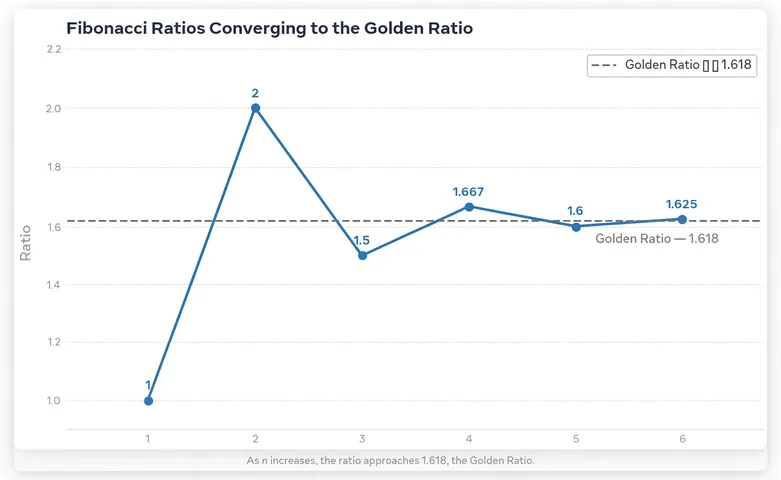
Divide each term by the one before it and watch what happens. The ratios run 1, 2, 1.5, 1.667, 1.6, and 1.625, swinging above and below a fixed value and landing closer each time. That value is the golden ratio, phi, about 1.6180339887.
Comparing consecutive terms is a ratio comparison like any other, and our ratio calculator handles the same kind of side-by-side comparison for everyday numbers. F(50) / F(49) reads 1.61803399, correct to eight decimal places.
The ratio never reaches phi exactly for a finite term, but it gets closer without limit. That slow, alternating approach is why phi is sometimes called the most irrational number.
Fibonacci Numbers in Nature and Real Life
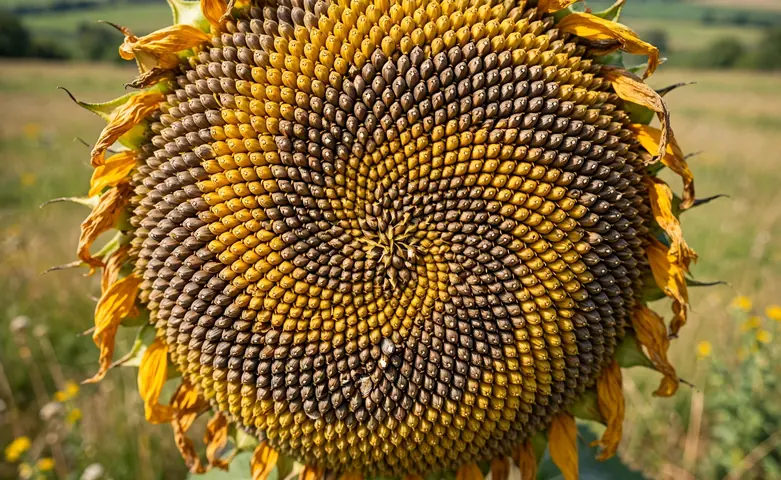
Sunflower seed heads often show 34 spirals one way and 55 the other, and cactus stems carry 13 spirals. New seeds pack at the golden angle, about 137.5 degrees, because that spacing leaves the fewest gaps.
The same numbers turn up in flower petals, pinecone scales, and tree branching. Artists and architects have borrowed the proportion for pleasing rectangles, and programmers meet the sequence in recursion, the classic example of a naive recursive function repeating work while a loop runs in linear time.
A Short History of the Sequence
Leonardo of Pisa, known as Fibonacci, introduced the sequence to Europe in his 1202 book Liber Abaci, through the rabbit-breeding problem that asks how many pairs of rabbits appear in a year when each pair breeds a new pair monthly. Indian scholars had described the same numbers centuries earlier while studying the rhythms of poetry.
Common Mistakes to Avoid
The most common error is the indexing shift. If one source counts F(1) = 1, F(2) = 1 and another counts F(0) = 0, F(1) = 1, the "10th term" differs by one position, so always confirm the convention first.
Rounding Binet's formula too early is the next trap. Truncating phi to a few decimals compounds into a wrong integer for large n, so carry full precision and round once at the end.
Also, do not expect the ratios to settle instantly. Early ratios like 1 or 2 sit far from phi, and the convergence only tightens past n = 15 or so. Finally, do not confuse Fibonacci numbers with Lucas numbers, which follow the same recurrence from different seeds, L(0) = 2 and L(1) = 1, producing 2, 1, 3, 4, 7, 11, and so on.
Looking for Fibonacci Retracement Levels?
If you came here for trading, you want a different tool. A Fibonacci retracement calculator plots price levels from a swing high and low at 23.6%, 38.2%, 50%, 61.8%, and 78.6%, with extensions at 127.2%, 161.8%, and 261.8%. Those levels borrow ratios from the sequence, but this page computes the sequence itself, the nth term, the running list, and the sum.
Frequently asked questions
What is the Fibonacci sequence?
The Fibonacci sequence is a list of whole numbers where each term is the sum of the two before it, starting 0, 1, 1, 2, 3, 5, 8, 13, 21, 34, 55 and continuing without end. This page uses F(0) = 0, so every term keeps the same index everywhere.
How do I find the nth Fibonacci number?
Type the position n into the calculator and press Calculate. The tool builds the sequence from F(0) = 0 and F(1) = 1, adds each pair of neighbors until it reaches F(n), then shows the term, the running sum, the ratio to the previous term, and every step.
What is Binet's formula?
Binet's formula finds the nth Fibonacci number directly: F(n) = (phi^n - psi^n) / sqrt(5), where phi = (1 + sqrt(5)) / 2 and psi = (1 - sqrt(5)) / 2. Because psi^n shrinks toward zero, rounding phi^n / sqrt(5) to the nearest whole number also works.
Why do the ratios of consecutive Fibonacci numbers approach the golden ratio?
Each term is roughly phi times the one before it, because phi satisfies x^2 = x + 1, which mirrors the recurrence. The ratio alternates above and below phi and closes in, passing 1.5, 1.667, 1.6, and 1.625 on the way to 1.61803399 at F(50) / F(49).
What is the sum of the first n Fibonacci numbers?
Adding F(0) through F(n) always gives F(n+2) - 1. For example, 0 + 1 + 1 + 2 + 3 + 5 + 8 + 13 + 21 + 34 = 88, and F(11) = 89, so 89 - 1 = 88. The calculator shows this sum next to every answer.
Where do Fibonacci numbers appear in nature?
Sunflower seed heads often show 34 and 55 spirals, cacti show 13, and flower petals come in counts like 3, 5, 8, and 13. New growth packed at the golden angle, about 137.5 degrees, fills space without gaps, which is why these counts keep appearing.
What is the difference between a Fibonacci calculator and a Fibonacci retracement calculator?
This page computes terms of the number sequence. A retracement calculator is a trading tool that plots price levels at 23.6%, 38.2%, 50%, 61.8%, and 78.6% of a swing from Fibonacci ratios. They share the name and the math but answer different questions.
Is the Fibonacci sequence the same as the golden ratio?
No. The sequence is the list of whole numbers 0, 1, 1, 2, 3, 5, 8, and so on. The golden ratio is the single number phi, about 1.6180339887. Ratios of neighbors in the sequence converge to phi, which is why the two are always mentioned together.
Related calculators

Factorial Calculator
Exact factorials up to 300 with digit counts and trailing zeros.
Use calculatorPermutation & Combination Calculator
Count arrangements with nPr and selections with nCr.
Use calculatorExponent Calculator
Raise any base to any exponent with expansions and scientific notation.
Use calculatorPrime Number Calculator
Check if a number is prime and see its prime factors.
Use calculatorSquare Root Calculator
Find square, cube, and nth roots with simplified radicals and verification.
Use calculatorRatio Calculator
Simplify ratios, scale them up or down, or split an amount by ratio.
Use calculatorLCM & GCD Calculator
Find the LCM and GCD of any numbers, with step-by-step working.
Use calculatorMean Median Mode Calculator
Get mean, median, mode and range from any number list.
Use calculatorNumber to Words Converter
Spell any number out in English words.
Use calculator