Small Business Mileage Reimbursement Calculator
Work out what your business driving is worth. Enter your total business miles and the rate per mile to see your total reimbursement, your per-trip average, and your monthly and annual totals.
Formula: total reimbursement = business miles x rate per mile. Per-trip average = total / number of trips. Monthly total = total / months. Annual total = monthly total x 12.

Formulas verified against standard references. Calculator logic tested with verified worked examples. Published: November 11, 2026 | Last updated: November 11, 2026. Fact-checked: November 11, 2026. Our methodology
How to Use the Small Business Mileage Reimbursement Calculator
Getting your reimbursement takes four quick entries. The tool multiplies your business miles by your rate, then breaks the total into a per-trip average and a monthly and annual projection.
- Enter your total business miles for the period you are claiming. Count only business driving, not your normal commute.
- Enter your rate per mile in cents. The tool starts at 76 cents, the IRS business rate for miles driven from July 1 to December 31, 2026. Change it if your employer pays a different rate.
- Enter how many separate trips those miles cover, and how many months to project. The default is 12 months, which gives a full year projection.
- Press Calculate, or press Enter. The total appears first and large, with the per-trip average, the monthly total, and the annual projection below. Press Reset to clear the form and start over.

The Small Business Mileage Reimbursement Formula
The small business mileage reimbursement formula is total reimbursement = business miles x rate per mile. The rate is in cents, so divide it by 100 to get dollars per mile, then multiply by your miles.
The per-trip average is total reimbursement divided by the number of trips. The monthly total is total reimbursement divided by the number of months, and the annual projection is the monthly total times 12. The rate covers fuel, maintenance, insurance, registration, and depreciation in one number, so you do not track those costs separately. Our fuel economy calculator works out your actual fuel cost per mile if you want to compare it with the rate you are paid.
Worked Example: 1,200 Business Miles at 76 Cents
A small business owner drives 1,200 business miles in the year, spread over 24 trips, at the 2026 second-half IRS rate of 76 cents per mile. Here is exactly what the calculator does.
- Convert the rate to dollars: 76 cents / 100 = $0.76 per mile.
- Total reimbursement: 1,200 x $0.76 = $912.
- Per-trip average: $912 / 24 trips = $38 per trip.
- Monthly total: $912 / 12 months = $76 per month.
- Annual projection: $76 x 12 = $912 for the year.
As a second check, 285 miles at the first-half 2026 rate of 72.5 cents is 285 x $0.725 = $206.63. The same steps work for any mileage total, so try your own numbers in the tool above.
The 2026 IRS Mileage Rate Split
2026 has two business mileage rates, because the IRS raised the rate in the middle of the year. Miles driven from January 1 to June 30, 2026 use 72.5 cents per mile, and miles driven from July 1 to December 31, 2026 use 76 cents per mile. The 2025 rate was 70 cents per mile.
The split matters when your claim covers the whole year. Add the two halves separately, with each half at its own rate, instead of pricing every mile at one rate. For example, 5,000 miles in each half pays 5,000 x $0.725 plus 5,000 x $0.76, which is $3,625 plus $3,800, for $7,425. Pricing all 10,000 miles at 76 cents would overstate the claim by $175.
The rate is set by the IRS each year from a study of the fixed and variable costs of running a car, and it can change mid-year when fuel prices move sharply. This calculator leaves the rate editable, so you can enter 72.5 for first-half miles, 76 for second-half miles, or your employer rate if it differs.
What Counts as Business Mileage
Business mileage is driving you do for work, beyond your normal commute. Driving from your office to a client, between two work sites, to a supplier, or to a temporary work site all count. Driving from home to your regular workplace does not count, and neither does driving for personal errands. If a trip mixes business and personal driving, only the business part counts.
Parking fees and tolls for business driving are claimed on top of the mileage amount, not inside it. The standard rate already covers fuel, repairs, insurance, and depreciation, so you cannot claim those costs again on top of the rate for the same miles. Our budget calculator can help you fit vehicle costs into your monthly plan.
How to Keep a Mileage Log That Holds Up
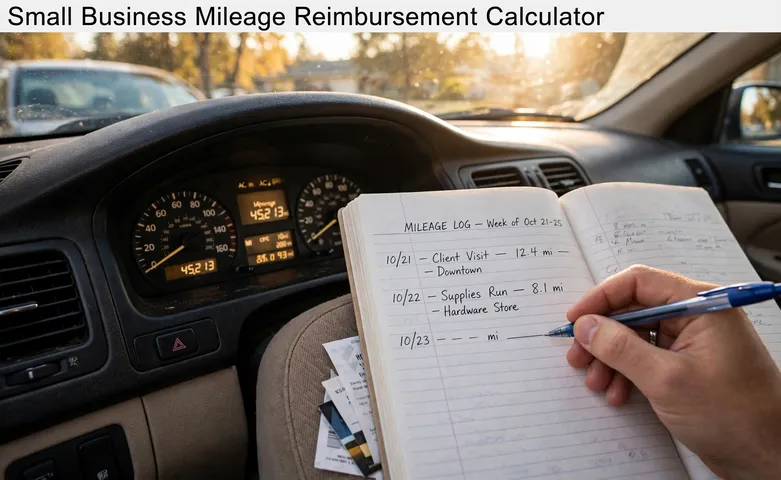
A calculator only totals the numbers you enter. The log is what proves them. Record each trip when it happens, with the date, the starting and ending odometer readings or the miles driven, the destination, and the business purpose.
Keep the log in one place, whether that is a notebook, a spreadsheet, or a mileage tracking app. Photograph receipts for parking and tolls and keep them with the log. At the end of each month, add up the business miles and check the total against the calculator before you submit the claim. That monthly check catches missing trips while you still remember them. Our income tax calculator estimates the tax side once your yearly totals are in.

Frequently asked questions
What is the IRS mileage rate for 2026?
The IRS business rate is 72.5 cents per mile for miles driven from January 1 to June 30, 2026, and 76 cents per mile for miles driven from July 1 to December 31, 2026. Use the rate that matches the date you drove, and check IRS.gov for the current rate before you file a claim.
How do I calculate mileage reimbursement?
Multiply your business miles by the rate per mile. For example, 1,200 business miles at 76 cents is 1,200 times $0.76, which is $912.
Is mileage reimbursement taxable income?
Reimbursement paid at or below the IRS standard rate under an accountable plan is generally not treated as taxable wages. Amounts above the IRS rate, or payments without a proper expense report, may be taxable, so check your employer policy and talk to a tax professional.
Can I claim my daily commute?
No. A normal drive from home to your regular workplace does not count as business mileage. Driving from one work site to another, or from your office to a client, does count.
What records do I need for a mileage claim?
Keep a log with the date, the destination, the business purpose, and the miles for each trip. Record each trip when it happens, because a log rebuilt months later is much harder to support.
Should I use the standard mileage rate or track actual expenses?
The standard rate is simpler, because you only track miles and multiply by the rate. Actual expenses can be larger for a newer or more expensive vehicle, but they need detailed records for fuel, insurance, repairs, and depreciation, and you cannot use both methods for the same vehicle in the same year.
This is an estimate for planning, and actual reimbursement depends on your employer policy and the current IRS rate, so confirm the rate and talk to a tax professional before you file, and see our disclaimer for the full terms.
Related calculators

Fuel Economy Calculator
Work out your fuel cost per mile and compare it with your reimbursement rate.
Use calculatorMobile Pet Grooming Van Fuel Cost Calculator
Estimate fuel costs for a service van that drives to clients all day.
Use calculatorSalary Calculator
Turn an hourly rate or annual salary into pay per week, month, and year.
Use calculatorBusiness Loan Calculator
Work out monthly payments and total interest on a business loan.
Use calculatorBudget Calculator
Build a monthly budget and see where your money goes.
Use calculatorIncome Tax Calculator
Estimate your federal income tax from your income and filing status.
Use calculator