Ring Size Converter
Convert a ring size between the US, UK, EU/ISO and Japanese systems with this ring size converter. Pick the system you know, type the size, and press Calculate to see every equivalent, plus the inner diameter and circumference in mm and inches. Free, no sign-up, everything runs in your browser.
Conversion method: sizes match a row in a standard international chart and convert through the row's inner diameter in millimeters. The US scale adds 0.8128 mm of diameter per whole size, and EU/ISO equals the inner circumference in mm.

Formulas verified against standard references. Calculator logic tested with verified worked examples. Published: November 5, 2026 | Last updated: November 5, 2026. Our methodology
How to Use the Ring Size Converter
Converting a size takes less than a minute. The tool needs three choices and one number.
- Pick the system you know in the "From system" box. Choose US / Canada, UK / Australia, EU / ISO, Japan, or an inner diameter in mm or inches.
- Type the size in the Size field. For a UK size, type a letter such as N, and write a half size as N1/2.
- Pick the "To system" you want the answer in, then choose how many decimals the mm and inch figures show.
- Press Calculate, or press Enter. The converted size appears first, with every equivalent and the step-by-step working below it.
- Press Swap to flip the two systems and convert straight back, or press Reset to start over.
How Ring Size Conversion Works
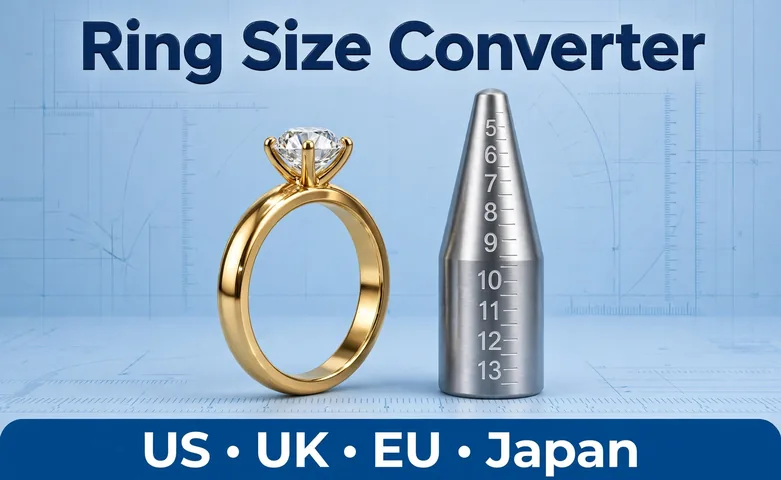
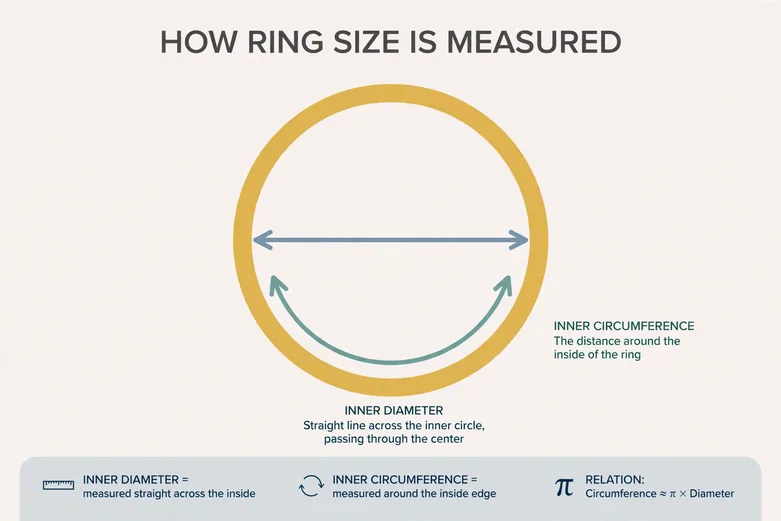
Every sizing system describes the same physical ring. The converter matches your size to its row in a standard international chart, then reads every equivalent off that row. The inner diameter in millimeters is the common thread, because it is the one measurement every chart agrees on.
In the US and Canada, sizes run as whole and half numbers from 3 to 13, and each whole size adds 0.8128 mm of inner diameter. In the UK, Ireland and Australia, sizes run as letters from A to Z with half sizes, and each letter step adds about 1.25 mm of inner circumference. Across most of Europe, the size number simply states the inner circumference in millimeters under ISO 8653, so EU 54 means about 54 mm around the inside. Japan uses its own integer scale that climbs about a third of a millimeter of diameter per step.
Put together, US 7, UK N½, EU 54 and Japan 14 are four names for one ring, a 17.3 mm inner diameter with a 54.4 mm inner circumference. The circle calculator covers the diameter and circumference math behind those numbers.
Where Each Sizing System Comes From
The systems grew up separately, which is why one finger can have four different numbers. The US scale came from American manufacturers who stepped diameters by 0.032 inch, and Canada uses the same scale. The UK letter system came from British jewelers who stepped circumference by about 1.25 mm per letter, and Australia and New Zealand kept it. Mainland Europe standardized on ISO 8653, which states the inner circumference in millimeters, so France, Germany, Italy and Spain all use it. Japan uses its own numeric scale, and China tracks the Japanese numbers closely.
Because the systems round differently, published charts can disagree by a size at the edges, and the Japanese column is the usual culprit. When a jeweler needs certainty, they measure the inner diameter in millimeters and ignore the labels.
How to Measure Your Ring Size at Home
If you do not own a ring sizer, a strip of paper works. Wrap it snugly around the base of the finger, mark where it overlaps, and measure the length in millimeters. That length is the inner circumference. Divide it by 3.1416 to get the inner diameter, then enter that diameter in the converter. The length converter helps if your ruler reads in inches.
Measure at the end of the day at room temperature, and measure twice. Fingers swell with heat, salt and exercise, often by half a size.
Common Mistakes Between Similar Sizes
Most wrong orders come from look-alike sizes. UK N and UK N½ differ by half a US size, so read the ½ carefully. EU 54 and Japan 14 look unrelated but name the same ring, while Japan 54 would be enormous, so double-check which numeric system a label uses.
A size that falls between two chart rows rounds to the nearest standard size, and ties round up, because a slightly loose ring is safer than a tight one. Wide bands fit more snugly than thin ones, so jewelers often add half a size for bands wider than about 6 mm. The dominant hand usually runs half a size larger than the other hand, so measure the exact finger that will wear the ring. Shoe sizes carry the same country-to-country confusion, and the shoe size converter handles those.
Popular Ring Sizes at a Glance
A few sizes cover most orders. These rows come straight from the chart the converter uses.
| US | UK | EU | Japan | Inner diameter |
|---|---|---|---|---|
| 6 | L½ | 52 | 12 | 16.5 mm |
| 7 | N½ | 54 | 14 | 17.3 mm |
| 8 | P½ | 57 | 16 | 18.2 mm |
| 9 | R½ | 60 | 18 | 19.0 mm |
| 10 | T½ | 62 | 20 | 19.8 mm |
The average US ring size is about 6 for women and 9 to 10 for men, measured at the ring finger.
Frequently asked questions
What is the most accurate way to convert ring sizes?
Start from the inner diameter in millimeters. It is the one measurement every chart agrees on, while letters and numbers are rounded differently from country to country.
Are US and Canadian ring sizes the same?
Yes. The United States and Canada share one scale, so a US 7 is a Canadian 7.
What is the difference between EU and Japanese ring sizes?
An EU size equals the inner circumference in millimeters, so EU 54 means about 54 mm around the inside. Japanese sizes use a separate numbering in which US 7 equals Japan 14. The two scales look similar but are not interchangeable.
How do I convert a UK letter size to a US size?
Find the letter on a standard chart. UK N½ equals US 7 and UK M½ equals US 6.5, with each letter step worth roughly half a US size. Type the letter into the converter above and it reads the US size off the chart row.
What should I do if my size falls between two sizes?
Round up to the larger size. A slightly loose ring slides over the knuckle comfortably, while a tight ring is hard to remove. This converter rounds ties up for the same reason.
Do I need a different size for a wide band?
Often yes. Wide bands fit more snugly than thin ones, so jewelers usually add half a size for bands wider than about 6 mm.
Related calculators
Shoe Size Converter
Convert your shoe size between US, UK, EU and CM foot length in one step.
Use calculatorLength Converter
Convert between millimeters, centimeters, meters, kilometers, inches, feet, yards and miles.
Use calculatorArea Converter
Convert square feet, acres, hectares, square meters and more.
Use calculatorVolume Converter
Convert liters, gallons, cups, milliliters and more with a full conversion table.
Use calculatorWeight Converter
Convert weight between kg, grams, pounds, ounces, stone and tons.
Use calculatorTemperature Converter
Convert between Celsius, Fahrenheit, Kelvin and four more temperature scales.
Use calculator