Mobile Notary Fee Calculator
Work out what a mobile notary visit will cost before you book it. Enter the number of signatures, the fee per signature, the travel fee and the mileage, and this mobile notary fee calculator adds up the total with every step shown. Free, no sign-up, everything runs in your browser.
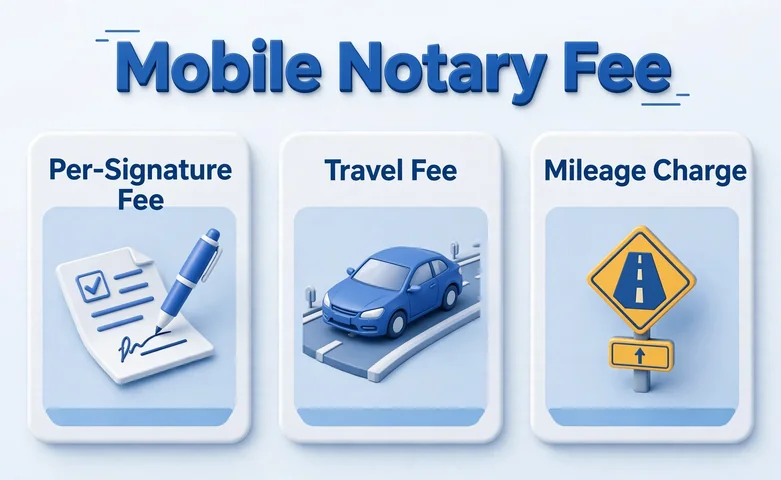
Formula: Total = (Signatures × Fee per signature) + Travel fee + (Miles × Rate per mile) + (Waiting minutes × Waiting rate) + Additional fees, then add the after-hours premium as a percentage of the subtotal.

Formulas verified against standard references. Calculator logic tested with verified worked examples. Published: November 6, 2026 | Last updated: November 6, 2026. Fact-checked: November 6, 2026. Our methodology
How to Use the Mobile Notary Fee Calculator
Getting an answer takes six quick steps.
- Enter the number of signatures that need notarizing. Count signatures, not documents, because one document can carry several.
- Type the fee per signature in dollars. Your state sets a maximum, and the default of $15 matches the California maximum.
- Type the base travel fee and the one-way distance in miles, plus the rate per mile.
- Add any waiting time in minutes and the waiting rate, or leave both at zero.
- Add any additional fees, such as printing or a loan signing package, and the after-hours premium if the visit is outside business hours.
- Press Calculate, or press Enter. The total appears first and large, with the signature cost, travel cost, waiting cost and the step-by-step math below. Press Reset to clear the form and start over.

The Mobile Notary Fee Formula
The total is the sum of five parts, plus an optional premium on the subtotal.
Total = (Signatures × Fee per signature) + Travel fee + (Miles × Rate per mile) + (Waiting minutes × Waiting rate) + Additional fees. The after-hours premium is then added as a percentage of that subtotal, so Premium = Subtotal × Premium percent ÷ 100.
Signatures is the count of notarized signatures. Fee per signature is the amount charged for each one, up to your state maximum. Travel fee is the flat charge for the visit. Miles is the one-way distance, and Rate per mile is the charge for each of those miles. Waiting minutes and Waiting rate cover time spent waiting at the appointment. Additional fees cover extras such as printing or a loan signing package. The same add-up structure is used by published notary calculators, and our loan calculator can help you plan the loan signing itself.
Worked Example: Two Signatures, Ten Miles
You need two signatures notarized at your home, ten miles from the notary. The fee is $15 per signature, the travel fee is $35, the mileage rate is $1.00 per mile, and there is no waiting, no extra charge and no after-hours premium. Here is exactly what the calculator does.
- Signature cost = 2 × $15.00 = $30.00.
- Travel cost = $35.00 + (10 × $1.00) = $35.00 + $10.00 = $45.00.
- Waiting cost = 0 × $0.50 = $0.00.
- Additional fees = $0.00.
- Subtotal = $30.00 + $45.00 + $0.00 + $0.00 = $75.00.
- Premium = $75.00 × 0% = $0.00.
- Answer: total fee $75.00.
Money is worked out in cents and rounded once, at the end.
Why the Per-Signature Fee Has a Limit
States set a maximum fee for each notarized signature, and the notary cannot charge more than that for the act itself. California sets the maximum at $15 per signature, Texas at $10 for the first signature and $1 for each additional one, Florida at $10 per act, and New York at $2 per signer. The exact maximum depends on your state and on the type of act, so check your Secretary of State page for the current figure.
The cap covers the notarization only. Travel, waiting, printing and other services sit outside it, which is why the total for a mobile visit is higher than the per-signature fee alone.
Travel, Mileage and Waiting Time
Travel is where mobile notary quotes differ most. Some notaries charge a flat travel fee by area, such as $35 for one town and $45 for the next. Others charge a base fee plus a rate per mile, often $1 per mile, measured one way to the appointment. A few charge mileage only, with no base fee. The calculator accepts all three styles, because you can set the base travel fee to zero and use mileage only, or set the miles to zero and use a flat fee only. If the visit is for a loan signing, our personal loan calculator can help with the loan side.
Always confirm whether the mileage is one way or round trip before you compare two quotes. A $1 per mile rate on a 10 mile one-way trip adds $10, while the same rate on the round trip adds $20.
Waiting time is charged when the notary arrives and the signer is not ready. A 30 minute wait at $0.50 per minute adds $15, so have the documents and identification ready before the appointment time.
Common Mistakes When Estimating Notary Fees
Counting documents instead of signatures is the most common mistake. A document with two notarized signatures costs twice the per-signature fee, not once. Count every signature line that needs notarizing before you enter a number.
Forgetting the travel fee is the second. The per-signature fee alone is never the total for a mobile visit, because the notary drives to you. Enter the travel fee and the mileage even when the trip looks short.
Mixing up after-hours premiums is the third. Some notaries add a percentage, others add a flat amount, and some do not offer evening or weekend visits at all. Enter the premium as a percentage here, and if your notary quotes a flat evening fee instead, add it to the additional fees field.
Finally, confirm what the quote includes. Printing, scan-backs and loan packages are sometimes included and sometimes extra, so ask for an itemized quote and check it against the breakdown this calculator shows.
Disclaimer
This calculator gives an estimate for planning and is for informational purposes only, not financial or legal advice. Notary fees are set by state law and vary by state, and actual charges depend on your notary and your appointment. See our disclaimer.

Frequently asked questions
How much does a mobile notary cost?
A straightforward local mobile appointment commonly costs $50 to $100 in total, made up of the per-signature fee plus a travel fee. Loan signings usually run $100 to $200.
What is the fee per signature?
It is the amount charged for each notarized signature, and your state sets a maximum for it. California sets the maximum at $15 per signature and Florida at $10 per act.
Does a mobile notary charge for travel?
Yes, in almost every case, as a flat fee, a rate per mile, or a base fee plus mileage.
What is the after-hours premium?
It is an extra charge for evening or weekend visits, often added as a percentage of the subtotal or as a flat amount. Some notaries do not offer after-hours visits at all.
Can a notary charge more than the state maximum?
No, not for the signature itself. The state maximum caps the fee for the act, while travel, waiting and printing are separate charges, so the total can still be higher.
Related calculators

Loan Calculator
Work out monthly payments, total interest and the full cost of a loan.
Use calculatorPersonal Loan Calculator
Estimate monthly payments and total interest on a personal loan.
Use calculatorCommission Calculator
Calculate commission earned from a sale price and a commission rate.
Use calculatorTip Calculator
Split a bill and work out a fair tip for any service.
Use calculatorSalary to Hourly Calculator
Convert an annual salary into an hourly rate, step by step.
Use calculatorBudget Calculator
Build a monthly budget from income and spending, with the balance shown.
Use calculator