Commission Calculator: Solve Any Commission Problem
Find the commission earned, the commission rate, or the sale amount. Enter the two values you know and get the third, with the working shown.

Formulas verified against standard references. Calculator logic tested with verified worked examples. Last reviewed: October 2026. Our methodology
The Three Commission Questions
Every commission problem is one of three questions. Given the sale amount and the rate, what is earned? Given the earnings and the sale, what was the rate? Given the earnings and the rate, how big was the sale? This calculator solves all three, so you never have to rearrange the formula by hand.
The core relationship never changes: commission equals sale amount times rate divided by 100. The rate is a percentage, so 6 percent means 6/100 or 0.06 in the multiplication. All three modes are just that one equation solved for a different unknown.

Flat vs Tiered Commission
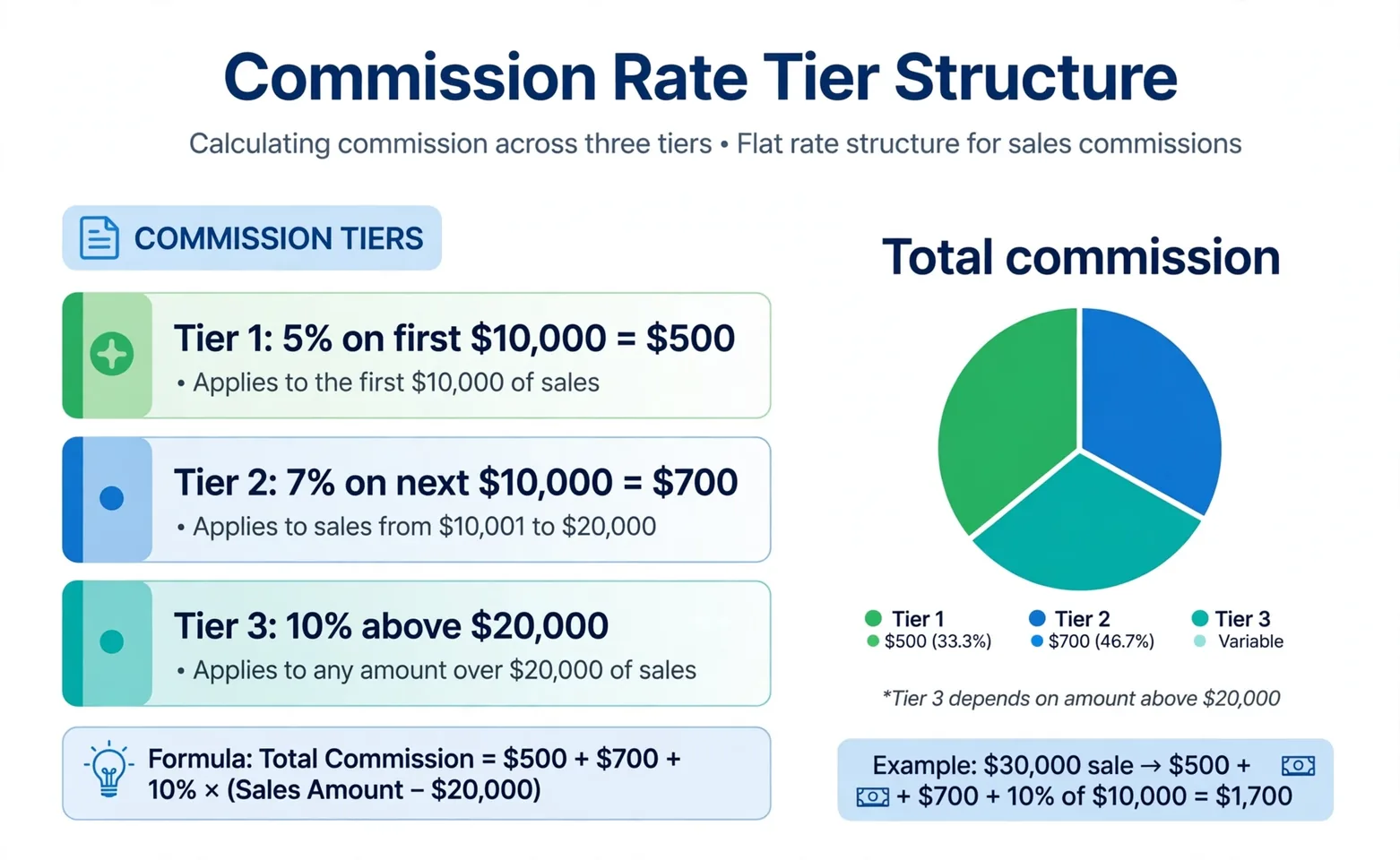
A flat commission pays one rate on the whole sale: 6 percent on $50,000 is $3,000. A tiered commission pays different rates on different slices, rewarding bigger sales: 5 percent on the first $10,000, 7 percent on the next $10,000, and 10 percent above $20,000 turns a $25,000 sale into $500 + $700 + $500 = $1,700.
This calculator handles flat rates. For tiered plans, run each slice as its own calculation and add the results. That matches how most tiered plans are actually documented: each threshold is a separate line on the commission statement.
| Tier | Rate | Slice of $25,000 sale | Commission |
|---|---|---|---|
| Tier 1 | 5% | First $10,000 | $500 |
| Tier 2 | 7% | Next $10,000 | $700 |
| Tier 3 | 10% | Above $20,000 | $500 |
Worked Examples
Example 1, find earnings: a $50,000 sale at 6 percent earns $50,000 x 0.06 = $3,000. Example 2, find the rate: $1,700 earned on a $25,000 sale is ($1,700 / $25,000) x 100 = 6.8 percent. Example 3, find the sale: $3,000 earned at 6 percent implies a sale of $3,000 / 0.06 = $50,000.
Example 4, real estate: a $400,000 home at a 2.5 percent buyer-agent commission earns $10,000. Splitting that 50/50 with a brokerage leaves $5,000 before taxes and fees, which is why agents track the split, not just the headline rate.
| Known | Unknown | Example result |
|---|---|---|
| Sale $50,000, rate 6% | Earnings | $3,000 |
| Earnings $1,700, sale $25,000 | Rate | 6.8% |
| Earnings $3,000, rate 6% | Sale | $50,000 |
Reading a Commission Statement
A statement should show the sale amount, the rate applied, any splits or fees taken out, and the net payable to you. Recompute the headline number with this calculator first; if it matches, the discrepancy, if any, is in the splits and fees below it.
Watch for the rate base: commission on gross sale versus net profit gives very different numbers. A 10 percent commission on $100,000 gross is $10,000, but on $20,000 net profit it is $2,000. Contracts should name the base explicitly.
Common Mistakes
The most common mistake is forgetting to divide the rate by 100: 6 percent is 0.06, not 6, so $50,000 x 6 would wrongly give $300,000. The second is solving for the wrong unknown, like dividing earnings by the sale when you meant to find the rate as a decimal and report it as a percent.
A third mistake is ignoring splits and caps. A headline 6 percent with a 50/50 brokerage split pays 3 percent to the agent, and monthly caps change the effective rate on big months. The calculator gives the gross commission; your contract gives the rest.
Negotiating and Planning
When comparing offers, convert everything to effective rate on expected sales: a 5 percent rate on $1M of expected sales beats a 7 percent rate on $500K. Ask whether the rate applies to gross or net, whether there is a cap or floor, and when it pays out, because a high rate paid quarterly is worth less than a lower rate paid monthly.
For pricing math around the commission, the discount calculator handles percent-off pricing, and the sales tax calculator adds tax to a sale amount, both useful when the commission base needs adjusting first.

Frequently asked questions
How do you calculate commission?
Multiply the sale amount by the commission rate as a decimal: $50,000 x 0.06 = $3,000 at a 6 percent rate.
How do I find the commission rate from earnings?
Divide earnings by the sale amount and multiply by 100. $1,700 on a $25,000 sale is a 6.8 percent rate.
What is a typical sales commission rate?
It varies widely: 5 to 10 percent is common in many retail and B2B roles, 2.5 to 3 percent per side is typical in US residential real estate, and some industries pay 20 percent or more on high-margin products.
What is the difference between flat and tiered commission?
Flat commission pays one rate on the whole sale. Tiered commission pays increasing rates on successive slices of the sale, so bigger sales earn a higher blended rate.
Is commission taxed differently?
Commission is ordinary income for tax purposes, usually withheld at supplemental wage rates on the paycheck. The calculator shows gross commission before any tax.
What is a commission split?
An agreement dividing the gross commission, for example 50/50 between an agent and their brokerage, before fees. Your take-home is the gross commission times your split.
Can I solve for the sale amount?
Yes. Choose the sale-amount mode, enter what was earned and the rate, and the calculator reverses the formula: sale = earnings / rate.