Limit Calculator
Enter a function f(x), the point x approaches, and a direction. The calculator samples the function from both sides of the point and reports the limit, an infinite limit, or that the limit does not exist, with the approach steps shown.

Formulas verified against standard references. Calculator logic tested with verified worked examples. Published: November 2, 2026 | Last reviewed: November 2026. Our methodology
What Is a Limit?
A limit is the value a function approaches as its input gets closer and closer to a point. It does not matter what the function equals at that point, or even whether the function is defined there. What matters is the trend of the nearby values.
Limits sit at the base of calculus. Derivatives are limits of average rates of change, and integrals are limits of sums. When you ask this calculator for a limit, it probes the function at points nearer and nearer to your target and watches where the values settle. If both sides settle on the same number, that number is the limit.
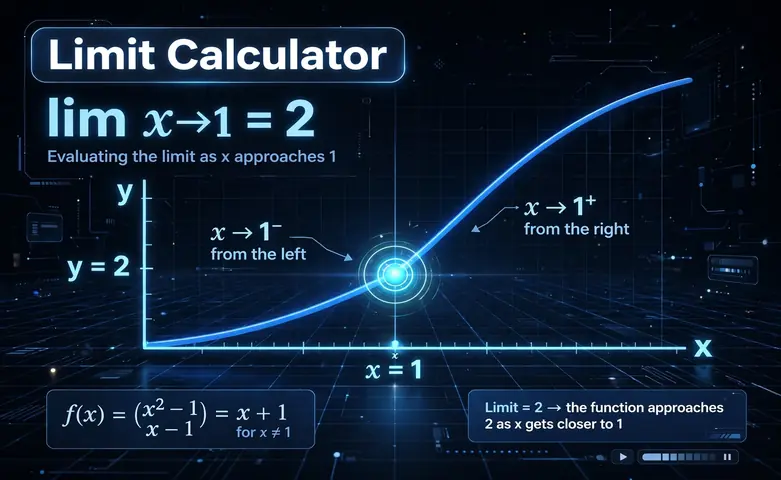
The Limit Formula
Mathematicians write a limit as lim x->a f(x) = L. Here f(x) is your function, a is the point x approaches, and L is the value the function tends toward. The arrow means approaches, not equals, which is why a limit can exist at a point where the function itself is undefined.
The calculator estimates L by evaluating f(a - h) and f(a + h) for h = 0.1, 0.01, 0.001, and smaller, then checking that the two sequences agree. If the function is continuous at a, direct substitution f(a) gives the same answer, and the calculator confirms it. If substitution fails with 0/0, the nearby values still reveal the limit. For hand-checking logarithms and exponentials in these steps, the scientific calculator keeps the rounding exact.
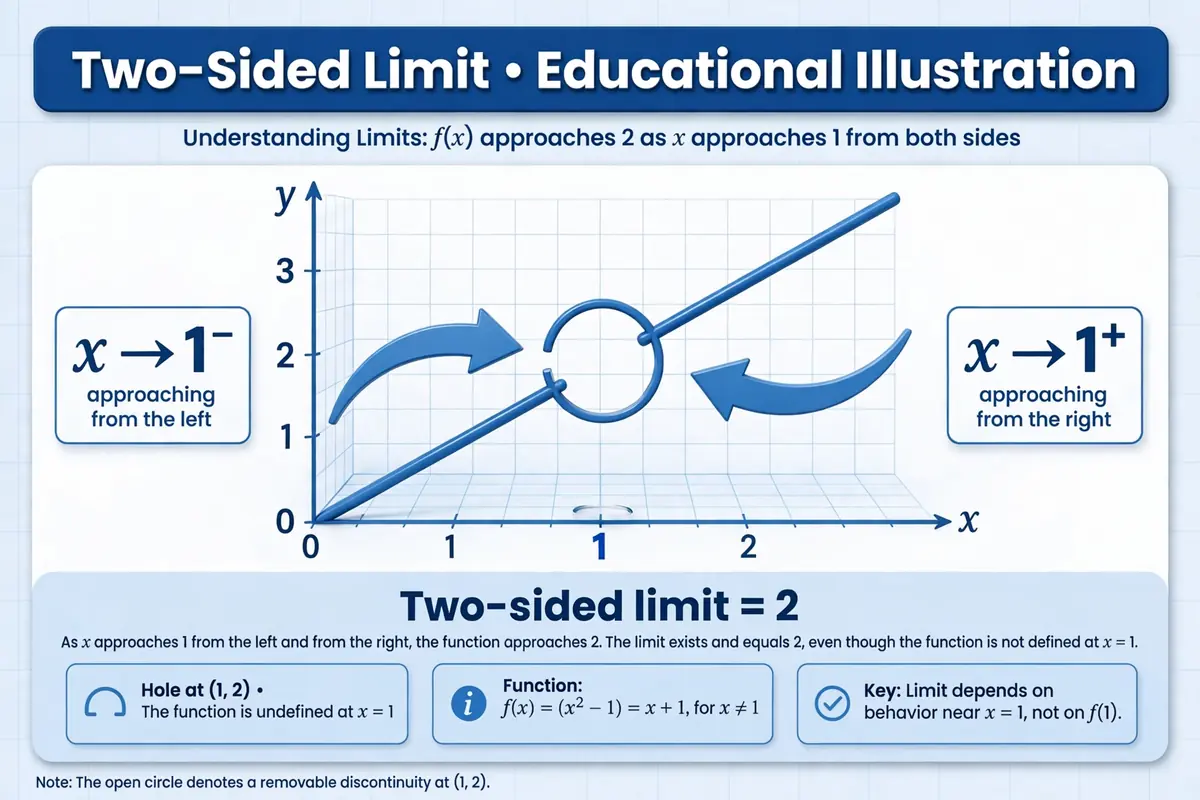
Worked Example: A Hole at x = 1
Find lim x->1 (x^2 - 1)/(x - 1). Direct substitution gives 0/0, which is undefined, so factor the numerator: x^2 - 1 = (x - 1)(x + 1). Cancel the common factor (x - 1) and the function simplifies to x + 1 everywhere except at x = 1 itself.
Now the limit is easy. As x approaches 1, x + 1 approaches 2. The approach table agrees: at x = 0.9999 the value is 1.9999, and at x = 1.0001 the value is 2.0001. The final answer is 2. The function has a hole at x = 1, but the limit fills it.
How to Use the Limit Calculator
- Type your function in the first field, for example (x^2-1)/(x-1). Use ^ for powers and write 2x or 2*x for multiplication.
- Set the variable letter, usually x, and type the point it approaches, for example 1.
- Choose two-sided, left-hand, or right-hand from the direction menu.
- Press Calculate to see the limit and the approach table behind it. Press Reset to clear the fields.
One-Sided vs Two-Sided Limits
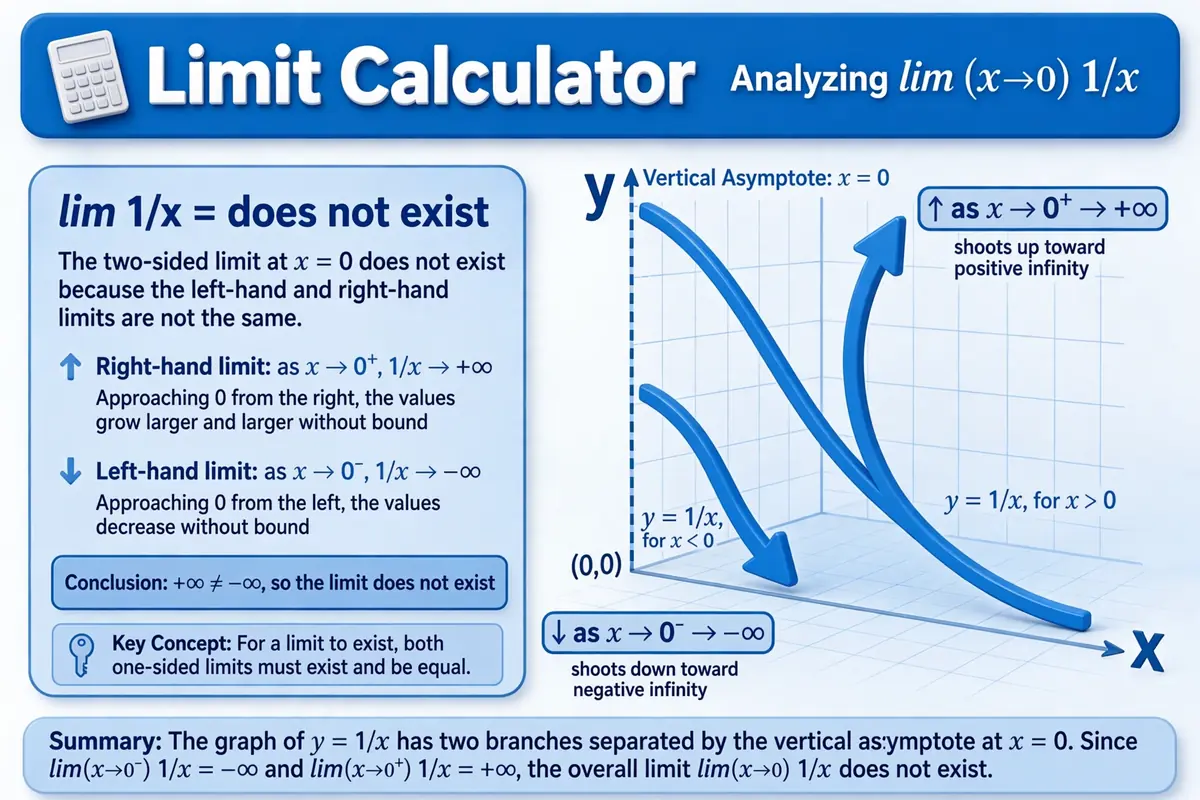
A two-sided limit asks what the function approaches from every direction at once. A one-sided limit asks only from below (x->a-) or only from above (x->a+). The two-sided limit exists only when both one-sided limits exist and agree.
Take 1/x at 0. From the right the values explode upward: 10, 100, 1000, so the right-hand limit is positive infinity. From the left they explode downward: -10, -100, -1000, so the left-hand limit is negative infinity. The sides disagree, so the two-sided limit does not exist. Choose the direction that matches your question, since one-sided questions appear at graph endpoints and jump discontinuities.
Common Limit Mistakes to Avoid
The biggest mistake is treating the function value and the limit as the same thing. Plugging x = 1 into (x^2 - 1)/(x - 1) gives 0/0, yet the limit is 2. Always check the nearby behavior, not just the point.
Two smaller traps catch students too. First, log means base 10 here and ln means the natural log, so log(100) is 2 while ln(e) is 1; mixing them up changes every answer. Second, trigonometric functions use radians, so sin(x)/x approaches 1 only when x is in radians. When a remainder step is part of your algebra, the modulo calculator checks the arithmetic, and the compound interest calculator shows the same exponential growth that limits describe at infinity.
Frequently asked questions
What is a limit in calculus?
A limit is the value a function approaches as its input approaches a point. It describes the trend of nearby values, so it can exist even when the function is undefined at the point itself. Limits define derivatives and integrals.
How do you find the limit of (x^2 - 1)/(x - 1) as x approaches 1?
Factor the numerator to (x - 1)(x + 1), cancel the common factor, and the function becomes x + 1. As x approaches 1, x + 1 approaches 2, so the limit is 2 even though the original expression is undefined at x = 1.
What does it mean when a limit does not exist?
It means the function does not settle on one value near the point. The usual cause is disagreement between the sides, as with 1/x at 0, where the left side heads to negative infinity and the right side to positive infinity.
What is the difference between a limit and the function value?
The function value is f(a), the number the formula produces at the point. The limit is what f(x) approaches near the point. For continuous functions they match, but at a hole or jump they can differ, and the limit still exists.
Can a limit be infinity?
Yes. When function values grow without bound near the point, the limit is positive or negative infinity, as with 1/x approaching 0 from the right. Infinity describes the behavior; it is not a finite number you can substitute back.
How does this limit calculator work?
It parses your expression safely, then evaluates the function at points closer and closer to your target from the left and from the right. If both sides converge to the same value, that is the limit. If they disagree or diverge, it reports that the limit does not exist or is infinite.
Related calculators

Scientific Calculator
Advanced math with trig, logs, and exponents.
Use calculatorPercentage Calculator
Find what percent one number is of another.
Use calculatorModulo Calculator
Remainder of any division, with full working steps.
Use calculatorHalf-Life Calculator
Solve decay, time, or amount for half-life problems.
Use calculator
Compound Interest Calculator
Growth of savings with compounding interest.
Use calculatorTip Calculator
Split the bill and tip fairly in seconds.
Use calculatorLoan Calculator
Monthly payment and total cost of any loan.
Use calculator
GPA Calculator
Compute your grade point average from course grades.
Use calculator
Age Calculator
Exact age in years, months, and days.
Use calculatorTime Zone Converter
Convert times between world time zones.
Use calculator