Half-Life Calculator
Fill in any three of the four values: initial amount, remaining amount, elapsed time, and half-life. Leave the unknown blank and the calculator solves it, then shows the decay constant and mean lifetime.

Formulas verified against standard references. Calculator logic tested with verified worked examples. Last reviewed: November 2026. Our methodology
The Exponential Decay Formula
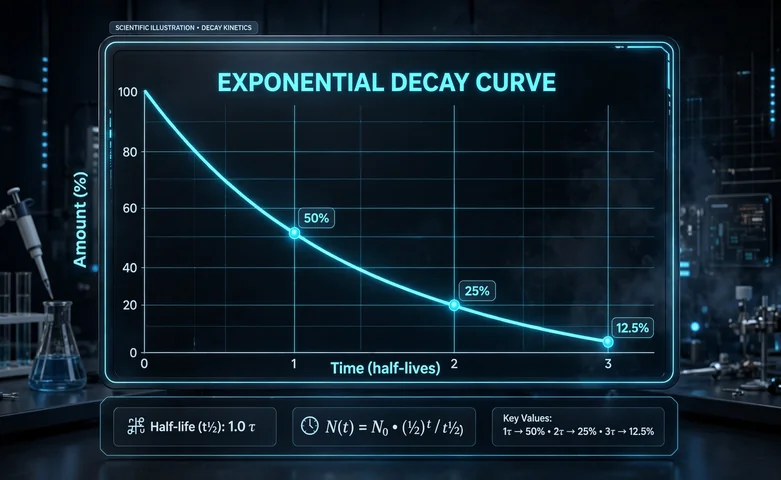
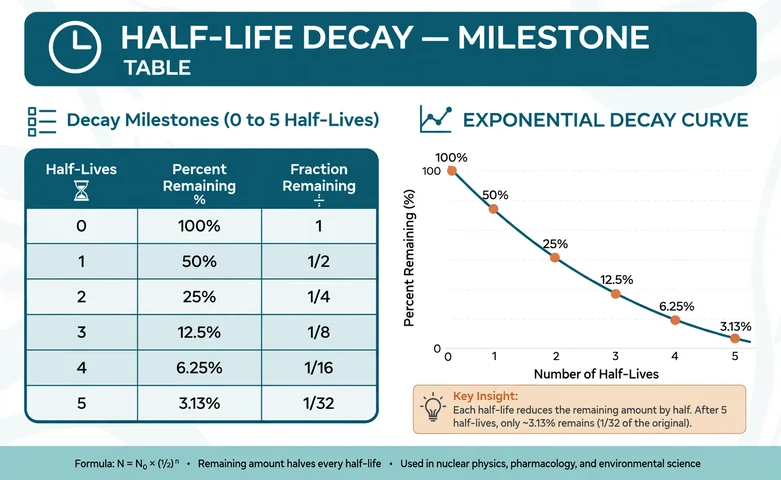
Half-life is the time it takes for a quantity to fall to half its starting value. After one half-life 50% remains, after two 25%, after three 12.5%, and so on. The governing equation is N(t) = N0 x (1/2)^(t / half-life), where N0 is the starting amount and N(t) is what remains after time t.
Because the equation links four values, knowing any three determines the fourth. That is the whole calculator: leave one field blank, and the right rearrangement of the formula solves it.
Three Equivalent Forms
The same physics can be written three ways. The half-life form uses (1/2)^(t/half-life). The decay-constant form uses e^(-lambda x t), where lambda = ln(2) / half-life. The mean-lifetime form uses e^(-t/tau), where tau = 1/lambda = half-life / ln(2).
The calculator reports all three constants because different fields prefer different forms: physicists quote lambda, engineers quote half-life, and statisticians quote mean lifetime.
| Form | Equation | Constant |
|---|---|---|
| Half-life | N(t) = N0 x (1/2)^(t / t1/2) | t1/2 |
| Decay constant | N(t) = N0 x e^(-lambda t) | lambda = ln(2) / t1/2 |
| Mean lifetime | N(t) = N0 x e^(-t / tau) | tau = 1 / lambda |
Solving for Each Variable
Leave remaining amount blank and the calculator applies the decay law directly. Leave the initial amount blank and it divides the remainder by the decay factor. Leave time blank and logarithms invert the exponential: t = half-life x ln(N0/Nt) / ln(2). Leave half-life blank and the same rearrangement gives half-life = t x ln(2) / ln(N0/Nt).
The one hard rule: the remaining amount can never exceed the initial amount. If it could, the formula would return a negative time, which is the math telling you the inputs are impossible.
Worked Example: Carbon-14 Dating
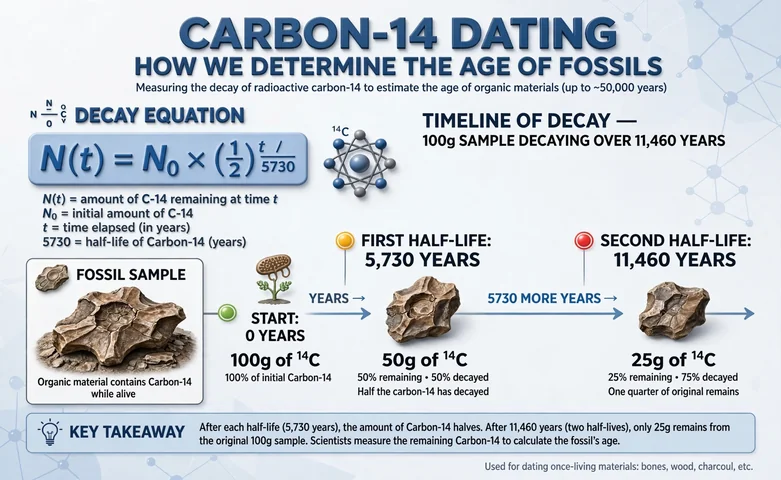
Carbon-14 has a half-life of about 5,730 years. A sample starts at 100 grams; 11,460 years pass. How much remains? The number of half-lives is 11,460 / 5,730 = 2, so the remainder is 100 x (1/2)^2 = 25 grams.
Flip it: an archaeologist measures 25% of the original carbon-14 in a fossil. With N0 = 100, Nt = 25, and half-life 5,730, time = 5,730 x ln(100/25) / ln(2) = 5,730 x 2 = 11,460 years. This is exactly how radiocarbon dating turns a ratio into a date.
Half-Lives of Common Substances
Half-lives span from fractions of a second to billions of years, which is why the same formula serves nuclear physics, medicine, and archaeology. A few reference values are worth knowing.
| Substance | Half-life | Used for |
|---|---|---|
| Carbon-14 | 5,730 years | Archaeological dating |
| Uranium-238 | 4.468 billion years | Geological dating |
| Potassium-40 | 1.25 billion years | Rock dating |
| Iodine-131 | 8.02 days | Thyroid treatment |
| Radon-222 | 3.8 days | Radiation safety |
What the Model Assumes
The calculator assumes ideal first-order decay: the half-life never changes, nothing is added or removed except by decay, and the sample is large enough that statistics stay smooth. Real systems with multiple decay chains or changing conditions need more elaborate models.
It also treats time as continuous and the amount as divisible. For discrete counts like atoms, the formula gives the expected value. For money growing instead of decaying, the compound interest calculator is the mirror image: same exponential math, pointed upward.
Frequently asked questions
What is half-life?
The time it takes for a quantity undergoing exponential decay to fall to half its initial value. After each half-life, half of what remained disappears.
What is the half-life formula?
N(t) = N0 x (1/2)^(t / half-life), where N0 is the initial amount, N(t) is the amount after time t. Equivalent forms use the decay constant lambda or the mean lifetime tau.
How do you find the half-life from two measurements?
half-life = t x ln(2) / ln(N0 / Nt). Enter the two amounts and the elapsed time, leave half-life blank, and the calculator solves it.
What is the decay constant?
lambda = ln(2) / half-life. It is the fractional decay rate per unit time, used in the form N(t) = N0 x e^(-lambda t).
What is mean lifetime?
tau = 1 / lambda = half-life / ln(2). It is the average time a particle survives before decaying, about 1.44 times the half-life.
How much remains after 3 half-lives?
12.5%: each half-life halves the remainder, so (1/2)^3 = 1/8.
What is the half-life of carbon-14?
About 5,730 years, which makes it useful for dating organic material up to roughly 50,000 years old.