Leap Year Calculator
Check whether any year is a leap year with this leap year calculator. Enter a single year to see the 4/100/400 rule worked out step by step, with the days in the year and the next and previous leap years. Or switch to Year range mode to count and list every leap year between two years. Free, no sign-up, everything runs in your browser.
Rule: a year is a leap year when year ÷ 4 leaves no remainder and year ÷ 100 leaves a remainder, or when year ÷ 400 leaves no remainder.

Formulas verified against standard references. Calculator logic tested with verified worked examples. Published: November 5, 2026 | Last updated: November 5, 2026. Our methodology
How to Use the Leap Year Calculator
Checking a year takes four quick steps. The tool works in two modes, so pick the one that fits your question.
- Choose "Single year" to check one year, or "Year range" to list and count the leap years between two years.
- Type the year in the "Year" field, or type the start and end years in the "Start year" and "End year" fields. Use whole years from 1 to 9999.
- Press Calculate, or press Enter. A single year shows the answer with the divisibility steps, the days in the year, and the next and previous leap years. A range shows the count with the full list of leap years.
- Press Reset to clear the form and try another year.

The Leap Year Rule
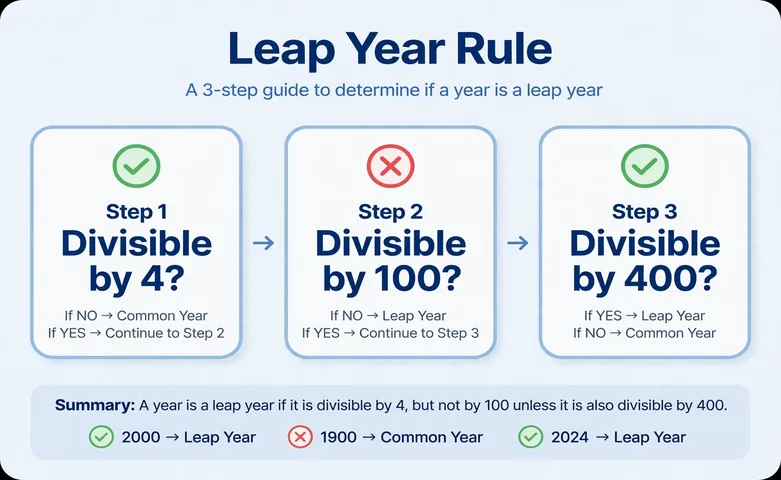
A year is a leap year when it divides evenly by 4, unless it also divides evenly by 100, unless it divides evenly by 400 as well. That is the whole rule, and the calculator on this page applies its three tests in order.
The first test is the divide-by-4 test. 2024 passes it because 2024 ÷ 4 = 506 exactly, while 2025 fails because 2025 ÷ 4 = 506.25, which is not a whole number.
The second test is the century exception. 1900 divides evenly by 4, but it also divides evenly by 100, so it is a common year. The third test is the 400-year rescue. 2000 divides evenly by 100 and by 400, so it keeps its leap day and stays a leap year.
Why the Rule Has Exceptions
The rule exists because a year is not exactly 365 days long. Earth takes about 365.2422 days to orbit the sun, so a plain 365-day calendar drifts about six hours every year.
Adding one day every four years was the Julian calendar's answer, but an average year of 365.25 days runs slightly too long. Those extra 11 minutes a year pushed the calendar about 10 days off by 1582.
The Gregorian reform dropped three leap days every 400 years to fix the drift. That is why century years usually skip the leap day, and why the average Gregorian year is 365.2425 days, very close to the true 365.2422.
The 400-Year Cycle
The pattern repeats every 400 years, and each cycle holds exactly 97 leap years. 400 years therefore total 146097 days, which divides to an average year of 365.2425 days.
The years 2000 to 2100 hold 25 leap years, from 2000 through 2096 in steps of four. 2100 is skipped because it divides evenly by 100 but not by 400, so the next leap year after 2096 is 2104, an eight-year gap instead of the usual four.
Try the range mode on this page with 2000 and 2100 to see the count worked out with the floor formula. If you were born on February 29, the age calculator shows your exact age in years, months, and days.
Common Mistakes to Avoid
The most common error is trusting the divide-by-4 test alone. It correctly flags 2024, 2028, and 2032, but it wrongly flags 1900 and 2100. Always apply the century tests before you call a year a leap year.
Another mistake is mixing up the Julian and Gregorian rules. Under the old Julian rule every fourth year was a leap year with no exceptions, so 1900 would have been one. This calculator uses the Gregorian rule for every year, including years before 1582.
Finally, do not enter year 0. The civil calendar jumps from 1 BC to AD 1 with no year 0 in between, so the calculator accepts whole years from 1 to 9999 and explains the limit if you type 0.
What This Calculator Does Not Cover
The tool checks the Gregorian leap year rule only. Other calendars use different intercalation rules, so a year that is a leap year here may not be one in the Hebrew or Islamic calendar.
It also does not find the weekday of February 29 or add days across a leap day boundary. To find the weekday of any February 29, use the day of week calculator. To add or subtract days across a leap day, use the date calculator.

Frequently asked questions
What is a leap year?
A leap year is a year with 366 days instead of 365. The extra day, February 29, keeps the calendar aligned with the time Earth takes to orbit the sun.
How do you check if a year is a leap year?
Divide the year by 4. If there is a remainder, it is a common year. If it divides evenly, check 100. A century year that divides evenly by 100 is a common year unless it also divides evenly by 400, like 2000.
Is 2100 a leap year?
No. 2100 divides evenly by 4 and by 100, but not by 400, so the century exception applies. The next leap year after 2096 is 2104.
How many leap years are there in 400 years?
Exactly 97. That gives 146097 days per 400-year cycle and an average year of 365.2425 days, very close to the true solar year of about 365.2422 days.
Why does February get the extra day?
The Roman calendar added its intercalary day at the end of February, which was then the last month of the year. The Gregorian reform kept the tradition, so February 29 is the leap day.
Does the calculator work for years before 1582?
Yes. It applies the Gregorian rule proleptically, meaning the same rule is extended backward before the calendar was adopted. Real historical calendars varied by country and date, so treat pre-1582 results as the proleptic rule, not local history.
Related calculators

Day of Week Calculator
Find the weekday for any date, past or future.
Use calculatorDate Calculator
Add or subtract years, months, and days from any date, with weekday.
Use calculatorAge Calculator
Find your exact age in years, months and days from your birth date.
Use calculatorWeek Number Calculator
Find the ISO week number, ISO year, and week range for any date.
Use calculatorMoon Phase Calculator
Find the moon phase and illumination for any date.
Use calculatorBusiness Days Calculator
Count business days between two dates or add business days to a date, skipping weekends and holidays.
Use calculator