Golden Ratio Calculator
Split any length in the golden ratio with this golden ratio calculator. Type one measurement, press Calculate, and get the longer segment, the shorter segment, and the total, with every step shown. It uses phi = 1.6180339887, so the ratio holds exactly at any decimal setting. Free, no sign-up, everything runs in your browser.
Formula: (a + b) / a = a / b = phi, with phi = (1 + sqrt(5)) / 2.

Formulas verified against standard references. Calculator logic tested with verified worked examples. Published: November 5, 2026 | Last updated: November 5, 2026. Our methodology
How to Use the Golden Ratio Calculator
Getting an answer takes five quick steps. The tool needs just one measurement plus two settings.
- Type your measurement in the "Length value" field. Use any unit you like, centimeters, inches, or pixels, because the tool never converts units.
- Choose what the value represents in the "What does this value represent?" dropdown. Pick Total length (a + b), Longer segment (a), or Shorter segment (b).
- Pick the decimal places in "Decimal places". Four is a good default for design work.
- Press Calculate, or press Enter. The page shows the longer segment, the shorter segment, the total, a ratio check, golden rectangle dimensions, and the step-by-step working.
- Press Reset to clear the form and try another value.
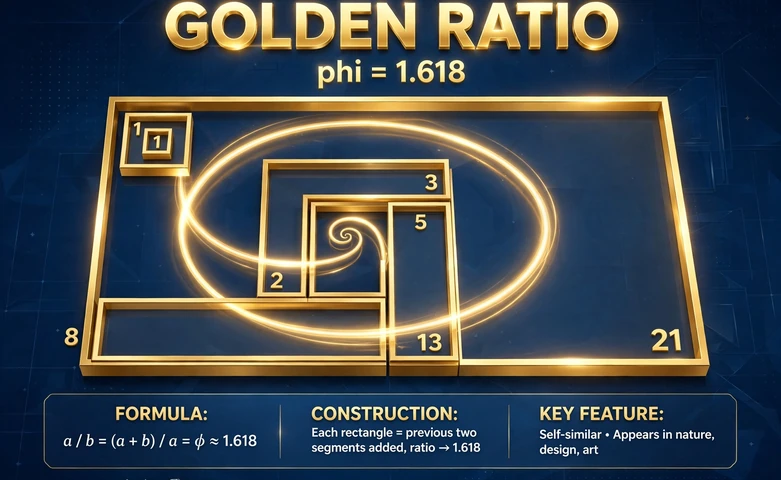
The Golden Ratio Formula
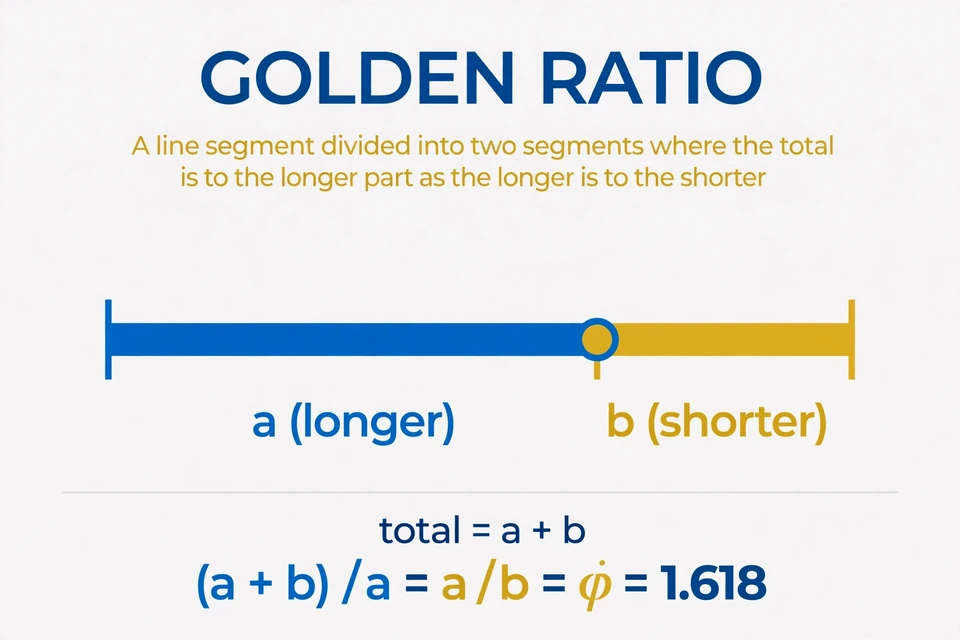
A line sits in golden ratio when the whole divided by the longer part equals the longer part divided by the shorter part. Both quotients equal phi, about 1.6180339887.
The formula is (a + b) / a = a / b = phi, where a is the longer segment, b is the shorter segment, and a + b is the total length. Phi itself comes from phi = (1 + sqrt(5)) / 2, the positive root of x^2 = x + 1. To break down the square root step on its own, try the square root calculator.
Worked Example: Splitting a Total of 100
Start with a total length of 100. Divide by phi to get the longer segment: a = 100 / 1.6180339887 = 61.8034. Subtract from the total to get the shorter segment: b = 100 - 61.8034 = 38.1966. Now check the ratio: a / b = 61.8034 / 38.1966 = 1.61803399, which matches phi. The longer segment is always about 61.80% of the total, and the shorter segment takes the remaining 38.20%. Comparing two lengths this way is a plain ratio comparison, the same kind the ratio calculator handles for everyday numbers.
Why Phi Is a Special Number
Phi carries two properties no other positive number has. First, phi squared equals phi plus one, so phi^2 = 2.6180339887. Second, the reciprocal of phi equals phi minus one, so 1 / phi = 0.6180339887, and the decimal tail stays exactly the same. Those two facts are why multiplying or dividing by phi steps so neatly between the total, the longer segment, and the shorter segment.
Phi is irrational, which means its decimal expansion runs forever without repeating. Every value you ever see for it is rounded. The calculator carries the full floating-point value internally and rounds only the display, so the ratio check stays exact at your chosen decimals.
Where the Golden Ratio Shows Up
Nature packs things efficiently, and the golden angle, about 137.5077 degrees, keeps turning up where packing matters. Sunflower seed heads grow new seeds at that angle because it leaves the fewest gaps. Nautilus shells grow in a spiral whose chambers widen by roughly phi with each turn.
Designers use the ratio as a practical tool, not a rule of nature. A 1 to 1.618 grid divides a layout into a pleasing large area and a smaller sidebar. Type scales step by 1.618 to jump from body text to headings. Logos nest circles and rectangles at phi multiples to feel balanced.
A note of caution helps here. Claims that the Parthenon or the Mona Lisa were deliberately designed around phi are disputed by modern scholars, since the measured ratios are approximate and may be coincidental. Use the ratio for its clean math, not for mystical authority.
Golden Ratio and Fibonacci Numbers
Divide each Fibonacci number by the one before it and watch the result settle. The ratios run 1, 2, 1.5, 1.667, 1.6, 1.625, swinging above and below a fixed value and landing closer each time. That value is phi, about 1.6180339887. F(50) / F(49) already reads 1.61803399, correct to eight decimal places.
The ratio never reaches phi exactly for a finite term, but it closes in without limit. Each term is roughly phi times the one before it, which is why the sequence grows so fast. To explore the sequence itself, the term positions, the sums, and the convergence, try the Fibonacci calculator.
Common Mistakes to Avoid
Rounding phi to 1.618 before you divide is the most common error. The rounding compounds through every multiplication, so carry the full value and round once at the end. This calculator does exactly that.
Check the mode before you press Calculate. Typing the shorter segment while the dropdown says "Total length (a + b)" silently flips the answer. One glance at the dropdown prevents the whole class of error.
Do not confuse the ratio with a percentage. The longer segment is 61.80% of the total, but it is 61.8 units only when the total is 100. Percentages always need a stated base, which the percentage calculator makes explicit.
Finally, do not call a rectangle golden just because it looks balanced. A golden rectangle must satisfy (a + b) / a = a / b exactly, not roughly. Measure the sides, divide, and compare against 1.6180339887 before you claim it.

Frequently asked questions
What is the golden ratio?
The golden ratio, written phi, is the number (1 + sqrt(5)) / 2, about 1.6180339887. A length sits in golden ratio when the whole divided by the longer part equals the longer part divided by the shorter part.
How do I divide a line into the golden ratio?
Type the total length into the calculator with "Total length (a + b)" selected and press Calculate. The longer segment is the total divided by phi, and the shorter segment is the rest. A total of 100 gives 61.8034 and 38.1966.
How do I find the longer part if I only know the shorter part?
Select "Shorter segment (b)", type your value, and press Calculate. The longer segment is the shorter one times phi. A shorter segment of 100 gives a longer segment of 161.8034 and a total of 261.8034.
What is the difference between the golden ratio and the Fibonacci sequence?
The golden ratio is a single number, about 1.6180339887. The Fibonacci sequence is a list of whole numbers where each term is the sum of the two before it. Ratios of neighbors in the sequence converge to the golden ratio, which is why the two are always linked.
Is 1.618 exactly the golden ratio?
No. Phi is irrational, so its decimals never end or repeat. 1.618 is a rounded value that works for quick estimates but drifts in exact design work. This calculator keeps full precision internally and rounds only the display.
Can this calculator make a golden rectangle?
Yes. A golden rectangle has sides in the ratio 1 to phi, so the calculator's segments a and b are exactly its long and short sides. The result panel also shows the rectangle's diagonal. For a rectangle whose short side is 100, select "Shorter segment (b)" and the long side becomes 161.8034.
Related calculators

Fibonacci Calculator
Find the nth Fibonacci number and explore the sequence.
Use calculatorRatio Calculator
Simplify ratios, scale them up or down, or split an amount by ratio.
Use calculatorPercentage Calculator
Find what P% of any number is, instant answers with the formula shown.
Use calculatorMean Median Mode Calculator
Get mean, median, mode and range from any number list.
Use calculatorFraction Calculator
Add, subtract, multiply and divide fractions with this free fraction calculator. Get simplified answers, mixed...
Use calculatorSquare Root Calculator
Find square, cube, and nth roots with simplified radicals and verification.
Use calculator